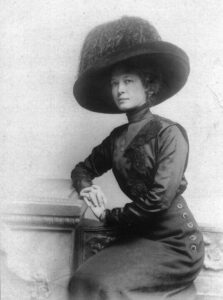
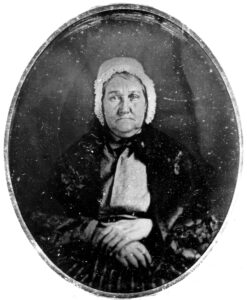
Miss Eliza McQueen of Maxton, a milliner, is shown wearing one of her elaborate designs. At one time no lady would be seen outside of her home without her hat and gloves. This photograph is courtesy of the Maxton Historical Society and is featured in my book Images of America- Robeson County.
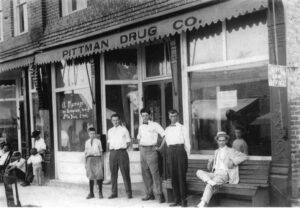
For time out of mind men have gathered in front of stores on benches to contemplate the problems of the world. Luke Blue, J.P. Brown, Wiley Taylor, Knox Kyle, Marvin Stubbs, Hyden Rouse, Royal Rouse, Nance Jones and John Gibson are doing just that in front of the Pittman Drug Company in Fairmont. This photograph is courtesy of the Town of Fairmont and is featured in my book Images of America- Robeson County.
Who would have thought that when Joe Sugar was driving his wagon to Raleigh in 1916 and stopped to check out a store in St. Pauls, NC that 100 years later his grandson and namesake would still be operating the family business. The journey took many twist and turns from his immigration to store owner. Joe Sugar was born January 10, 1889 in Ariogala, Lithuania. His birth name was Tsukera, the Russian word for Sugar. He arrived at the Locust Point dock in Baltimore on May 15, 1906 aboard the ship The Main. His son, Stanly, said of his father “he couldn’t read or write English, but someone forgot to tell him he was poverty stricken and he went to work making two dollars a week.”
Baltimore was home to a large Jewish Immigrant community and like many young Jewish males Joe started selling goods on consignment for the Baltimore Bargain House. He peddled clothing through the Carolinas on foot with a pack on his back until he raised enough money to purchase a horse and buggy. He slept many nights with the stars for his lights and the sky for a roof.
In October 1911 Joe and three of his brothers opened Joe Sugar & Co. in Bennettsville, SC. Joe made a trip to Baltimore to secure goods and visit his family. He met Anne Leviton and began courting her. They were married three weeks later and she returned to Bennettsville with him. Their first child Emanuel was born July 1914. By 1916 he realized that the business was not big enough to support four Sugar brothers. Joe and his small family were headed to Raleigh when he stopped in St. Pauls and heard that the Townsend Brothers had a store for sale that was making $50 a Saturday. They had found a new business and a new home. Daughter Beatrice was born in 1917 with Stanly following in 1924 and Leon in 1928.
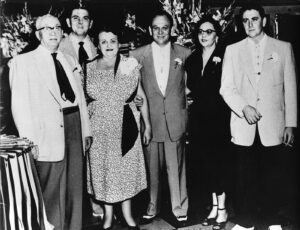
Sugar family left to right: Joe, Stanly, Anne, Emanuel, Beatrice and Leon
Each of the Sugar children began working in the store. Sugar eventually opened a store in Lumberton that was later purchased by his son, Emanuel. His daughter, Beatrice, and her husband, Ernest Fleishman, operated a lady’s store in Lumberton and son, Leon, operated a store in Lumberton before opening his store in Fayetteville. Stanly returned from World War II and helped manage the St. Pauls store.
Stanley Sugar grew up working with his father and mother from the time he was ten in their general merchandise store. Stanley convinced his parents to change the store to focus just on clothing for the entire family. He said many times it was the best move. In 1960 Stanley made another a bold move and began to stock the men’s section with clothing for Big and Tall men as well as the short man.
It all started when a customer walked in with his hard-to-fit 12-year-old who was already 6’4”. Stanley knew he had found the store’s future. Under one roof he brought together 177 sizes of sport coats and suits from a 35 extra short to a 70 long portly. Pants from a 28 waist to a 76, which two average size people could easily fit.
He told a reporter in 1987 “I’m over inventoried. I’m always over inventoried. What built my business is having the merchandise. Most stores are scared to death to buy the way I buy.”
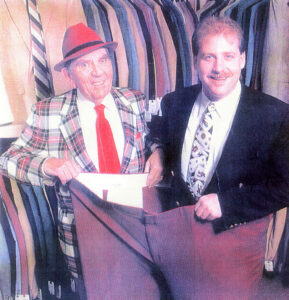
Stanly in his trademark red hat with Joe, who is standing in one leg of a size 70 dress pants.
He use to not be able to sleep at night at the thought of ordering 500 Ultrasuede coasts in 15 sherbet shades or buying $150,000 worth of clothes in three hours. Stanley said “But it’s always worked out.”
Stanley closed the children’s department after his youngest daughter grew out of those sizes into young women’s sizes. Then in January 1974 a newspaper advertisement announced the Sugar’s would be closing the ladies clothing department.
In 1985 Stanley was named Retailer of the Year by the Men’s Apparel Club at the 45th Annual Anniversary Ball. At that time the store was 6,500 square feet with a work force of 18. Stock included 8,000 shirts, 7,000 slacks, 2,500 sport coats and 3,500 suits.
Stanley said in a 1986 interview that he always had the moral support of his wife, Annette, whom he met in Seattle while in the Navy. “Soon as I married her, I brought her down to North Carolina to dry her off and see what she looked like. She’d been in the fog all her life. When she first came, she hated the climate, but now you couldn’t run her out with a shotgun.” The Sugar’s three daughters – Fran, Jackie and JoAnn, known to everyone as The Sugar Lumps, grew up working in the store with their grandparents and father.
The present-day Joe Sugar, son of Leon and Mickey Fleishman Sugar, grew up in Fayetteville. His mother debated long and hard to find a name for her son. Mickey’s father had recently died and she wanted to honor her father by naming him Leon but did not want him as a Jr. So, she thought using the L and calling him Larry but her Aunt Dot said “Larry Sugar is not a good name that honors no one. She said your father-in-law just passed away too. Call the boy Joe and give him Lawrence as a middle name.” Aunt Dot also told her niece that who knows he might end up down there at that store one day.
Did Aunt Dot signal the future for infant Joe? Or maybe it was when he started working with his father at his clothing store? Maybe it was destiny he does decent from three Jewish clothing merchant families – the Sugars of St. Pauls and Fayetteville; the Fleishmans of Fayetteville and his grandmother Fleishman was a Weinstein, niece of Lumberton merchant Aaron Weinstein. Young Joe did not think he would find himself in the clothing business.
After graduating from NC State, he entered the financial world. He was working as a stock broker when he called his Uncle Stanley in August 1986. He had a stock he wanted to sell Stanley. He recalls “Stanley told me ‘Listen, I’ve got some stock to sell you’ ” Stanley was looking for someone to take over the then seventy-year-old family business. One selling point Stanley told him was that Joe had the right name and would not have to spend money on a new sign. Joe drove down to the store to look around. After meeting the personnel, he liked what he saw. He talked to his family and decided that Joe Sugar’s of St. Pauls is where he belong.
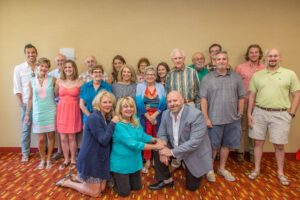
Joe Sugar descendants gathered for centennial event. Photo courtesy Ponce Photography
Joe like his predecessors has made his own mark on the business. He issued a catalog for the business for several years. He has taken the business to the internet establishing a website and promoting the business using social media. His biggest mark came when Hurricane Floyd ripped the roof of the building in 1999. He enlarged the business into the next two buildings and redesigned the exterior of the buildings. He continues to provide quality clothing and service as his family has for over a century.
After Gen. William Tecumseh Sherman’s Union Army devastated Atlanta, he began his infamous march through the South in early January 1865. By March 7, his troops had reached North Carolina and begun their reign of terror on Robeson County.
While Sherman himself passed through the Laurinburg area on his way toward Fayetteville, his troops were spread all across neighboring Robeson County. Some of the county’s residents left detailed accounts of encounters with the troops during what turned out to be the final weeks of the war, including the Rev. Washington S. Chaffin, Annabella McCallum McElyea and Ellen Douglas Bellamy.
Lumberton The Rev. Chaffin, a circuit-riding Methodist minister, was living in Lumberton at the time of Sherman’s raid. His diary, located in the Special Collections Library at Duke University, gives his viewpoint of the time the Yankees were in town.
Rev. Washington S. Chaffin
He writes on March 9, 1865, of the Yankees’ arrival, which led to robbery and the burning of railroad property:
“Cotton was burning in different heaps,” he wrote. “Great excitement. The Yankees are said to be in two different places near here — I am incredulous, just as I penned the last word in the last line, two couriers came straining their steeds down street from Major Blount’s hollering, ‘The Yankees are coming, the Yankees are coming.’ They were not couriers, but a part of the raiding party. Almost in an instant the streets were swarming with Yankee cavalry charging in every direction. There were some 300 to 500 of them, I suppose. They robbed me of Mrs. Chaffin’s watch — Also stole Kate. They burned the county bridge, R. R. Bridge, and depot. Entered many houses & committed many depredations — They did not come into our house. Whence they came from and whither they went, I know not. My wife was greatly excited. I have owned Kate 5 years, 11 months & 17 days — She has never been sick — I traveled with her on horseback 17,102 miles.”
While Lumberton was still in shock over the loss of personal property, as well as the railroad bridge and depot, Chaffin made the following prayer on March 14 that showed his courage and strong belief in reconciliation:
“In our nation may all malice, & hatred & wrath be laid aside — that there be no more sectional animosity, so that violence shall no more be heard in our land, wasting nor destruction in our borders. May the President of the nation have the piety of Joseph, and his counselors — wisdom — may they be good men & disposed to measures of peace, that there may be peace in all our borders & that all the people may engage in the industrial pursuits of life.”
He noted in the diary after the prayer, “Exception, I learn has been taken to it.”
Fork community Annabella McCallum McElyea, known to most everyone as “Aunt Becky,” lived in the southwestern corner of the county in the community known as Fork.
“Aunt Becky” Annabella McCallum McElyea
She was a regular correspondent to The Robesonian from 1907 until her death in 1926. While her articles often carried the current news of her community, the bulk of her writings dealt with her recollections of days gone by. On March 18, 1909, soon after the 44th anniversary of Sherman’s march through Robeson, she wrote about her memories of the raiding troops.
She called Sherman’s bummers a “veritable band of thieves and robbers stealing everything from horses to ladies’ jewelry and clothing.” She and her sister had packed their best clothes and jewelry in a trunk and had it put in the loft of their “black mammy’s house,” which was the first place searched by the troops.
The troops that came to her father’s home were led by a man on horseback who attempted to ride into the house. Her mother objected and was told, “Why, Madam, when I’m at home I ride this horse into my parlor.” Aunt Becky commented that “the four-footed beast was by all odds a more fitting occupant than the two-legged one.”
She summed up their time in the community: “They were bent on completely devastating the land and for this reason carried off and destroyed many articles which were of no use to them.”
Floral College Floral College, the first North Carolina college to confer degrees to women, was chartered on Jan. 11, 1841, and located about three miles north of Maxton.
Floral College
Floral College was one of the casualties of the “War Between the States” as surely as any human casualty. Due to economic hardships, the loss of students, and fear of being unable to provide safety to students, the college was forced to close for a time.
Shutting down the school provided opportunity for other use. O.G. Parsley and Dr. John Dillard Bellamy, prominent Wilmington residents, felt that Wilmington would come under Yankee rule early in the war and desired to move their families where they would be safer. They rented the deserted campus and moved their families there.
Ellen Douglas Bellamy was born May 11, 1852, the fourth child of the Bellamys. On April 26, 1937, at the age of almost 85, she began writing her memoirs. Her booklet titled “Back With the Tide” covers the period that the family resided at Floral College and gives insight into lives of well-to-do families in southeastern North Carolina during the Civil War.
Ellen Douglas Bellamy
This is her story:
“I loved that little village (Floral College community) — life was so sweet and different there. We entered a select private school, just a short walk around my brothers, John and George, and I was taught by Mrs. Maria Nash, widow of Rev. Frederick Nash, a Presbyterian minister. I loved that teacher and feel that I learned a great deal during our few sessions there.
“There were some very pleasant, congenial families living at Floral. Mrs. Eliza McLaughlin, a lovely widow, had moved there a few years earlier from Columbia, South Carolina, with four pretty daughters and six handsome sons. There was, also, the Lilly family; Mr. Edmund Lilly keeping a store with a little of everything. The stock became depleted and could not be replenished, so he soon sold out and closed up. I remember my sister and Miss Lizzie Parsley purchased a box of white pallbearer’s gloves and dyed them in green tea and distributed them among their friends.
“I must not forget the Watsons; old Major Watson was a rare character who kept the Inn, or Tavern; his wife and three old maid daughters made up his family. It was his house the General Francis Blair chose for his headquarters for the two days and nights the Yankee army was there. He was a scamp, although later he was nominated for Vice-President of the United States; he was defeated. That was the only time my father ever scratched a Democratic ticket; he could not vote for a man who talked so insultingly to my mother and other ladies.”
Bellamy remembered the fear and desperation in the community when the Yankees arrived:
“It was this same old Major Watson, the newsmonger of the village that Josie Davis and I with Misses Mary and Callie McLaughlin, taking a walk, approached for news, as it had been reported the Yankees were not far away, heading for us. Major Watson called out: ‘Run girls, the blue jackets are coming!’ There they were like a swarm of bees through the woods and did we run!
“Then they rushed in demanding food and drink. We had only milk and a barrel of scuppernong wine, made the summer before at Grovely; when they tasted it and found it too new and sweet, they pulled out the bung and let every bit run on the ground. My mother was made to taste all food before they would for fear she had poisoned it.
“In the twinkling of an eye, the whole house was ransacked; they appropriated anything they fancied. Some flat silver and the new silver cake baskets were hidden among trash and rubbish under crated furniture in the lumber room, another big square tin cake-box full of silver was buried in the lot, at side of the front steps near the root of a big tree; the ground was thickly covered with leaves; surprisingly, it escaped their bayonet thrusts, which were made every few feet, feeling for buried treasures.
“The silver forks, used at every meal, my mother wore down her stocking legs for several days, the prongs of one inflicting a painful wound on the calf of her leg!
“Mrs. Peter W. McEachern, whose husband had been killed in battle in Virginia, moved to Major Watson’s for protection, bringing with her carriage horses and her husband’s horse that had been sent home from Virginia. Suddenly she saw the Yankee soldiers astride her horses riding away. She rushed to General Blair and implored him to restore her husband’s horse, at least. He said: ‘Kiss me and I will grant your request.’
“She replied, ‘You rascal! I would die first.’ So, she never saw her horses again. Do you wonder that my father refused to vote for him when he ran for Vice-President, with Seymour, on the Democratic ticket?
“The house we occupied then, Steward’s Hall, had a long dining room, in rear; one end we used as a kitchen, and the remainder of that long room was packed from floor to ceiling with corn, peanuts in bags, and other foods, many of them brought from our own commissary department. The Yankees swore it was a Rebel Commissary Department, and in a few minutes every vestige was gone! Our servants, cooks, maids, nurse, and wash maids were completely demoralized, and when the Yankees offered to take them to Wilmington every one of them left us!”
Floral College re-opened in January 1866 and operated until 1872. The old campus was not entirely abandoned. Steward’s Hall became the home of the Rev. H.G. Hill and his family. The main building was used as a public school for years, and another building was purchased by the Purcell family and moved to an adjacent area to serve as their home.
Steward’s Hall was moved in 1950 beside Centre Presbyterian Church, where it serves as an education building for the church, still carrying out its original purpose as an edifice of education.
Churches Sherman’s troops often chose to camp in and around churches during their march through the South. Antioch Presbyterian Church, near Red Springs, and Bethel Presbyterian Church, near Raeford, were campsites of Union troops. Both were left unharmed but this was not the case for the Lumber Bridge Presbyterian Church. The troops camped at Lumber Bridge on the evening of March 10 and began to tear down the church and nearby Temperance Hall for fuel. The next morning they used the remaining lumber to construct a causeway.
Antioch Presbyterian Church
The members of Lumber Bridge Presbyterian Church managed to rebuild the church in only three years, which was accomplished by sacrifices of the members. In 1887, a $3,000 claim was filed against the federal government for the loss of the buildings. Every year the claim was defeated until March 3, 1915, when a claims bill was passed by both houses of Congress to pay the trustees of the church $1,800.
Lumber Bridge Presbyterian Church
This week marks 153 years since Sherman’s troops brought destruction and hardship to Robeson County. Memories remain. There are more stories of that painful time never recorded publicly. Robeson County History Museum is a good place to preserve the memories, photographs and artifacts of our residents.
Driving down Elm Street in Lumberton, N.C., you see the typical architecture that is found in most Southern towns.
But when you reach the 600 block, you find a Spanish-style building with a distinctive letter S over the arched entryway. The building is so different that it stands out, raising curiosities about its history.
Stephens Funeral Home
This landmark building was the former Stephens Funeral Home, operated by a family that spent nearly 70 years serving the needs of the county’s bereaved.
Family life
James Linley Stephens was born Nov. 13, 1878, in Fairmont to James Alfred Barney Stephens and Hannah Pittman Stephens. He studied at the Fairmont schools and the University of the South in Sewanee, Tenn. He moved to Lumberton in 1904, where he would remain for life.
J.L. Stephens, Sr.
On May 16, 1906, he married Quintie Floyd, who was born Sept. 22, 1888, to English Goodrich Floyd and Martha Stephens. The next year they attended the Jamestown Exposition, which celebrated the 300th anniversary of its founding.
The couple lived in two different homes on Elm Street before moving in August 1912 into the home they built at 1200 N. Chestnut St. Ownership of the home remains in the Stephens family today.
They were blessed with four children. The first, Stephens’ namesake, James Linley Stephens Jr. (Jim), was born Oct. 27, 1912. A second son, Bruce Boney Stephens, was born Aug. 15, 1915, and named for a close family friend who was an Atlantic Coast Line Railway conductor.
Their daughter, Mabel Dare Stephens, was born Nov. 13, 1919. She became a history teacher. She married James Chappell Dew on May 17, 1952. They were parents of one daughter, Teressa Stephens Dew, and three sons, James Chappell Dew Jr., Joseph Hartwell Dew and Linley Stephens Dew. She died March 10, 2010.
Their third son, Ralph Beamon Stephens, was born March 31, 1921 and named for the Rev. Dr. Ralph Beamon, pastor of Chestnut Street Methodist Church.
Early career
When Stephens first arrived in Lumberton he went to work for Caldwell and Carlyle, a general merchandise firm, first as a fertilizer deliveryman and later as a salesman in the men’s clothing section.
During this time, many general merchandise firms offered items needed at the time of
death, including caskets and burial robes. Some companies later expanded this portion of their business, as more people looked for full-service funerals.
In 1912 W.W. Carlyle left the business, and it was renamed R.D. Caldwell & Son. That same year the store enlarged the undertaking business. A Robesonian newspaper advertisement stated that Stephens would be their embalmer, as he had completed a two-year course and had the highest score of anyone taking the State Board of Examiners exam.
From the beginning of his career, Stephens became involved with the N.C. Funeral Directors and Embalmers Association. He was elected third vice president in 1913 and he later served as first vice president. He was a charter director of the N.C. Burial Association, which was organized in 1933 to license cemeteries.
In January 1914 Stephens formed a partnership with Troup Crossland Barnes, who was a sheriff’s deputy. They conducted business at 400 N. Chestnut St. under the name of Stephens and Barnes, advertising as furniture dealers and funeral directors. The first floor of the store contained their furniture line, as well as a full line of musical instruments, including pianos and organs. The second floor housed the undertaking parlor and embalming room.
An advertisement from that first year stated that they paid 10 cents per pound for cotton when the money was applied to accounts or in trade for furniture, stoves or pianos. The business was a success, and by 1925 they had opened branches of the furniture business in Fairmont and Laurinburg. In July, they opened the Stephens-Barnes Funeral Home in Fairmont.
Politics and civic service
Stephens was active in Lumberton politics, being elected to six terms on the City Council from 1913 through the 1930s. He served as mayor pro tem for a portion of that time. In 1911, he served on the sanitary committee to study the installation of public flush toilets in town. He also served on the fire committee.
He was just as involved in civic organizations, serving as a director of the Thompson Memorial Hospital and later as a trustee of the Robeson County Memorial Hospital. He was one of the original directors of the Carolina Theater and original stockholder of Pine Crest Country Club.
He was honored a year before his death for 50 years of service in the Masons. He was a member of the First Baptist Church.
Family business
The firm of Stephens and Barnes dissolved in 1932, with Stephens taking the funeral home portion and Barnes keeping the furniture sales business. In August 1932 the Stephens Funeral Home opened in the old King Building on Second Street across from the city park. This building was where the plaza is now located facing the current Robeson County Library that was built on the city park property, In the newspaper article about the opening, it was stated that he was the oldest registered embalmer in Robeson County. It stated that he would be handling the bodies and his sons would be helping with the funerals. At this time, the Stephenses also began operating an ambulance service.
In December 1937 the funeral home moved into a new building on Elm Street. The white stucco building with a tile roof was designed by Frank Lenton of Wilson and constructed by local builder W.B. Burney. The building, which cost $13,500, including $2,500 for equipment, was declared one of the best-arranged and best-equipped mortuaries in the state.
Beautiful reception rooms were decorated with the latest chrome and leather furniture. The chapel, decorated in shades of green, gold and rust, featured a Hammond organ. The back portion of the building housed the preparation room and casket display room.
James Linley Stephens Sr. died Nov. 5, 1953, four years after he had turned over the
operation of the funeral home to his three sons. The brothers divided the workload: Jim was the embalmer, Bruce operated the ambulance service and Ralph was the business manager. Mrs. Stephens followed her husband to the grave nine years later, dying Aug. 9, 1962.
St. Mark’s Lutheran Church was formally organized at the Stephens Funeral Home on Sunday June 1, 1952, after having met there since the previous fall. The congregation continued to have services there until the church’s building was completed at 24th and Barker streets.
The sons
James Jr. was a retired lieutenant commander in the U.S. Naval Reserves and was beachmaster with the Pacific fleet in World War II. He married Mary Hamilton on Dec. 29, 1942. They had a son, Richard Hamilton Stephens.
Jim StephensBruce StephensRalph Stephens
Jim was a recognized authority on environmental protection, ornithology and ecology. He was a member of American Ornithological Union. He died May 20, 1976. In October 1978 the former River Ranch, located on the Lumber River along Riverside Drive, was renamed James Linley Stephens Park in honor of his work as a naturalist, ornithologist and conservationist by the Lumberton City Council. The renaming came at the request of the Robeson County Wildlife Club, of which Stephens was a charter member, and the Roundtree Hunt Club.
Bruce served in the Army during World War II, including 19 months in Iceland. He married Morris Johnson Marley on June 17, 1945. They have one daughter, Morris Marley Stephens Drayton. Bruce was often referred to as having a good sense of humor: His maid once said, “To be in the kind of business he is in, he sure gets a lot of fun out of life.” He died Jan. 28, 1975.
Ralph was a pilot for American Airlines during World War II. One interesting incident during his time as a pilot happened July 4, 1947. It was reported around the country by The Associated Press. While on his regular flight from Salt Lake City to Seattle, just out of Boise, Idaho. Capt. E.J. Smith noticed Stephens blinking the landing lights.
When asked why, Stephens replied, “There’s a plane approaching off our bow.” Eventually, they decided the object was not a plane; it was a flying disk. Soon it was joined by four additional disks.
“They were definitely larger than our plane, fairly flat, smooth on the bottom and rough on top,” Smith was quoted as saying. The stewardess also saw the disks.
The airplane radioed the ground station, but the station could not see the disks, which disappeared for a few minutes and then reappeared for a few minutes. Shortly after the disks disappeared for a few minutes again, they then reappeared for about 15 minutes.
“The disks vanished suddenly,” Smith was quoted as saying. “Up until last night, we all had
discounted 90 percent of the reports we’d read in the papers or heard over the radio. But now, frankly, I’m baffled.”
The Robesonian reported this incident, also stating that Stephens flew trans-Atlantic flights during the war and that he was “Lumberton’s most experienced airman.”
Ralph married Carolyn Long on April 9, 1955. They have one daughter, Carolyn Long Stephens Watson. He died Jan. 8, 1982.
End of era
In December 1981, a month after Ralph became sick, his family decided to close the funeral home, after 67 years of serving Lumberton and Robeson County.
Margaret Spruill had dealt with the father and sons over the years, coping with the loss of grandmother, mother, aunt and daughter. She summed up the lives of these men in the Jan. 19, 1982, issue of The Robesonian:
“I feel I speak for a vast number of Robeson people when I say a heartfelt ‘thank you’ to these four men, Mr. Stephens and his sons … for burying our dead through the years. The Stephens boys conducted funerals with a dignity that lent an air of reverence to each service. At the sad times they were kind and considerate, but at the happy times they met life with zest and keen enjoyment.” She ended with, “So we say goodbye to these men who stood shoulder to shoulder to help others meet life’s saddest experiences yet enjoyed the happy times which came their
way.”
A walk around downtown Lumberton reveals many unique and interesting buildings. If you venture out of the commercial district into the nearby residential areas you will find equally wonderful homes. A desire to find out more about who designed and built these monuments for the movers and shakers of Lumberton led me on a trip to the local history room at the Robeson County Library.
Special issues of local papers provided a great deal of information but when I found Doris Burney Willard’s Burney Builders – I knew that I had hit the jackpot. Doris, daughter of Thomas Matthew Burney, in 1986 compiled all research, interviews with family members and newspaper articles on her family into a book about this family of builders. Three generations of the Burney family spent the first 50 years of the 20th century using their knowledge of carpentry and engineering shaped the city’s architectural heritage.
The family of builders began with William Burney (May 18, 1842 – November 11, 1920) born in Bladen County to Richard Burney (1806-1848) and his wife, Elizabeth Allen (1810-1900). William Burney served as a private in the Confederate army and on January 6, 1867 he married Elmira Cain (1850-1931). They made their home on a Bladen County farm west of Tar Heel.
They were the parents of seven children, namely Florence Lorena Burney (December 31, 1867 – October 20, 1911), Robert Nevins Burney (November 24, 1869 – December 17, 1955), Valeria Burney (June 12, 1872 – May 16, 1963), Anna Burney (August 23, 1874 – July 3, 1945), William Moody Burney (December 23, 1876 – August 24, 1956), Charles Randle Burney (May 22, 1879 – June 19, 1944) and Thomas Matthew Burney (January 6, 1882 – January 17, 1965).
During 1903 and 1904 William Burney built the homes for Lumberton merchants, Luther H. Caldwell and J.P. McNeill, and set the standard for the superior level of craftsmanship found in all Burney built structures. The two-story Queen Anne style homes were similar in design both featuring two-tier porches. The McNeill home was torn down after suffering fire damage in 1967. The Caldwell home located at 209 West 8th Street was added to the National Register of Historic Places in 1978.
Luther H. Caldwell Home
William Burney died as a result of a number of strokes. Three of his sons and his son-in-law, Dock Walters, built his coffin out of 12 inch black walnut boards that Burney had milled for that purpose.
Second generation
William Moody Burney learned his craft from his father and later worked with his brother in law Doctor Pink Walters (Valeria’s husband). He married his first wife, Annie (maiden name unknown), on Christmas Day 1906 in Cleveland, Alabama. They were parents to a son, Lessie Byron, and daughter, Eula Mae. After Annie’s death, he married Mary Lynn Ellis on September 6, 1942.
William’s first building project as sole contractor was the office and gin of the Robeson Cotton Oil Company. In 1917, he built the Lumberton Municipal Building on the corner of Elm and Second Streets. The municipal building stands vacant waiting to be useful once again. These two buildings represented an expansion of Burney style design, but continued the level of craftsmanship.
Lumberton Municipal Building
William Moody Burney and his brother, Thomas Matthew Burney did business as Burney Brothers Builders from 1918 to 1922. After this date, they ceased their partnership and focused their efforts on building their own independent contracting firms. This partnership however produced three significant structures; the Baker Sanatorium (later the Medical Arts Building), the Freeman Printing Company and the McIntyre Building on Chestnut Street.
Baker Sanitorium
William built the ochre-colored pressed brick building with Tuscan columns on the corner of Elm and Fifth streets for the First National Bank; it later housed the Sanitary Café and the Brown House Craft Store. In 1938, he added another style to his palette, by building the Spanish Revival style stuccoed Stephens Funeral Home on Elm Street.
Stephens Funeral Home
Other notable structures were homes built for Dr. R.S. Beam, Ira Bullard, M.A. Geddie, Kelly M. Barnes (currently Biggs funeral Home), and Dr. Stephen McIntyre (currently home of Mr. and Mrs. David Branch).
The second partner in this generation of Burney builders was Thomas Matthew Burney, who, like his brother, worked for father and brother-in-law, Dock Walters. Matt married Mary Emily (Mollie) Russell on December 28, 1910. They were the parents of Russell Thomas, Mary Pauline (Polly), Doris Elizabeth, Loris Faye and Cleo.
They settled in Lumberton about 1913 and Matt built a bungalow style home for them on the corner of Pine and 14th Streets. In 1929 Mollie started operating the home as a tourist home, the forerunner of the modern Bed and Breakfast. In 1937 Matt enlarged it into a two-story home. Their daughter Polly continued to operate the tourist home for years. During the tobacco market sales at Lumberton’s ten tobacco warehouses there was never an empty room.
In 1926 Matt built the Thompson Memorial Hospital, which later housed the Lumberton town office and was demolished in 2006 to make room for the parking lot of the new city hall. He built three tobacco warehouses the Britt and Hedgepeth both on Pine Street and the Carlyle on First and Chestnut. In 1938 he constructed a modern masterpiece for the Norment Motor Company on West Fifth Street which was designed by his son, Russell Thomas Burney.
Thompson Memorial Hospital
In 1945 Matt accepted the position as building engineer for the Farmers Cooperative Exchange and Cotton Growers Association for North and South Carolina. In this position, he was responsible for overseeing and maintaining all buildings associated with the company in both Carolinas. He held this position until his death in 1965. During his tenure, thirty-eight FCX Service Centers opened.
The homes of this generation of Burney builders varied greatly in design. They ranged from the Elm Street brick home of R.C. Adams with its corbelled corner and red tile roof to the colonial revival home of Robert C. Lawrence (author of The State of Robeson) at the corner of North Walnut Street and Elizabethtown Road and the outstanding art deco home for Edwin Welsh behind the Lawrence home. All three of these structures are still standing. The art deco house is one of the finest surviving examples of this style in North Carolina.
RC Adams HomeRobert C Lawrence Home
Third generation
Lessie Byron Burney was born December 19, 1907 to William Moody Burney and his wife, Annie. He received a degree in architectural engineering in 1930 from North Carolina State University. He worked for three years after college with his father in Lumberton.
By 1937 Byron was living in Raleigh and in 1947 obtained his North Carolina architect’s license. He served as architect for several Lumberton homes which included the Elm Street home of Hector MacLean and the Barker Ten Mile Road homes of Dudley Jennings, Foster Davis and Frank McLeod, Jr. Byron Burney retired in 1972.
Russell Thomas Burney was the oldest child of Thomas Matthew Burney and his wife, Mary Emily Russell. From the earliest years of his life Russell was always on construction sites with his father. First as water boy, then a mason’s assistant and finally truck driver.
Russell graduated with a civil engineering degree from The Citadel in 1934. He married Peggy Moody in 1937 and began working with his father in Lumberton. Their firm was known as Thomas M. Burney and Son, Inc.
In 1938 Russell designed and his father built what was to be called their greatest modern work, The Norment Motor Company was located on West Fifth Street. The high art deco style building featured large plate glass windows and terrazzo flooring.
Norment Motor Company
The Pittsburgh Plate Glass Company featured the building that year in its advertising. The company hired Russell as an architectural and engineering representative in the Carolinas and Georgia.
In 1941 Russell served as a consulting engineer for the construction of Camp Davis. He was engineer of construction and maintenance for the North Carolina Shipbuilding Company in Wilmington during World War II.
He founded R.T. Burney, Inc. and engaged in the design and construction of bridges, wharves and fishing piers from Florida to Virginia.
Russell’s specialty became steel piers after the one he designed and built at Surf City was the only pier to survive Hurricane Hazel in 1954 from Florida to Virginia.
Russell’s son, Russell Thomas Burney, Jr. also graduated from The Citadel with a degree in civil engineering. He has worked with many firms building schools, bridges and roads.
Son-in-law builder
Doctor Pink Walters was born January 18, 1864 to William Pinckney Walters (1829-1905) and wife, Sarah Ann Loe (1825-1887). He married Esther D. Atkinson and they were parents to Linnie Mae, Fannie, William Oscar and Marcus Floyd. Esther died in 1900.
In 1903 Dock married Valeria Burney, daughter of William and Elmira. They were parents of Joseph Neal, William Manley and Sarah Elmyra.
He was a Lumberton commissioner from May 1912 until May 1914 and a director of the Planter’s Bank and the National Bank.
Dock built the Planter’s Bank on the corner of Fourth and Chestnut Streets (later Scottish Bank and First Union) and the National and Jennings Cotton Mills.
Planter’s BankNational Cotton Mill Lumberton
This family of builders set their distinctive mark on the landscape of Lumberton with their distinctive and quality built homes, office building and industrial sites that were needed during its period of growth. While many of their architectural treasures survive; many more have fallen to the rolling bulldozer.
For centuries people have been drawn to the mineral springs in America and around the world. It was claimed that the waters of Saratoga, New York would cure kidney and liver complaints, rheumatism, diabetes, heartburn, cancer, malaria, hangovers and, “weakness of women”.
The red colored waters of Red Springs became a drawing card for those seeking relaxation and health-giving waters. We learn about the legend of the red waters from Beatrice McEachern Bullock’s 1969 booklet “A Brief History of Red Springs”.
“An Indian Brave at sunset, returning wearied from the day’s hunt, knelt to drink from the deep spring that bubbled cool and refreshing from the sands beneath the towering pines. He thought to rest awhile before seeking the lodge where a dark-eyed maiden waited. But alas, his rival for the maiden’s hand, lurking in the forest, sent a death arrow speeding and the stricken warrior fell forward into the quiet waters and sank from sight. Only the bronze hued blanket flung across his shoulder, was left floating silently on the surface.
And even today when the late afternoon sun throws its slanting rays through the trees, the dying light catches the gleam of the blanket that lies always just beneath the surface of the water.”
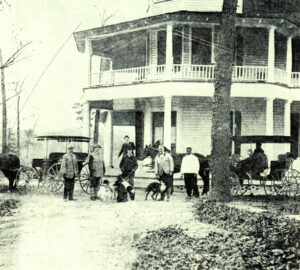
Hunting party in front of hotel
Gone long since is the wide, deep pool from which the Indians drank and to which many years later, journeyed plantation families seeking the pleasant, health-giving water. In its place came pipes from which the same medicated water gushed freely, leaving behind the familiar russet sediment. Summer cottages, a hotel and a few permanent homes began to cluster about the spring and a tiny village came into being and took its name from its famous water.”
On March 11, 1775 “Sailor” Hector McNeill received a land grant from King George III of England and he purchased the adjoining tract. This property covers most of the present town.
The waters started attracting not only settlers but many visitors. Malcolm McNeill, Jr., grandson of “Sailor” Hector, constructed on what is now Main Street just north of Second Avenue. The hotel opened July 4, 1852 was great fanfare and festivities including the Lumber Bridge Light Infantry. He died two years later and his brother, Hector McNeill known as Squire McNeill or Red Hector, took over the hotel.
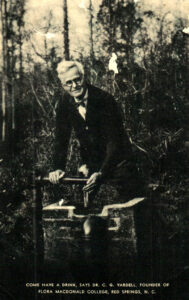
Dr vardell and the springs
In the October 14, 1858 issue of the Fayetteville Observer gives an account of a reporter’s visit to McNeill’s hotel. “Mr. McNeill is an intelligent, industrious man very attentive to his guests and over solicitous of their comfort and enjoyment. Of the water, there can be but one opinion – it is delicious. No one can sit for, on a warm day, beside the gushing fountain, drinking freely of its crystal water, without coming to that conclusion. It is delightfully cool, clear and sparkling. To drink a half dozen glasses in as many minutes is no uncommon thing.”
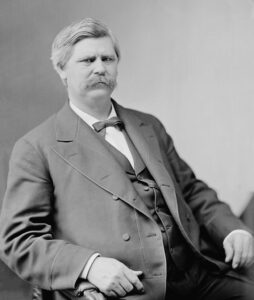
The hotel and nearby fairgrounds of the Robeson County Agricultural Society were the sites of all major special occasions and events including a visit in the 1880s by former Governor Zebulon Vance. Vance Avenue was named in his honor.
Gov. Zebulon Baird Vance
In 1891 the hotel property was purchased by Solomon Townsend and his son, Benjamin Wesley Townsend, natives of Richmond County. Solomon was married to Hannah Jane Baldwin and his son chose Janie Robeson McMillan, daughter of Hamilton McMillan, as his wife. The Townsends demolished the old hotel and built Hotel Townsend.
The Townsend’s chose Phil Wright of the firm of Wright Bros., former manager of the LaFayette Hotel in Fayetteville as well as hotels in Danville and Charlottesville, VA to operate the hotel. Newspaper articles about the grand opening extolled the hotel and all its amenities which included “electric bells, gas-lighted rooms, hot and cold baths and cuisine worthy of the manager’s reputation.”
The grand opening took place June 30, 1891 to a full house of guests and visitors including a special train with two cars from Fayetteville and another train with guests from Bennettsville, Cheraw, Maxton and Rockingham.
“The board piazza of the hotel, so alluring and cozy for the confidential and even lover-life tete a tete, the embowered walks leading to the spring and the leafy campus with its clumps of overhanging trees.” The declared the hotel in all respects equal to the Atlantic Hotel at Morehead City.
The Fayetteville Observer stated the ball lasted from 11pm until 2am and then went into great detail about the dresses and jewelry of the female guests including “Miss Mamie Bidgood in Blue silk, Marechal Niel roses and pearls; Miss Lida Wright in black China silk with a demi-train, gold trimming and ornaments and carrying an ostrich fan; Miss Ruth V. Smith in cream point lace over white silk wearing diamonds; Miss Vista Dudley in cream dotted Swiss and diamonds; and Miss Bessie Irby wearing cream satin and lace with diamonds.”
An advertisement for Hotel Townsend in 1896 declared it as “one of the best arranged in this part of the state” with indoor baths and toilet rooms, live music during the season. An1897 advertisement heralded that it had all modern conveniences and that the waters could cure stomach and kidney ailments. Rates were $2 a day, $10 a week or $30 a month.
The Hotel Townsend served as the place to host huge events like in August 1905 when it was the center location for all the activities surrounding the annual Home Comer’s Week. This was a time for all former Robesonians to return and renew old friendships. Senator JL McLauirn of South Carolina stood on the porch to deliver his speech about Scottish poetry and history to 3000 people. In September 1910 the hotel hosted a visit by NC Governor W.W. Kitchen.
Lots of people used the hotel host private parties like the All Hallow’s Eve party in 1902 given by Miss Ida Townsend which featured a gypsy, witch and ghosts with weird and fantastic lights. The writer talked in length about the food served which included chicken salad, salmon biscuits, peanut sandwiches tied with ribbons of color, frappe, coffee, chocolate nuts and luscious fruits. The writer then apologized for not being more familiar with many new stylish dainties served on the occasion. The Leap Year Party of 1912 hosted by the young ladies of the town entertained the town’s young men. Lots of amusements filled the evening including the men’s apron hemming competition which Hector Currie won. The Leap Year Party of 1912 hosted by the young ladies of the town entertained the town’s young men. Lots of amusements filled the evening including the men’s apron hemming competition which Hector Currie won.
In June 1907 the property was sold and purchased by The Robeson County Educational Association which was incorporated by C.G. Vardell, J.I. McMillan, J.N. Buie, H. Graham and B.W. Townsend. The association’s propose was to establish a school for boys, library and a nursing school. The hotel was refurbished and the next year was advertising that they had updated to an all electrical system and had installed a new water works system.
It was after this group of new owners took control that the name changed to Red Springs Hotel. In 1910 the manager J.L. Harrison hosted all the stockholders and their families which totaled 100 for a Thanksgiving Dinner. Candles and an oak fire lighted the room and the Levin’s Orchestra of Raleigh played during the dinner.
Lots of guests returned year after year for the healing waters and the plentiful game hunting in the countryside. Couples like Mr. and Mrs. Malcolm Craig of Canada who loved the mild climate of Red Springs and its refreshing waters. In the April 28, 1897 Fayetteville Observer appeared a letter from Mrs. Garrason saying that when she first arrived at Hotel Townsend she had not been able to eat for two months. She goes on to say she saw no change in the first week but by weeks two and three she was able to eat without inconvenience and started to gain weight. She finished by saying it had been a year since she went to the springs and she would advise a visit by anyone suffering indigestion.
In 1936 the old hotel was becoming unsafe and it was demolished and the lumber used to construct the gym at Flora Macdonald College.
During the tenure of this hotel there were others in Red Springs including the Exchange Hotel owned by J. McC. Buie and later purchased by A.B. Pearsall and G.H. Hall. Mrs. Nellie Shooter, a very talented milliner, worked hard and in 1891 also built a hotel and added to it in 1894. Known as Hotel Red Springs it had an office, parlors and dining room as well as twenty-one guest rooms. It stood on the corner of Main Street and Third Avenue. She rented it out to several others over the years at times taking over the management of it herself. It closed sometime before 1908 when the Hotel Townsend was named Hotel Red Springs.
The hotels were not the only business to make money from the springs in March 1906 the Red Springs Bottling Works was opened by BW Townsend, Martin McKinnon and AB Pearsall. They produced carbonated water, high grade ginger ale and all kinds of soft drinks.
Red Springs reigned as the South’s Saratoga for almost 85 years and now only survives in yellowed newspapers, faded postcards and memories of older residents. You can still drive down Main Street and see one of the old spring sites covered with a shelter and marked with a sign.
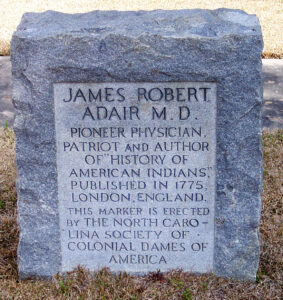
For nearly 70 years a granite monument stood at the intersection of U.S. 501 and N.C. 710 on the outskirts of Rowland. The monument honored Dr. James Robert Adair – physician, patriot, Indian trader and author.
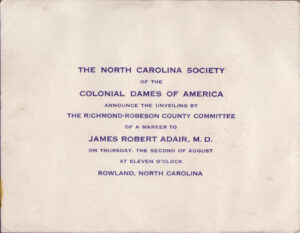
Monument ceremony The hot summer sun beat down on August 2, 1934 as the Robeson-Richmond Committee of the National Society of Colonial Dames of America placed the granite monument to the memory of Adair.
The committee’s president, Mrs. N.A. McLean, presided over the events before a crowd of more than 500. Mary Harllee and Jane Alford, descendants of Adair, were chosen to unveil the monument. Dr. A.R. Newsome, secretary of the State Historical Commission, accepted the monument on behalf of the state. Special guests were Gov. and Mrs. A.W. McLean; Col. and Mrs. W. Chauncey Alford; Col. William Curry Harllee; Brigadier General Manus McClosky, commander of Fort Bragg; Dr. Paul P. McCain, head of State Tubercular Sanatorium; and Wiley McNair, a New Orleans riverboat captain.
Invitation to monument unveiling
Before the unveiling everyone gathered in Ashpole Presbyterian Church where they were addressed by Newsome, McCain, Col. Harllee, McClosky and C.J. McCallum, elder of the church. Gen. McClosky spoke fondly of Harllee with whom he served in Cuba, the Philippines and China throughout World War I.
McClosky went on to say he felt a common tie with Adair, since he also was Scotch-Irish and North Carolina was his adopted home. He said that Adair “made a plea for preparedness, warning against impractical dreamers who believed war could be avoided by treaties. The greatest cost of war is not in lives, money or the consequent economic upheaval, but in the widows and orphans and others who are bereaved.”
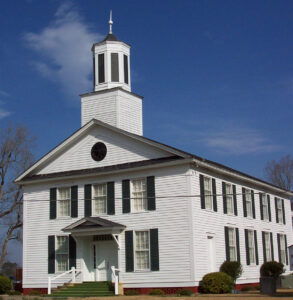
The Rowland Garden Club cared for the monument for years. About eight years ago the Colonial Dames were approached about having the monument moved from the intersection. Plans were discussed and it was hoped that the state highway department would relocate the monument. This was not to be and due to the efforts of many individuals it is located now beside the front entrance of Ashpole Presbyterian Church.
Ashpole Presbyterian Church in Rowland, NC
Adair’s life Adair was born about 1709 in Ireland and migrated to Pennsylvania in 1730 with his father and brothers. In 1735, he was a business partner with Indian trader George Galphin in Charleston, S.C. His first trading was with the Catawbas and Cherokees but he later enlarged his area to cover trade with the Choctaws and Chickasaws
He settled with his first wife on a plantation called Fairfields in present-day Greene County. By 1770, he settled on plantation Patcherly near Rowland with his second wife.
He was father of John Adair, who married Jennie Kilgore; Edward Adair, who married Elizabeth Martin; Sara Anna Adair, who married William McTyer; Elizabeth Hobson Adair, who married John Cade; and Agnes Adair, who married John Gibson.
At the age of 65 he answered the call to join the patriots’ cause against Great Britain by joining General Francis Marion. He served as medical officer on the general’s staff.
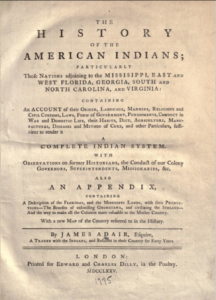
Time with American Indians In 1775 Adair’s book, “The History of the American Indians; particularly those nations adjoining to the Mississippi, East and West Florida, Georgia, South and North Carolina, and Virginia,” was published in London. He had received a letter of introduction from Benjamin Franklin to a leading London publishing house.
Adair’s memoirs show the life of a backcountry trader and the daily interactions with the American Indians. Adair presents the history and culture of the Catawba, Cherokee, Creek, Choctaw, and Chickasaw Indians he gathered from more than 40 years among them.
This publication offered the most complete look at the Indians and was eagerly accepted by policymakers, diplomats and scholars. It became easier to work with them by knowing more about their laws, government, religion and domestic life.
TItle page of Adair’s The history of the American Indians published in 1775
Adair became embattled in a political tug-of-war with the French in trying to entice the Choctaw Indians to break alliance ties with them and side with the British. This was encouraged by South Carolina Gov. James Glen. But the Choctaw people were divided in where their loyalty lay and the result was a bitter civil war among tribal members.
Problems also arose because Glen and his friends saw this as a chance to increase their personal fortunes. At the end of King George’s War (1744–48), Adair visited the French at Fort Toulouse. It was reported that he had joined the enemy when in fact he was arrested and faced the possibility of hanging.
He managed to escape and returned to his efforts of persevering the Indian history and culture. The Indian war of 1760-61 found him again going against the French when he was commissioned as a captain to a band of Chickasaws.
A major thesis of his book that is not widely accepted any longer is his 23 arguments to demonstrate that the American Indians were of Hebrew descent and the Lost Tribes of Israel. Many agreed at the time that the Indians might be descendants of the ancient Jews. The theory was not only accepted by Elias Boudinot, president of the Continental Congress, but expanded in his own book, “Star in the West, or An Attempt to Discover the Long-lost Tribes of Israel,” published in 1816.
His descendants Adair’s descendants have numbered in the thousands and have spread out from Robeson County to all points of the world. They have become soldiers serving in all wars, farmers, business leaders and teachers. Some of his descendants who have gained national attention are Hugh McCall, former CEO of Bank of America; and Malcom McLean, founder of McLean Trucking, Sea-Land Company and Trailer Bridge.
Sources: Adair, James. “The History of the American Indian”; The Robesonian August 6, 1934; Harllee, William Curry. “Kinfolks”; and The Encyclopedia of Alabama.
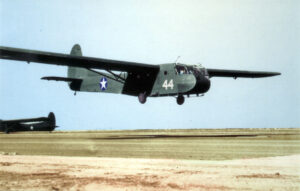
December 7th, 1941, was justly called a “day that will live in infamy.” Indeed, repercussions of the surprise attack on Pearl Harbor from Japan were felt even in the Robeson county area. The immediate response found the men and women volunteering to enlist in the nation’s armed forces. World War II left lasting mark on Robeson County with the construction of the world’s largest glider air assault training base.
The first mention of the Laurinburg Maxton Airbase is found in the minutes of the Maxton Town Board meeting of December 23, 1941 when Mayor W.H. Hasty announced that interest had been shown by the federal government in locating an airport in the vicinity of Maxton, as part of its effort to bolster air defenses in response to the surprise attack 16 days earlier. The February 6, 1942 issue of The Robesonian announced that the Civil Aeronautics Authority would be constructing a Class 3 airport similar to the Raleigh-Durham Airport near Maxton.
The town commissioners established a committee of 10 men to conduct a search for land that would be suitable. Maxton approached the City of Laurinburg about the possibility of working together on the project; they were joined by Robeson and Scotland Counties in purchasing 613 acres to lease for a $1 per year to the government to be used as a military reservation. In order to pay their fourth of the cost, Maxton issued bonds in the amount of $12,000.
Glider training at Laurinburg Maxton Airbase
Site established
The site was referred to in the May 1942 town minutes as the Maxton-Laurinburg Airbase Project, but sometime shortly afterwards the Army named the site the Laurinburg-Maxton Airbase. Even in the planning stages, the Army desired to increase the site and began the process of purchasing the surrounding property. Small and large parcels were purchased from thirty-seven owners totaling over 4600 acres. Not everyone was happy with the location of the airbase as can be gathered in a letter from Mrs. Lula Cox Sheppard to President Roosevelt in May 1942 quoted in the book “Forgotten Fields of America” by Lou Thole:
The government is taking several places for an air base including Our little place and I was wondering if we could get just one Little corner of which we live as it is on the outer edge.
We love our home so very much we hate to leave the place. It was just a little forgotten spot when we took it over, and we have built it up all we could.
But please understand sir, I could not complain at it up to the government if it is for defense, for we are too glad to do all we can for our country.
We have a son in the Navy and we are buying defense bonds through
the plant at which we work.
Fortunately for the Shepard family, the Executive Branch allowed arrangements to be worked out so that the family house was saved and relocated to a corner of land near the larger tract purchased by the Government. Their house was moved by placing logs under it and rolling to the new location where it was set on a new foundation.
Construction begins
The government authorized construction on April 20, 1942 with much of the labor being provided through the Works Progress Administration, a “New Deal” era agency that provided work to many during the Depression. An account from the May 1942 edition of The Robesonian rumored that while the plans called for a $500,000 airport that the project was really a glider training school that would cost 3 – 10 million dollars.
The base could rightly be called a city; it consisted of over 560 buildings and three runways 150 feet wide and 6,500 feet long forming a triangle. The cost was over ten million dollars and netted 20 miles of paved roads within the compound. Colonel Younger A. Pitts, a veteran of twenty-seven years of Army flying, oversaw the construction and served as the first commander of the Base. In addition to the new airbase the facilities at the Lumberton Airport and Camp MacKall were also used in the glider training program.
Housing problems
The sudden influx of thousands of soldiers caused problems unlike any the surrounding area had ever experienced. Nearly every home in Maxton made rooms available to rent to soldiers that had families since there was no married housing on the base.
Flora Lou Morgan Morton remembers her mother renting all of the upstairs rooms to soldiers and their wives. Her mother had a rule that she would not rent to a couple with children, so she always asked to make sure that the couples were childless. Mrs. Morton remembers one couple that her mother forgot to ask, and as they were moving in the sound of a baby crying was heard. Her mother started upstairs to tell them that they would have to leave in the morning but the begging of her own three children convinced her to let the family stay ― in fact they stayed over two years.
Patsy Hamer recounted in “Forgotten Fields of America” that her mother also opened her house to construction workers building the base and to soldiers.
Mother hired three cooks to prepare and serve meals to the construction workers… the cost was $1 a day for three meals.
Each of the four upstairs bedrooms was rented for $7 per week. The high demand for sleeping space led the day shift workers to share their rooms with night shift workers.
First anniversary
On September 1, 1943 the airbase celebrated its first anniversary; the event drew a crowd of over 10,000. The air show consisted of twenty-five planes with paratroopers making jumps and was topped off with the landing of four gliders. The celebration also included a softball game, a dance for the enlisted men and a dinner -dance for the officers. Colonel Pitts is quoted in August 25, 1943 issue of the base newspaper, The Slipstream before the celebration:
When we glance backward over the rugged path behind us, as the
first anniversary of our base approaches, it’s easy for us to pick out the obstacles we have overcome, for they were many. It is primarily the fine spirit, the willing cooperation of the officers and men and civilian employees of this command that turned this North Carolina farm land and the chaotic piles of lumber and dirt that decorated it, into a fine modern Army air base.
But in war-torn days such as these, the time for reminiscing is brief. So let’s devote it to constructive thinking, by looking back only to consider and plan ways to correct errors that crept in here and
there among our accomplishments. We must also look forward
and resolve that one year from now we will have doubled our progress.
The same issue goes on to give the early history of the base by those soldiers that were first to arrive at the base. Cpl. Jerry Giles remembers fields of cotton filled with pickers trying to get in the last crop to be grown on the property and of seeing Cpl. Eugene Dunham shooing a sow and her brood from beneath the barracks. Captain Robert DuBose remembered that all the offices were cramped into the Base Headquarters Annex along with a one-chair barber shop, and mini PX stocked with candy and drinks, as well as a dispensary. These first arrivals found farm roads and two gates guarded by civilians.
They also found many of God’s creations that the area was known for – namely gnats, mosquitoes and files. Set. George Tuttle remembers
As we walked across the weeded patch, we stepped high,
for we’d heard rumors of snakes being around to welcome us. We were really pioneering.
Casualties suffered
The year 1944 saw a change of command. Colonel Lloyd L. Sailor assumed command in March, replacing Colonel Pitts; however, his tenure would be short due to other needs. Sailor was replaced in June by Colonel Ellsworth Pierce Curry. During this year the base also suffered casualties. In May, a glider crashed killing an officer and injuring two others. The later part of the year twelve men on a C-47 were killed when a parachuted supply bundle dropped during a training mission hit the plane, and caused loss of control.
Recreation
The soldiers found time for much needed recreation on the base and according to the base newspaper, The Slipstream; they were entertained by traveling shows such as Ina Ray Hutton and her Orchestra. The paper also reported that the base had eight softball teams, movie theater and swimming facilities; by 1943 the base also had its own band that performed concerts three times a week.
Further evidence of the concern of the community over the morale of the soldiers stationed at the base is shown in September 1942 minutes of the Maxton Town Council. The Council appointed a special committee to work with the USO Committee in selecting a lot for a building. The building was erected the following year on Saunders Street (now Martin Luther King Highway). An article in the July 28, 1943 edition of The Slipstream announced the opening of the Maxton USO from 6pm until 11:30pm with Miss Minnie Lou McRae serving as hostess. An average of fifty men a night have enjoyed singing and dancing along with the piano and juke box.
Base closed
When World War II ended in 1945 talk began about the closing of the Laurinburg-Maxton Airbase and what the Towns of Maxton and Laurinburg would do with the property. Beginning in February 1946 joint discussions between the two towns yielded a desire to turn the base hospital over to the Scotland County and to lease the airport facilities to Presbyterian Junior College for an aviation training program.
In May 1946, the towns entered into a lease agreement with Airports Operations, Inc. a corporation established by Presbyterian Junior College to operate the aviation program. In June 1946, the towns voted that Scotland County Hospital Association could operate the base hospital but due to the fact that the towns did not obtain clear title to the property until March 1947 it was not until April 1948 that the hospital and forty-four acres were actually donated to the association.
Maxton and Laurinburg entered into an agreement in 1948 to form the Laurinburg-Maxton Airport Commission to administer the airport property. Today, the airport still functions, not only as a working airport, but as a tangible reminder of the area’s contribution to freedom during World War II.
Those who have seen the movie remember that every hundred years the small Scottish village appears out of the mist for one day. Well in Robeson County we have an area that I have named Brigadoon. It is the McAlpin-McNair Cemetery and at first thought you must be thinking how can a cemetery appear and disappear. The answer is plain and simple neglect – over the years the cemetery as become so overgrown that the twenty foot tall main monument erected in memory of Duncan and Catherine McNair could not even be seen. The McNairs and their monument are an interesting part of Robeson County’s history.
The McNairs
Duncan McNair and his wife, Catherine McCallum McNair, along with their young son, John, traveled from Kentyre, Argyleshire, Scotland in June 1786 and settled in the area of Bladen County that would become St. Pauls about a mile west of the Stage Road. Less than a year after they arrived Robeson County was created by splitting off part of Bladen County and naming it in honor of Col. Thomas Robeson the hero of the Revolutionary Battle of Elizabethtown.
Duncan McNair found himself surrounded by many like minded Scottish emigrants desiring to participate in Presbyterian worship but commuting to the nearest church in Fayetteville was out of the question for most families. Plans were made to form a local congregation and the St. Pauls Presbyterian Church was founded in 1799. The Rev. Daniel Brown preached the first sermon and was the supply pastor for about one year and McNair was elected the first Ruling Elder. The area around the St. Pauls Presbyterian Church began to organize into a community and in the 1830s the post office took the name St. Pauls after the church thus the founding of the church lead to the creation of the present Town of St. Pauls.
Descendants
The McNairs had four sons Malcom, John, Robert and Duncan and two daughters Polly and Catherine. Malcom married Margaret Dalrymple, John married Polly Graham, Robert married Elizabeth Patterson and Duncan married Elizabeth McNair. Daughter Polly married Neil McArthur and Catherine married Neill McGeachy. Their descendants have gone forth to be soldiers, pastors, business leaders and politicians serving not only St. Pauls and Robeson County but all across the United States. Twenty-seven young men of the family served in the Confederate Army with only four losing their life during the fighting.
Margaret Dalrymple McNair, daughter-in-law of Duncan and Catherine McNair
John Calvin McNair, the McNair’s grandson through Malcom and Margaret Dalrymple McNair, graduated in 1849 from the University of North Carolina at Chapel Hill and became a schoolmaster teaching for a while at the Robeson Institute in St. Pauls. After his brother’s death he entered Columbia Theological Seminary in South Carolina, where he took special interest in the questions of science and theology. In April 1857 he was licensed as a Presbyterian minister. He was encouraged by his mother to study abroad in Scotland and while there he became sick dying on January 19, 1858. He was buried in Old Grange Cemetery in Edinburgh, Scotland.
In his will of May 26, 1857, he left his estate to provide for his mother until her death and then to establish a lecture series at UNC Chapel Hill. The objective of the lectures is to show the mutual bearing of Science and Theology upon each other.
Robert Evander McNair, their great-great-grandson through Robert and Elizabeth Patterson McNair, found his career to be as a lawyer and politician. He began his law practice in the late 1940s and in 1951 was elected to the S.C. House of Representatives where he served as chair of the Labor Commerce and Industry Committee and later the Judiciary Committee. He was elected Lieutenant Governor of South Carolina in 1962 and served until he succeeded Donald S. Russell as Governor of South Carolina in 1965. In 1966, he was reelected to a full term as governor serving, at that time, an unprecedented six years in that office. Governor Robert E. McNair died on November 17, 2007.
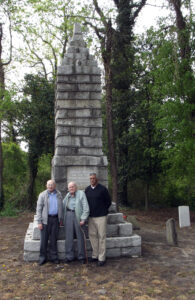
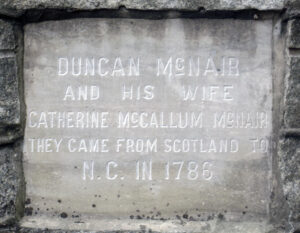
The Monument The effort to erect a monument to the McNairs was headed by their great-granddaughter Miss Etta Brown, French Professor at Flora MacDonald College and historian of the Virginia Dare Chapter of the Daughters of American Colonists. She contacted as many descendants as she could find and found many willing to contribute toward the cost of the monument. The results lead to a railroad car of Mount Airy granite being delivered to the old McAlpin-McNair graveyard where the McNairs are buried. The monument was built with a square base eight feet by eight feet and rises twenty feet in height. The front has a gray marble tablet that reads “McNair” while a matching tablet on the rear reads “Duncan McNair and his wife Catherine McCallum McNair. They came from Scotland to N.C. n 1786.” The monument was dedicated with a large crowd of descendants present in April 1932. In June 1932 Miss Etta Brown presented a marble memorial tablet to the St. Pauls Presbyterian Church which is in a place of honor in the sanctuary. It reads “Duncan McNair First Ruling Elder of this church Elected 1799.”
McNair MonumentClose up of McNair Monument
Preservation
In the years since the monument was place in the cemetery they both have been neglected at times. In the 1950s the young boys of the church cleaned off the cemetery making the monument visible from the road but before long the area was taken over by weeds, vines and small trees blocking it from the view. In the early 1990s church member and local historian, Bill McKay, cleared off the area trying to preserve this rich part of local history. He tried his best to continue the heavy task of removing undergrowth and vines until his death in 2005.
Recently Tommy Hall a descendant who grew up in St. Pauls but now lives in Fayetteville spearhead the efforts to reclaim the monument and graveyard from the debris and vines. He was one of the young church boys who worked to clean up the cemetery in the 1950s. He contacted Rennert Mayor Michael Locklear to see if anyone in the community was willing to help with the effort. Hall was surprised to learn from Locklear that people in the community were very willing to donate time and heavy equipment to preserve what they considered to be an important part of their history. They managed to not only put this cemetery in the best physical shape that it has seen since 1932 but in the process also reclaimed the Tolar Cemetery that adjoins it. The beautiful gravestones and wrought iron fence was completely hidden by vines and trees had grown up twisting the fence. The Tolars played a large role in the early history of Rennet. When the town was incorporated in 1895 Bunyan, Carson and U.S. Tolar all served as original town commissioners and Thomas J. Tolar was the first postmaster.
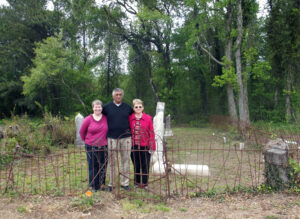
Amanda Tolar, Rennert Mayor Michael Locklear and Adelaide Tolar Shoemaker
Recently in April of this year a small group of McNair and Tolar descendants and history lovers gathered eighty-one years after the monument was erected to celebrate their ancestors, the restoration of the graveyards and McNair’s oldest descendant. The day was opened with prayer by Rev. Sue Hudson pastor of St. Pauls Presbyterian Church and a talk by Hall about the preservation efforts. Hall introduced 97-year-old J. Browne Evans, the oldest member of the church and thought to be the oldest living descendant of the McNairs. The afternoon was a great time of fellowship, renewing old friendships and discussing genealogy.
St. Pauls Mayor Buddy Westbrook, J. Browne Evans and Rennert Mayor Michael Locklear
One lesson is to be learned from this preservation effort and that is that each of us needs to do our part to preserve the rich, diverse history of Robeson County. There is something that everyone can do from cleaning off an old cemetery to helping to track down old photographs to taking time to talk with our elders and recording their memories. Do not make the mistake of thinking someone else will do it like the Nike commercial says “Just Do It.”