Blake Tyner – Historian & Storyteller

Menu
  • Home
  • About Me
  • Historical Projects
  • Publications
  • Lumberton Downtown Stories
  • Lumberton Haunted History Walk
Menu

Author: blaketyner

Lumberton Haunted History Walk

Posted on October 4, 2024 by blaketyner
Lumberton Fire Station

Step into the shadows with historian Blake Tyner for a chilling stroll through Lumberton’s most haunted tales!

Prepare to be captivated by the dark back stories of murder, crime, and mayhem that still echo through the streets.

Elm Street, Lumberton, NC

Saturday, October 26, 2024

4:00 pm – 5:30 pm

During the Hogtoberfest (for more information about Hogtober)

Old Lumberton Jail

Free event – request donations to Fire Station Restoration Fund

More information coming!!!

Dark Waters of the Lumber River Preserved in Poems

Posted on August 13, 2024 by blaketyner

It doesn’t matter if you call it Drowning Creek, Lumber River or the Old Lumbee the dark waters that wind through Moore, Scotland and Robeson Counties draws you in almost hypnotizing you. In the early years of the county the river served as a highway for commerce. Trees harvested in the county were rafted down the river to the Little Pee Dee and on to Georgetown, SC.

When I think of the Lumber River, I think of the first lines of Lord Byron’s poem “She Walks in Beauty”

She walks in beauty, like the night

Of cloudless climes and starry skies;

And all that’s best of dark and bright

Meet in her aspect and her eyes

Over the years pen has been put to paper to capture the river in poetry the most notable from the first four decades of the 1900s are William Laurie Hill, Woodberry Lennon, Clara Johnson Marley and John Charles McNeill.

Dr. William Laurie Hill
Hill was born March 29, 1835 in Maxton, NC to William R. Hill and Sarah Simmons Hill. He was brother of Rev. Halbert G. Hill, long time pastor of the Maxton Presbyterian and Center Presbyterian Churches. The brothers’ book “Blue Bird Songs of Hope and Joy” was marketed as a collection of songs that are like a breath of spring from out Southland. William was referred to as the poet laurate of the North Carolina Press Association Editor of “Our Fatherless one” the newsletter of Barium Springs Presbyterian Orphanage. He died in November 1921 at the age of 86 and is buried in the Centre Presbyterian Church Cemetery, Maxton, NC. His poem Old Lumber River was printed in the January 16, 1908 issue of The Charlotte Observer.

Old Lumber River

Yes, thou art old. and generations past.
The Red man’s home was in thy forest’s vast.

Along thy current shot his swift canoe –

He knew each cove, and vapid-swamp and slough.

And in thy swamps, did he the wild game chase.

And in thy swamp, did he the wild game chase.

Arts of the finny tribe, he wisely knew –

And many well rewarded casts he threw.

Alone with nature dwelt these Redman there –

Hunting their game, the ‘possum, deer and bear –

While for some fancied cause, in vengeful wrath.

Their council held; they strike the dread war-path.

Years pass – and now we see the Scotch-man come,

To build along thy banks a thrifty home –

The Redman sees with awe, great clearing made

Upon the sandhills sloping to the glade.

The hunting grounds, now yield crops of maize –

And sheep and cattle in new pastures graze –

Before the woodman’s ax, the Redman flee,

Seeking some spot where white men may not be.

Vain hope! for savage men must now give place

To men of brawn, and brain, a sturdy race.

The poor Indian fades from mortal view –

No more to seek this haunt, that once he knew.

In all these changes. Lumber River flows

Her quiet way! And as each season goes

More people settle on her thrifty sod.

Rear homes and alters for Almighty God.

Flow gentle river, onward to the sea.

The good folk on try banks are loving thee.

True men and sages on thy sandhills dwell –

Not would some highland home suit them as well.

A son of thine, oft sweetly sung of the three,

And now he sleeps by creeping vine and tree

He lov’d so well: and thou shall hear no more –

The magic cadence of his skillful oar,

No more will he of “Lumber River” sing.

No more his soulful voice shall tell of spring

Along thy banks; or in thy “bonnie braes,”

Or charm us, with his sweet “October days.”

But now, as thou art flowing to the sea.

Thy voice is gently whispering to me.

Of him who sung those songs to nature true.

Songs rich with sympathy, and ever new.

Old River, ever dear to him – to me.

We loved thy lily pads, and every tree

Along they shady banks, nor would we sleep.

Where thou couldst – not o’er us thy vigil keep.

William Laurie Hill

Floral Manse, January 14th, 1908

Woodberry Lennon

Lennon was born January 16. 1885 in Columbus county, son of the Frances and Sue Lennon. The family moved to Robeson County shortly after his birth and he lived practically all his life in Lumberton. He graduated from Wake Forest College in 1907, completing his law course at the same time. He served as deputy clerk of Superior Court, solicitor of the recorder’s court and for a short time as recorder. For most of his legal career he practiced law alone but for a short time was in partnership with Horace Stacy, Sr. 

From his obituary in The Robesonian February 12, 1923 “Woody, as he was known to practically everyone here and to a large number throughout the state, was a genius at map drawing, as is evidenced by his extraordinary good map of Robeson county, made last year. Not only is it a credit to Mr. Lennon, but to the county itself. If he had an enemy it is not known. In his early manhood he showed his ability for handling complex things and was appointed deputy to the clerk of the Superior Court of Robeson county. Many legal problems were solved by Mr. Lennon while he was attorney for the town of Lumberton. In many instances he was a very valuable asset to the town and during the time he was thus employed the authorities and town fathers knew that their guidance in affairs was being well handled by the young lawyer.”

The Sunday after his death Dr. Charles Henry Durham pastor of Lumberton First Baptist Church spoke from the pulpit about Lennon. In Durham’s words Lennon was an active part of all the work of the church and that his place would never be filled. He was especially faithful to the preparation of the musical programs. He not only sang but also played the violin. Durham went on that “while we miss him today in our own choir here, we know that he is filling his place for the first time in the heavenly choir along with the angels in glory.” Durham also urged the younger members of town to step into the ranks, fill in their places, complete the work so nobly begun and emulate his example.
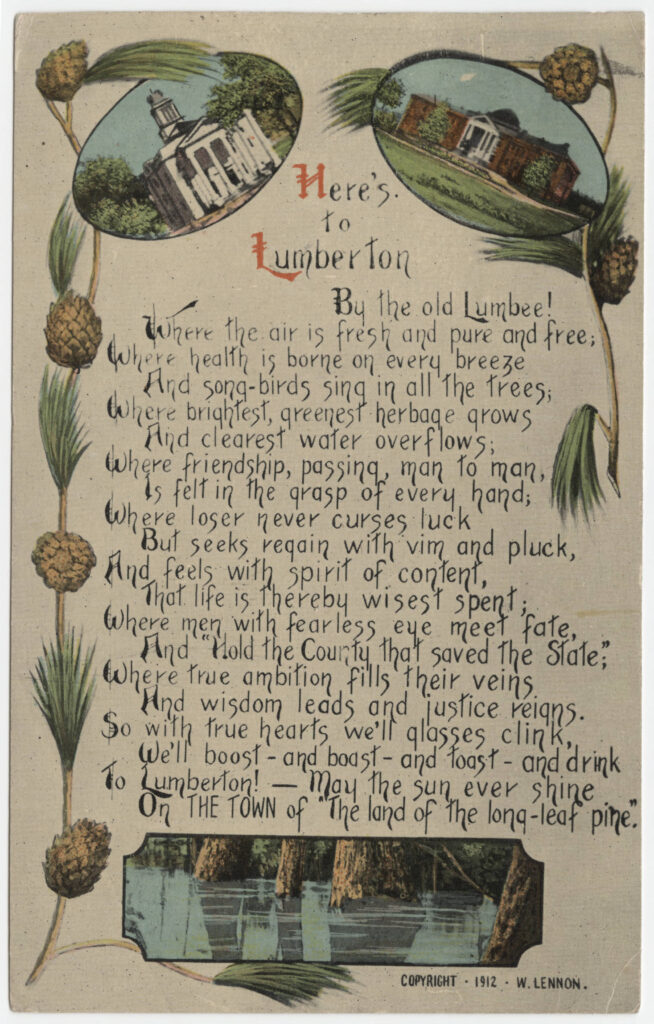
Postcard of Lennon’s Poem

Lennon’s poem “Here’s to Lumberton” first appeared in a special issue of The Robesonian on October 19, 1911. The newspaper referred to Lennon as the Bard of Robeson. He died in 1923 at the age of 38. He was sick only a week, death being due to pneumonia following influenza.

Clare Johnson Marley
Clare Johnson was born 1896 in Moore County, North Carolina but moved to Lumberton to attend school and be near her brother, Dr. Thomas C. Johnson who operated the Thomson Hospital after the death of Dr. Thompson. She lived with her sister Mrs. J.R. Poole on Water Street within sight of the Lumber River. After graduating from Flora Macdonald College, she began her 44-year teaching career in Lumber Bridge where she met her future husband. In 1917 she married Walter Ellis Marley, and they were parents of Margaret Modlin, Rebecca Moore, Morris Stephens and Walter Ellis Marley, Jr.
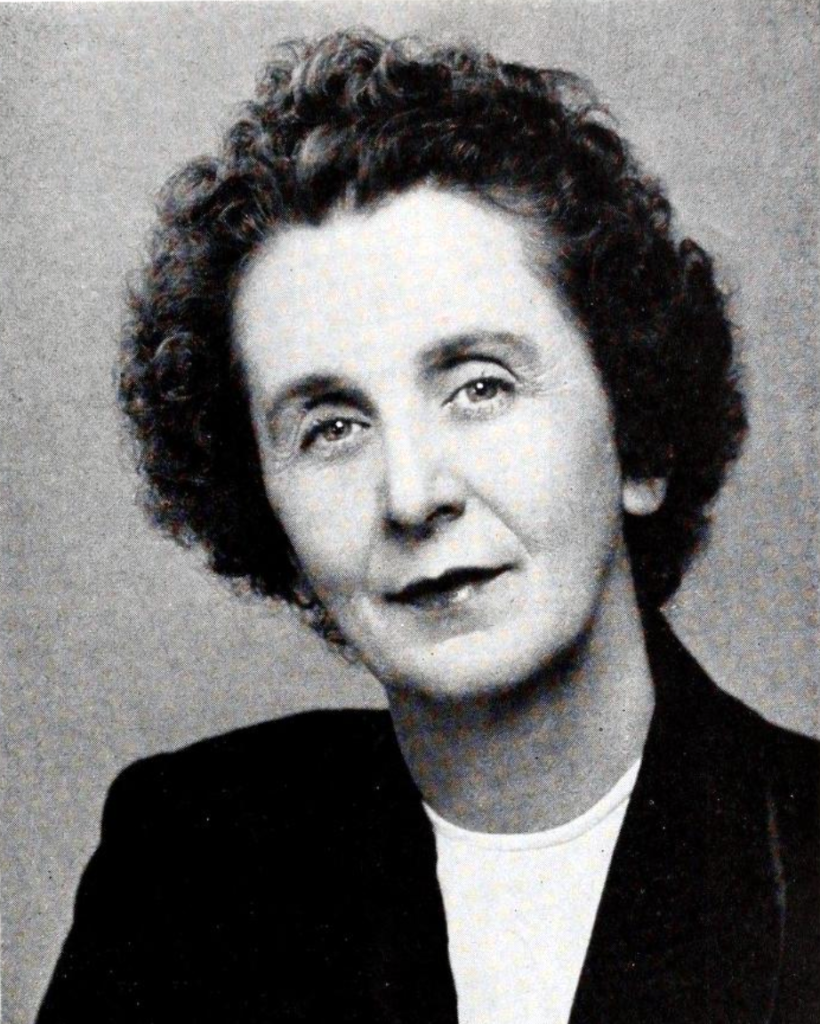
Clare Johnson Marley

She received her Master of Arts degree in Dramatic Art from University of North Carolina. Her love for playwriting came from her time with Dr. Frederick H. Koch, Founder and Director of the Carolina Playmakers. Her love for plays led her to write several plays based on North Carolina Historical events. Her works are persevered a n the Southern Historical Collection at UNC. Several of her plays written while a student at UNC were produced by the Carolina Playmakers: Swamp Outlaw, about the notorious “North Carolina Robin Hood,” Henry Berry Lowry; The Old Dram Tree, her first play of the Crusoe Island folk; Flora Macdonald, the highland girl who risked her life to save Bonnie Prince Charlie; Crusoe Islanders, a tragic drama of the Carolina Low Country; The Wraith of Chimney Rock, a play in verse, drawn from a legend, still cherished by the hill folk of the Great Smoky Mountains of North Carolina.

Mary Slocumb, a play in poetic prose about the North Carolina heroine of Moore’s Creek Battle between the Whigs and Tories, was produced at Chapel Hill in the Twentieth Annual Festival, 1943. Swamp Outlaw was published in the Carolina Play-Book in March 1940; The Old Dram Tree was published in Edgar Allan Poe’s Literary Messenger, in August 1942; Swamp Outlaw was included in The Players Magazine, The Educational Theatre in America, in May 1943.

Marley twice won the Sidney Lanier Cup for Playwriting, in 1943, for Flora Macdonald; and in 1944, for The Old Dram Tree. Many colleges, high schools, clubs and festivals preformed her plays over the year. A citation of honor, The Roland Holt Silver Cup for Playwriting, was awarded Clare Johnson Marley at the Carolina Playmakers Theatre by Professor Samuel Selden, Head of the Department of Dramatic Art, University of North Carolina, for outstanding work in graduate playwriting while working for her Master of Arts degree.

Her tribute to the Lumbee was published in the 1954-1955 National Poetry Anthology by Librarians and Teachers of the National Poetry Association.

Ever Onward Rolls the Lumbee

Ever Onward Rolls the Lumbee …*
‘Tis a serpent long, winding sluggishly
Through dense labyrinths of vines
And lowland mosses …
Dark and treacherous

With black waters rolling onward …
Ever onward toward the sea,
Countless whirlpools whirling
Restless quicksands sucking,
Green water snakes breaking the water …
Appearing and disappearing in capers turbulent …
Black water bugs darting here and there,
Long trailing mosses streaming out
From the limbs of gnarled Cypress trees,
Lacy junipers and venerable water oaks
Like an old man’s gray beard
In the frolicsome wind …
Marsh ducks feeding in the crab grasses
Along the water’s edge …
Wild geese flying southward,
Dark waters slapping the low banks,
A crane standing on one foot
Sleeping in the fading sunshine …
Churning waters.
Bull alligators fighting
Over the antiered stag
Trapper and struggling in quicksands
At the river’s edge.
The musical chirping of birds …
Bluebirds, cardinals, sparrows and thrush …
Foreboding hoots of an owl,
Screaming of the wildcat
On the track of the prey,
And the rushing of the wild boar
Through crackling sword grasses.
A crude raft of logs drifting down the river
Carrying two Croatans** sleeping
By wooden keys filled with moonshine***
Taken from a still
Hidden in the hollow of a giant oak
And loaded by the light of the moon …
Alligators slide down slimy banks
And follow the raft that rifts
On black waters that roll onward
Through dismal swamps,
Sea marches green,
Black waters of the Lumbee River
That move onward …
Ever onward toward the sea.

Footnotes to the poem by Marley – *Lumbee River is a deep, winding and treacherous river in Robeson County, NC, **Croatans are Indians located in Robeson County and said to be the descendants of the Lost Colony that amalgamated with the Croatans when Governor John White failed to return with his ship of supplies 1589, ***Moonshine is illicitly distilled liquor.


John Charles McNeill

One of the most loved poets that wrote about the Lumber River was John Charles McNeill. For the life of McNeill, I call on the 1991 writings of Richard Walser and the 1949 biographical sketch by Agatha Boyd Adams printed by UNC Press.
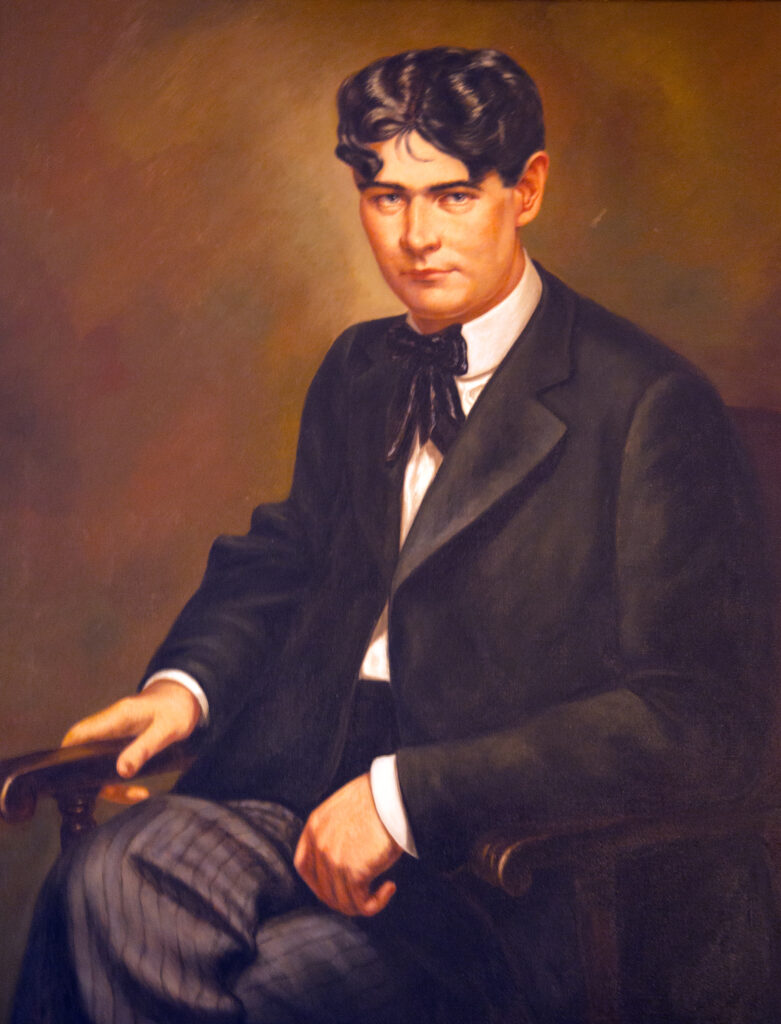
William Field’s portrait of John Charles McNeill

McNeill the youngest child of Captain Duncan and Euphenia Livingston McNeill was born July 24, 1874 at his father’s farm Ellerslie near Wagram., his father’s farm near Wagram in Richmond (later Scotland) County. John Charles had three sisters and a brother: Mary Catherine (Mrs. Jasper Lutterbok Memory), Ella (Mrs. Daniel A. Watson), Wayne Leland, and Donna.

His father in addition to farming had been at various times an editor, lecturer and writer. His mother was described as a woman of unusual beauty and of forceful character. The deep impression which she made on her poet son is evident in the many references to mothers and motherhood throughout his writing.

His father recalled that John Charles “from boyhood was delicate in his appetite. The

table might be loaded with luxuries, but he would choose only bread and milk, with butter and dainty fruits, not taking meats.” Perhaps a doctor might discover in this limited diet for a growing active boy one of the causes of the tragic illness of his early manhood. In spite, however of his dainty appetite and bookish tastes, he grew up strong and vigorous; “tall, slender, and beautiful in form and feature,” his father described him.

He had the freedom of the woods, the creeks and river, and the endlessly fascinating swamps, with their great variety of bird and insect and animal life. By his own witness, he was very early filled with that love of the outdoor world which never left him:
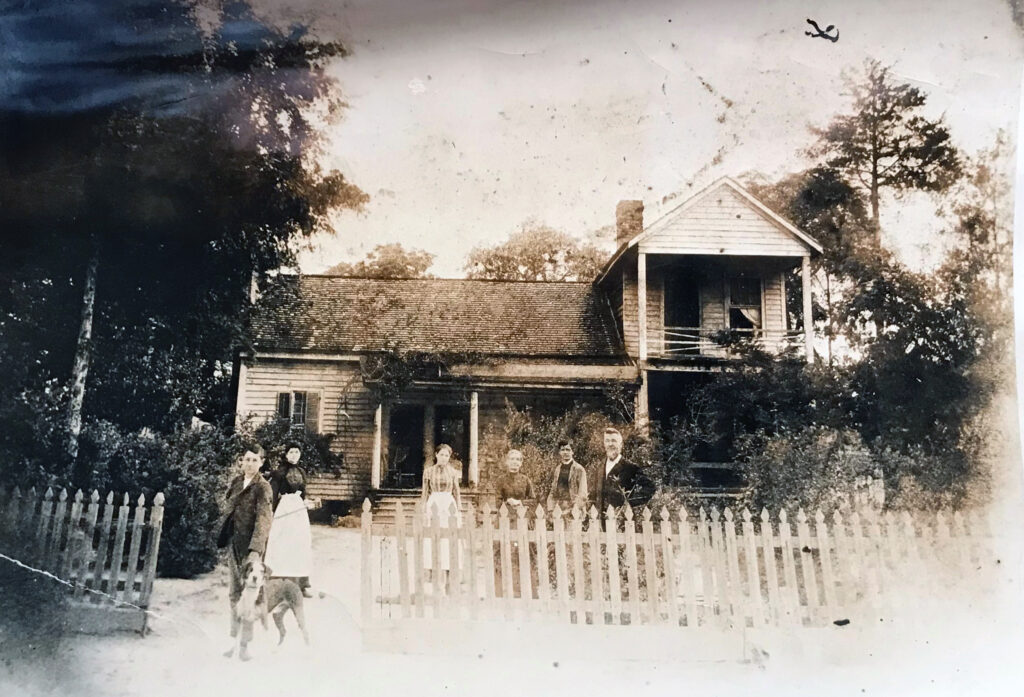
The McNeill family in front of Ellerslie. McNeill is posed with his dog

“The first thing I remember of this world or of any world, for that matter is the being lifted up by a big boy in a cadet uniform to get a peep of four blue eggs in a hollow. The big boy explained how they were bluebird eggs, how the bluebird’s noggin was not hard enough nor his bill enough like a chisel for him to dig out a hole for himself, and how he waited until the sapsucker had made and abandoned the nest, when he, the bluebird, moved in and took charge. I don’t know when George III died, but I know when that stump fell; will never forget where it stood nor the day, which now seems a thousand years gone, when I gazed with wonder at those eggs.”

McNeill’s boyhood was not a solitary one. He became a leader among the neighborhood boys, “the sunburnt boys,” as he later named them in his rhymes. He excelled in running, jumping, rowing and swimming; he knew to the full the cool delight of diving from “the springboard

extended over the old deep swimming hole and watching the mellow bugs on the surface scattered by plunging naked bodies.” He built boats to use on the river, one called “The Wild Irishman,” another “The Nereid.” The river and the nearby swamps and woods were as truly his home as the big farmhouse of his father, and to them he loved to return in memory and in writing.

When John Charles was twelve, the family moved from Ellerslie to another farm called Riverton on the other side of Wagram. The community bordered the Lumber River. John Charles started his formal schooling at Richmond Academy, later Spring Hill. In September 1894, John Charles McNeill entered Wake Forest College as a freshman. Here his ability gained quick recognition; he won the Dixon medal for the best essay his first year, and was appointed a tutor in English while still a freshman.

The year after graduation, McNeill went to Mercer University at Macon, Georgia, to teach English grammar and composition. The struggle to guide unwilling freshmen through the intricacies of syntax must have been a dull and irksome task for a youthful poet with a head full

of dreams.

Teaching did not however yield sufficient satisfaction for him to choose it as a profession. In 1900 he put out his shingle in Lumberton, over on the east bank of the Lumber River in Robeson County.

The practice of law in a small North Carolina town did not offer great variety or much of a challenge; nor did John Charles McNeill give himself up to it with any notable industry. The spell of the river extended to the very door of his office; the mysterious and enticing smells of the woods floated among his law books, and wild bird calls summoned him to explore. Clients often found the office locked because he had gone fishing. Naturally his practice did not flourish, but after his own fashion he was preserving his soul. Fishing expeditions meant also the storing up of images and observations which could be used later in poems.

While in Lumberton, McNeill bought an interest in a newspaper, the Argus, for which he wrote occasional editorials. When requested to do so, he happily wrote a brief county history to be included in the Dictionary of Robeson County (1900). In 1902 he sold his interest in the paper and returned to his native county, Scotland, where he formed a law partnership with Angus McLean in Laurinburg. During this period, he won an election to the State Legislature as a representative from Scotland County, and served a term in Raleigh. This political experience left little or no trace in his writing, except perhaps in his ability to cover political gatherings when he later worked for the Observer in Charlotte. Among the many local bills, he introduced was one to prohibit the sale of liquor in Scotland County and another to “prohibit the sale of fire-crackers more than three inches long.”

Meanwhile, he was pursuing his love of poetry. “Barefooted” appeared on 6 June 1901 in the Youth’s Companion, one of the nation’s most popular periodicals. Between January 1902 and December 1905, the prestigious Century Magazine used eighteen of McNeill’s poems, both lyrics and dialect verses.

In Charlotte, editor Joseph P. Caldwell of the Observer, a man of humor and ability, was searching for a feature-story writer to succeed Isaac Ervin Avery, recently deceased. When in the summer of 1904 H. E. C. (Red Buck) Bryant, a traveling representative of the Observer, called on McNeill in Laurinburg, McNeill admitted he was ready to leave the law profession; and after an interview in Charlotte, Caldwell hired him. Immediately McNeill started sending in copy to the Observer, though he did not officially join the staff until 1 Sept. 1904. Caldwell specified no definite duties. McNeill was to write whatever and whenever he wished; if he turned in no copy, Caldwell would understand. For the next three years, the editor’s faith in McNeill was amply rewarded. True, his columns came out irregularly, often on successive days, then nothing appeared for weeks. His columns had various titles: among them, “From Street and Lobby,” “Little Essays,” “Sunday Observations,” and “Unclassified Stunts.” He first used the heading “Songs Merry and Sad” on 2 October.

On October 19, 1905 the Patterson Cup, the first literary trophy in North Carolina, was awarded McNeill for a manuscript of poems published later as Songs Merry and Sad (1906). The award had just been established by Mrs. Lindsay Patterson in honor of her father, William Houston Patterson. President Theodore Roosevelt, at that time touring the State, made the presentation for the North Carolina Literary and Historical Association at the annual meeting of that body in Raleigh.

McNeill’s reply to the President after he presented the award “Mr. President, my joy in this golden trophy is heightened by the fortune which permits me to take it from the hand of the foremost citizen of the world. To you, sir, to Mrs. Lindsay Patterson, our gracious matron of

letters, and to the committee of scholars whose judgment was kind to me, all thanks.” Immediately after receiving the cup, he took the first train home to Scotland County to show it to his mother.

On the occasion of this award, J. P. Caldwell of the Observer, bursting with pride in the poet whom he had sponsored, wrote “Mark you, masters, — and this may be said without danger of turning his hard-Scotch head, — the man is a genius. The only fear concerning him is that North Carolina cannot hold him.”

There seems little doubt that the three years during which he worked for the Observer were among the happiest, and certainly they were the most productive, of McNeill’s life as a writer. To the rural McNeill, Charlotte seemed like a metropolis, and he was always delighted with the throngs coming and going. Yet his mind was never far away from Riverton, and when he occasionally disappeared, even during a busy time at the Observer, everyone knew he had gone for a while to walk the banks of the Lumber River. In the summer of 1907, he became ill and went to Wrightsville Beach in hopes of regaining his strength. When his condition worsened, he left his work and retreated to Riverton. On October 17, 1907 in his large room on the second floor of his parents’ home, he died of what was diagnosed as pernicious anemia. He was buried in the family plot at Spring Hill Cemetery. On the tombstone were engraved lines from his “Sundown” and the designation “Poet Laureate of North Carolina,” an unofficial title tendered him after he received the Patterson Cup. This period of activity was brought to an abrupt close by illness, which gradually increased until early in 1907 when he had to give up and go home to rest.

Sundown

Hills, wrapped in gray, standing along the west;

Clouds, dimly lighted, gathering slowly;

The star of peace at watch above the crest —

Oh, holy, holy, holy!

We know, O Lord, so little what is best;

Wingless, we move so lowly;

But in thy calm all-knowledge let us rest —

Oh, holy, holy, holy!

Lee M. White, editor of Wake Forest Student Vol. XXVII December 1907 No. 4 wrote “the death of Mr. McNeill, North Carolina and the South has lost one of her most brilliant men of letters. The “Robert Burns of the Old North State” is with us no more. Every lover of the beautiful, of poetry, of nature, feels his loss keenly, for his pen.”

Sunburnt Boys

Down on the Lumbee river
Where the eddies ripple cool
Your boat, I know, glides stealthily
About some shady pool.
The summer’s heats have lulled asleep
The fish-hawk’s chattering noise,
And all the swamp lies hushed about
You sunburnt boys.

You see the minnow’s waves that rock
The cradled lily leaves.
From a far field some farmer’s song,
Singing among his sheaves,
Comes mellow to you where you sit,
Each man with boatman’s poise,
There, in the shimmering water lights,
You sunburnt boys.

I know your haunts:  each gnarly bole
That guards the waterside,
Each tuft of flags and rushes where
The river reptiles hide,
Each dimpling nook wherein the bass
His eager life employs
Until he dies — the captive of
You sunburnt boys.

You will not — will you? — soon forget
When I was one of you,
Nor love me less that time has borne
My craft to currents new;
Nor shall I ever cease to share
Your hardships and your joys,
Robust, rough-spoken, gentle-hearted
Sunburnt boys!

The September 6, 1915 issue of The Robesonian talked about Lumberton photographer Miss Lilliam A. Ferguson publication illustrated booklet of “The Sunburnt Boys”. It stated that she photographed scenes around Riverton catching beyond a doubt the very scenes McNeill had in mind as he penned the lines. The booklet is a fitting tribute to the beautiful words of McNeill. McNeill’s childhood home, Ellerslie, was moved to the grounds of the former Spring Hill Academy and serves as a museum to his memory by the Richmond Temperance and Literary Society which was founded in 1853. The Society’s headquarters is a hexagonal building where the society members publicly avowed abstinence from strong drink, debated public issues, and shared views of the literature of the age.

The next time you stop to lose yourself in the dark waters of the Lumber River also take time to remember these writers who in putting pen to paper have preserved their love for our great river.
Dark Waters of the Lumber River Bring Pleasure

Posted on August 13, 2024 by blaketyner

Dark Waters of the Lumber River Bring Pleasure

The dark swift waters that wind through southern North Carolina like a black velvet ribbon have gone by many names – Lumbee, Drowning Creek and the Lumber River. It travels from Scotland and Hoke counties into Robeson and Columbus counties before merging into the Pee Dee River.

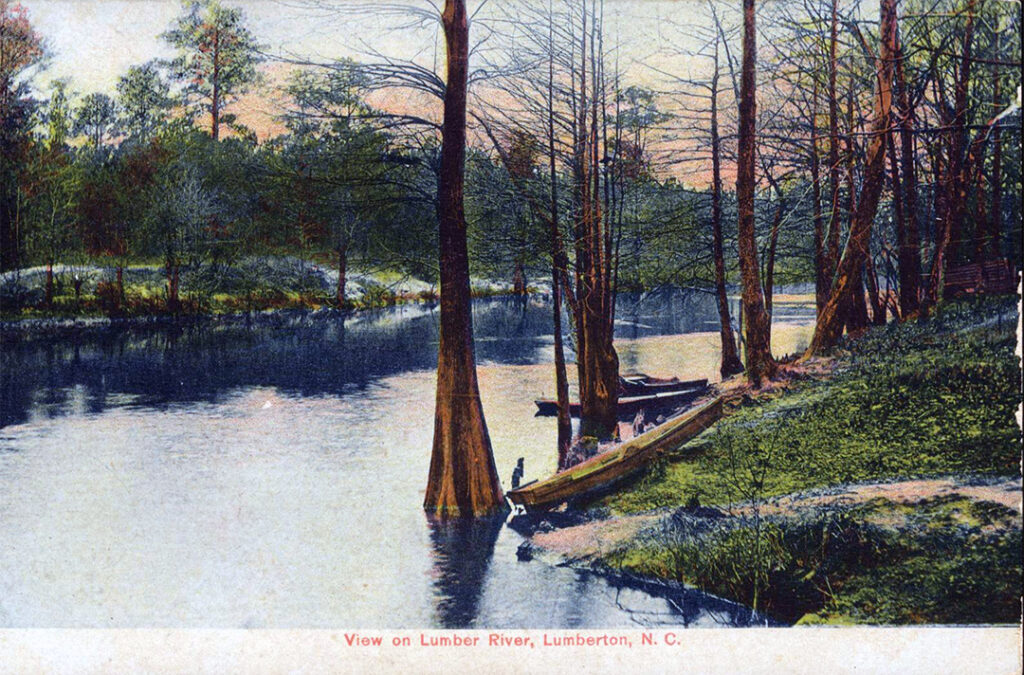
This early 20th postcard shows the beauty of the Lumber River with its tree lined banks.

At one time, the Lumber River served as one of the main thoroughfares for those living along its shores. It also served as a source of commerce and entertainment for generations. The Robesonian’s 1951 historic issue tells us that except for the courthouse, all of the early Lumberton buildings were along what is now known as Water Street, which was in the early days of the town known as the Wharf. There was a hotel, warehouses and a few stores that sold everything from silk to whiskey. Older folks told that in most any store you could find a whiskey barrel alongside the sugar barrel. The store keeper would draw a pint of whiskey and then grab a handful of sugar to mellow the liquor.

Fishing

The banks and waters of the Lumber River have called out as a siren luring young and old to come to the dark waters, fishing pole in hand, so that they might bring out the bounty of fish the river has to offer.

The Fayetteville News June 9, 1868, issue notes a letter that the reporter received from his brother in Lumberton giving glowing accounts of fishing in the river. He was able to fish just a few feet from the door of his store and was catching hundreds of yellow perch weighing from 16 to 24 ounces. The reporter stated if he had known of a store like that that was up for rent, he would have rented it for the term of his natural life at any price.

The Wilmington Morning Star provided lots of coverage of Robeson County, and it printed on April 27, 1876, that a report had been received from The Robesonian that, “Fishing season is now in all its glory and the fishermen are out early and late with the pole and line. The red breast, goggle-eye, blue brim and raccoon perch understand their business and lay hold of the hook with the most accommodating avidity. The tables of Robeson’s citizens are supplied with the most delicious of fresh water fish.”

In January 1, 1878, the Morning Star recounted the story of Dr. Richard Montgomery Norment, well known Robeson County politician. The doctor was fishing on the Lumber River when he lost a valuable gold ring overboard. He knew that with the deep water and soft, muddy bottom, there was no chance of retrieving the ring. Nine weeks later he was fishing in the same spot and caught a large trout. Later at home, he was preparing the fish to cook when in the stomach he found his ring that was lost for two months.

The April 2, 1881, Morning Star told of an attempt to protect the fish of the Lumber River in Robeson and Columbus counties.  It became a misdemeanor to take fish from the river between March 1st and November 1st by any means other than hook and line.

Lumberton Postmaster Gordan Cashwell for many years wrote an article called “Then and Now” which covered not only current affairs but recounted his memories of Lumberton through the years. One of his stories talks about one occasion of fishing that led to an appearance in court of one of Lumberton’s favorite citizens. In November 1946, Captain Bill Bullard, who spent most of his life fishing the Lumber River, was caught by a game warden breaking the gaming law by catching fish in a trap. He appeared before District Recorder Robert E. Floyd for trial. He was represented by Malcolm Seawell, a promising young lawyer who later became North Carolina Attorney General. He was a fishing buddy of Captain Bullard. Seawell knew the Captain was guilty and that the law was irrevocable. He instructed his client to plead “Not Guilty,” and to trust that he would provide an emotional speech that would end in a pronouncement of “Not Guilty.”

These are some excerpts from the Seawell’s speech:

“Your Honor: Captain Bill Bullard has fished the Lumber River for sixty-odd years. Thirty years before Your Honor and I were born he was taking fish from the dark waters. He is the last of a procession of fishermen whose ghosts were haunting the cypress boles and the eddies from McNeill’s Bridge to Winyah Bay. When Captain Bill started fishing there were no laws to say when, where and how a man might take a fish. In these ‘dead days beyond recall’ the fishermen could use dynamite, nets and deadheads. He talks to the river and it responds. They speak with voices which we cannot hear, but which they understand. Captain Bill is the most colorful figure this town has ever known. It will never see his like again. He has little of this world’s goods. And yet, he is richer by far than the richest man who has ever trod our streets. Captain Bill knew John Charles McNeill, the John Charles McNeill, the image of the Lumbee. He knew those ‘sunburt boys (now grown old) of whom the poet sang.’ Over the years have emerged a thousand stories about the Captain. He knows the great and near great, the rich and influential, and knows them well, but the friendship of the humblest citizen means more the Captain Bill. If you find Captain Bill guilty you must sentence him. That sentence may be a fine, or imprisonment and the revocation of his fishing license. “Revocation of his license? It would be better to send him to the roads.” How can Captain Bill live without fishing? — Fishing is his life. His life is fishing. The Almighty gave us the river and its fish. He gave them to Captain Bill. He never placed restrictions upon the manner in which the descendants of Adam could take a fish. I do not know what Captain Bill’s religion is. Sometimes I believe that he, in his own way, is more devout than any of us. He has learned well the commandment, “Love thy neighbor.” The river has been good to Captain Bill. He has not mistreated the river. How could he defile that companion of his? Your Honor, if you or I or anyone of us were sick and needed a succulent red-breast or bass to tickle a jaded palate, Captain Bill would get in his boat, come hell or high water, and bring us the fish. Where or how he may have acquired it, we would not know, and we would not ask. Often at daybreak or sunset, Captain Bill has paddled me upstream in that flat bottom boat. Whether we caught us a string or returned empty-handed was of little concern to us. We do not know what the future holds for us, nor for Captain Bill, but I can hope that in the hereafter, the Styx may be the Lumbee, and Captain Bill it’s Charon- – – waiting in his flat bottom boat at daybreak to take me to the river’s bend.”

In a footnote to the copy of Seawell’s record of his speech, he wrote the following:

“The verdict was “Not Guilty.” Captain Bill was a bit on the deaf side and did not hear the verdict. I took him by the arm and led him from the courtroom to the conference room. Captain Bill said, “Boy, what did he say? I said, he said you were not guilty.” Captain Bill said, “Well, I will be damned.” Captain Bill Bullard died June 1, 1953.

Swimming Places

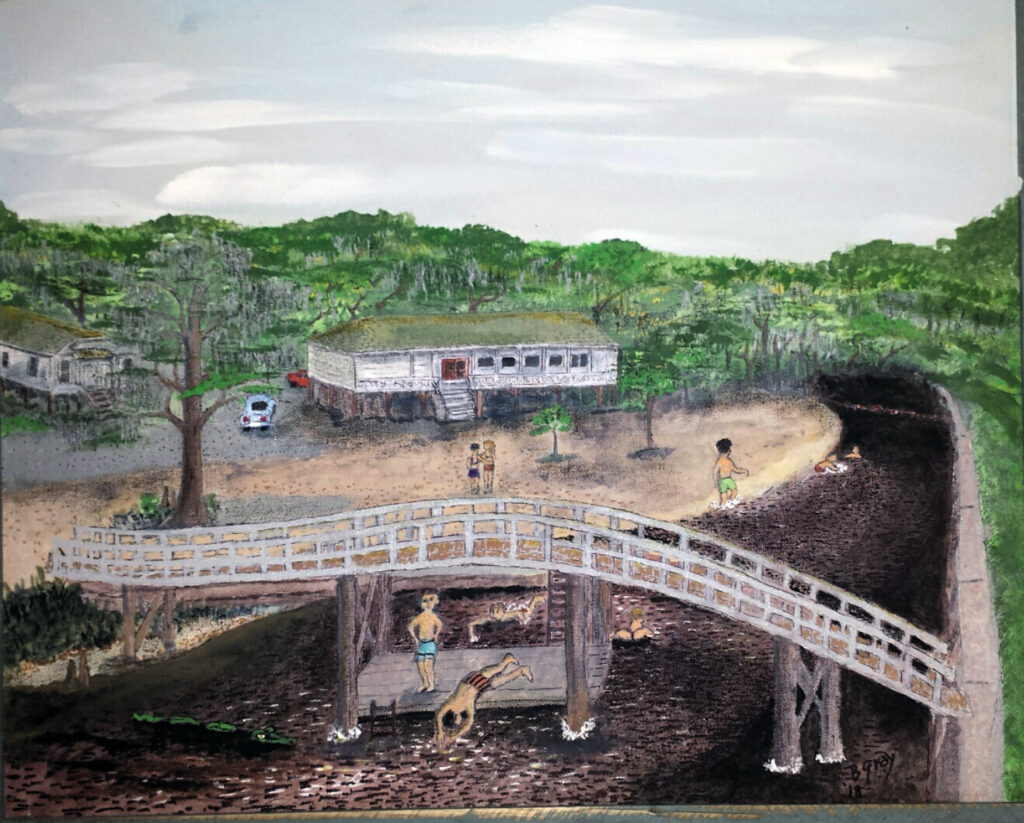
Bill Gray’s painting of McMillan’s Beach

Cashwell wrote on August 4, 1971 about swimming during his childhood:

“The only swimming facility was Lumber River where the water was less contaminated than it is today. Many old timers will remember McMillan Beach, Hecks, Rock Bottom, and Cypress in The Middle as being favorite spots where they went swimming. Not many present day Lumbertonians are aware of the fact that approximately 60 years ago, our town for a few years enjoyed a distinction it does not now have, and which few towns had at that time. The distinction came when our town commissioners about 1911, made provision for a municipally owned and operated swimming pool by the conversion of an existing reservoir of cement construction and possibly 20 by 30 feet in size for use as a pool. It was a part of the light and water plant then operated by the town and was located at the site of the present water plant at a point about due west of the dead end of West 6th Street. Its water supply was raw water pumped from the river by steam operated pumps. It had a roof, probably to keep leaves from nearby trees from falling into it, and the side walls above the cement were louvered to keep out the leaves and to give privacy to the bathers. A narrow wooden platform was provided around the edges of the pool and a dressing room was constructed.

“My recollection which is shared by several people who were then youngsters, is that the pool was provided for girls only. The girls wore the flowing bathing suits of that day which contained so much cloth, it must have been different to swim in them.

“Boys had a choice of several places where they went swimming in the river in the nude, by shedding their clothes on the river bank. Often when after a swim, they prepared to dress, they found that some of their devilish companions had tied their clothes into knots.

“Abi’s cove, several hundred yards below the railroad bridge, and the upper sand bar, now known as McMillan’s beach were used mostly by beginners and non-swimmers as the sand bars provided shallow water. “Rock Bottom,” which was located near the present junction of Jenkins Street and Riverside Drive was comparatively deep and was used by those who were good swimmers.

“Heck’s Swimming Hole,” located further up the river at a point near the old Goat Club, or the Mrs. S.S. Small residence was another favorite place used by swimmers desiring deep water. These places provided privacy for the nude bathers, as the area between the Carthage Road and the river was an undeveloped open field and woodland.”

The Charlotte Observer’s August 12, 1916, edition communicated that the Maxton Beach on the Lumber River for weeks had been victim to North Carolina’s Great Flood of 1916. The Observer reported that when the flood waters began to subside, “Once again young people will be having daily picnics on its banks, others will be swimming. Some will just be enjoying the refreshing coolness of the beautiful clear water stream and sandy bottom. Sportsmen will be coming out with canoes and spend months fishing in the waters full of trout, bream, red breast and jackfish abound.”

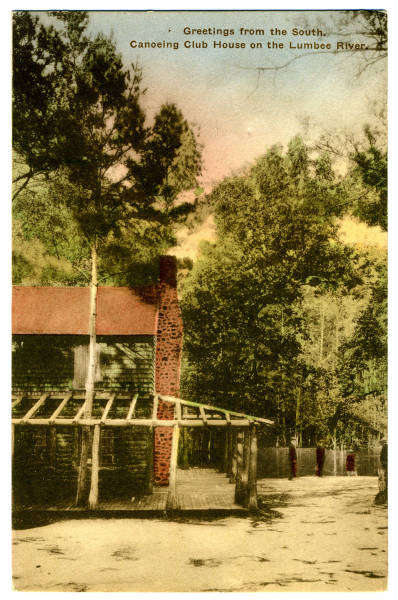
Postcard of the Canoeing Club House on Lumbee River

Jennings’ and McMillan’s Beach

The first mention of Jennings’ Beach that I found was in the May 20, 1917, issue of the Wilmington Morning Star in which the writer tells about accompanying G.E. Rancke, Jr., to Jennings Beach located 2 miles west of Lumberton on the Lumber River. It was managed by his father G.E. Rancke, Sr., who advertised it as “the pleasures of the seaside at home.”

Rancke advertised in 1918 that he had adult and children bathing suits for rent as well as candies for sale. That year, he also offered to donate half of the proceeds of the busiest day during the next three weeks to the Red Cross. In 1921, he was alone at the beach when he became sick and knew that the only way he could get to town was to lay in a boat and let it float to downtown. He was 86 at the time. In 1922, E.L. Whaley and John G. Proctor, Jr., swam the 3 miles from the beach to the Sixth Street Bridge in an hour and 10 minutes.

The July 6, 1933, Robesonian told that Jennings’ Beach was renamed McMillan’s Beach. In 1934, there was an advertisement for the site stating the charges for the season. The cost for admission was ten cents. If you planned to use the bathhouse, the cost increased to fifteen cents.  For twenty-five cents, you got admission, the use of the bathhouse, and the rental of a wool bathing suit. The ad also talked about season passes being available and that the site was well lighted for night swimming. The manager of the property at that time was Frank A. Wishart.

Over time, improvements were made to the site, including adding a playground and recreation building. The building housed a juke box and was used for dances and roller skating. The building was destroyed by fire in October 1967, and the entire site was closed around 1978.

In June 2000, Lula Williams gathered memories of McMillan’s Beach for an article for “Robeson Remembers,” a writing project of the Robeson County History Museum.

Williams said, “McMillan’s Beach was a landmark in Lumberton for several generations—in fact, it was the only place to swim and where most youngun’s learned how to swim from before the turn of the century to the ‘50s it had a dance pavilion and was a popular place for dates to go to dance to the jukebox fed by many nickels.  Then and earlier, there was a bathhouse where one could rent a basket to store clothes while swimming and a canteen where all kinds of snacks, soft drinks, ice cream and other goodies were available.

“Crossing the river at the upper end of the beach was a bridge with a platform underneath and a ladder going down from the bridge to the platform.  Erwin Williams Jr. remembered that you could dive from the platform or if you were really brave, you could dive from the bridge, but you had better have made sure that the river wasn’t low or the water wouldn’t be deep enough!

“The Boone family lived in the turn of the road just before you got to the beach.  That’s why the part of the water with the deep water just above the main beach was called “Little Boone.”  There was a huge tree on the far side of the river that had a long rope hanging down from the upper limbs and daredevils used to climb up and swing across the river on the rope and drop down into the deep black water.  Great fun!”

Frances Caldwell Dietzel loves to tell the following story about a happening on the Lumber River a little further downriver from McMillan’s Beach:  “It seems that years ago it snowed in Lumberton and the only hill around was in the back of Frances’ house on Caldwell Street.  A number of the then-younger set gathered there to slide down the hill in the snow—two of the group had real sleds and everybody took turns.  One named James McLeod (better known as “Bummy”) didn’t make the turn at the bottom of the hill in time and ended up in the river—clothes and all!  He says that there was ice right at the edge of the bank!  He had on big boots and a heavy coat and when he managed to get out of the river, his pants were frozen solid in under one minute!

“The group took Bummy into the house to dry off in the bathroom in front of an old-time round oil heater with the wick in the bottom—remember?  He borrowed a pair of Mr. Mike’s long johns while he waited for Bobby Lewis to run down three blocks to Bummy’s house on Chestnut Street to get him some dry clothes.  “Don’t think Bummy has ever lived this one down!  In truth, it’s probably a miracle he made it out of the river at all.

“Some others in the group were Sim Caldwell and Torry and Kenneth McLean.  Kenneth remembers a really big snow in March of 1927 that was six inches deep with ice.  He says everything in Lumberton came to a screeching halt except for kids playing in the snow and being pulled down Main Street behind Mr. John Fuller’s early model car!  Kenneth and Bummy think the close call Bummy had was a few years later than this.”

Jackie Oliver Utz recalls that Bunk Stone and her brother, John Hal Oliver, once caught an injured small alligator in Lumber River and brought him home.  “They said the alligator had been shot.  “He stayed in the dog house until my mother and I couldn’t stand it anymore!  I was afraid to go out the back door.”

Jackie continues, “Bunk, John Hal, Clarence Townsend and Stanley Meares spent many hours in small rowboats wandering up and down the river.  Often, they found sharks’ teeth and seashells along the banks when the river was low. 

“It’s hard to believe when you see the river today, but my friend, Kitty Edens, and her cousin, David Edens, swam down the river from McMillan’s Beach to the area now known as Stephens Park.  That was a dangerous and daring thing to do.  A crowd of us anxiously awaited their arrival at the end.”

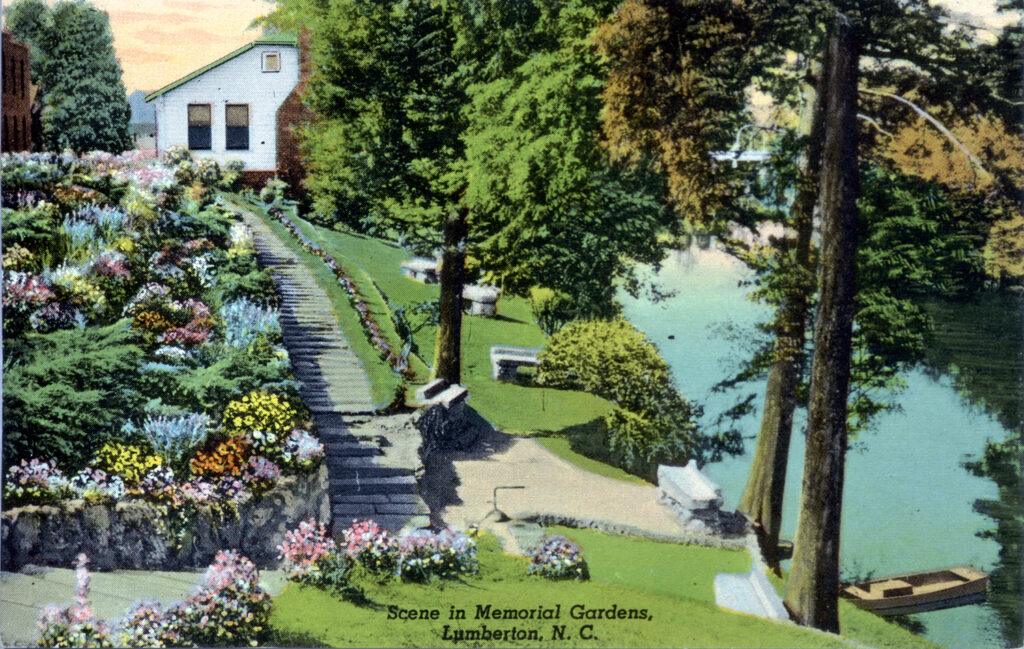
The downtown Lumberton riverside garden designed by Baker and Biggs


Riverside Garden

Mrs. Annie Caldwell Baker, wife of Dr. Horace Baker, Sr., had two great loves that were instilled in her by her mother, Dovie Carlyle Caldwell:  flowers and downtown Lumberton. Mrs. Caldwell establish a sunken garden at her home on the corner of Elm Street and Elizabethtown Road. Mrs. Baker continued to nourish the garden, which was the talk of downtown Lumberton

Her own garden was not the only place Mrs. Baker planted and cared for flowers. An article in the April 3, 1939, issue of The Robesonian announced that Mrs. Baker and her good friend, Kate Britt Biggs, were to serve as supervisors of the riverside beautification project. The project established a garden along the banks of the river between the Fifth Street bridge and the American Legion building. The labor for the project was provided by the Works Progress Administration, a New Deal program established by President Franklin D. Roosevelt to provide replacement jobs for those out of work due to the Great Depression. Mrs. Biggs stated, “We want anything from privet hedges to petunias.” The gardens served not only as a wonderful setting for a picnic, but as a place for those working downtown to get away from their busy work day to sit for a few minutes by the dark waters of the river surrounded by beauty. Sadly, nothing of the old garden survives except faded postcards.

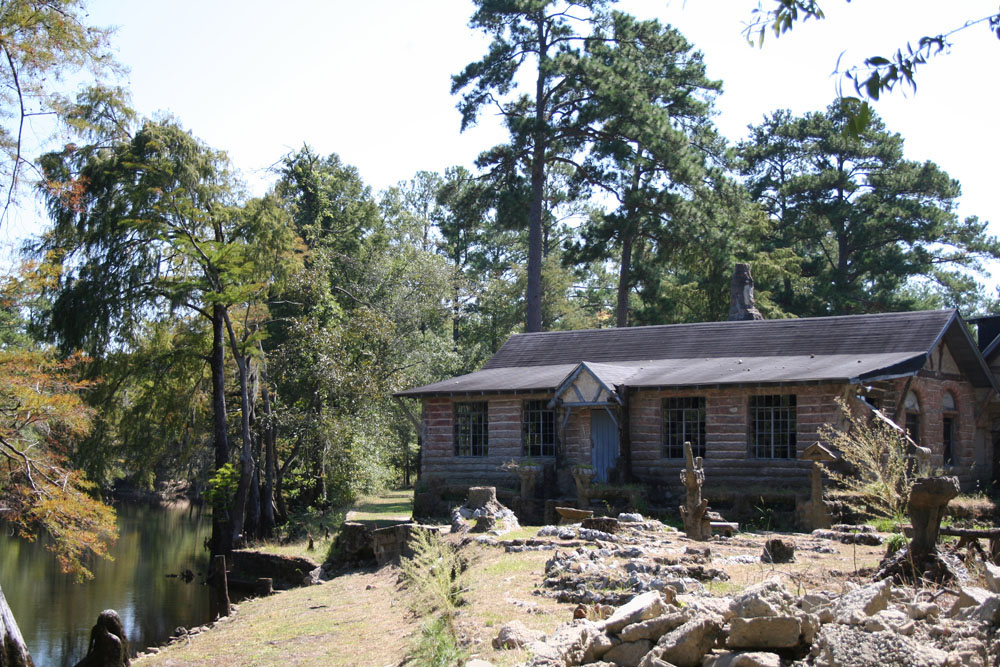
The McLean Castle is literally feet from the dark waters of the river.

McLean Castle

Mrs. Margaret French McLean, widow of former North Carolina Governor Angus Wilton McLean, in the late 1930s desired a place where she could entertain in a more casual atmosphere. Her Lumberton home on Chestnut Street known as Duart House was a very formal home. Her answer was to build a home on an eight-acre tract along the Lumber River that was once part of the National Cotton Mill property in West Lumberton. She chose German-born stone mason Christian Meyer, who came to America in 1905 and became naturalized in 1929. In October 1939, he arrived in Lumberton and worked at the St. Frances de Sale Catholic Church building a retaining wall along the Fifth Street side of the property. The wall was concrete and built to look like logs. It served as a flowerbox. He married Janie Edmund, daughter of Ellen Tyson and William O. Edmund. He was 50 at the time he married 29-year-old Janie, a waitress at Carolina Café. The couple lived with her mother and siblings on Old Whiteville Road.

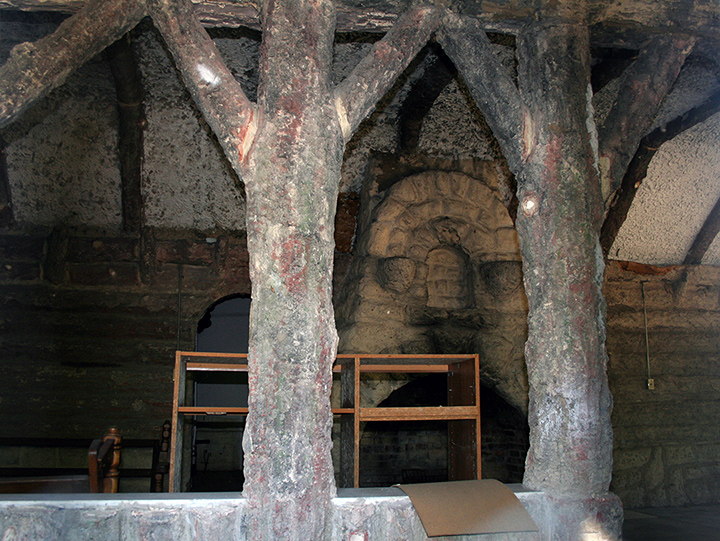
Meyer then began work on what has become known as “McLean Castle”. The home has the appearance of a Bavarian mountain home but was constructed completely of cast concrete. The home was built directly on the edge of the river bank with windows overlooking not only the dark waters but also out into the gardens of the property. The inside of the house carried out the same log design as the outside. The partial wall that separated the main living area of the house featured concrete trees with the appearance that their upstretched branches were holding up the roof. The room also featured a large fireplace. Meyer’s design for the grounds included a maid’s quarters behind the main house and a gazebo. There were small canals dug throughout the gardens to let water flow under the oyster shell and concrete bridge. He also designed concrete planters that looked like tree stumps and an old fashioned covered wishing well.

Things were not always good for this German immigrant as the sentiments around the world turned against Germany after its invasion of Poland. The July 10, 1940, issue of The Robesonian reported that rumors that were spreading all over Lumberton about Meyer. They included that he had been spirited away to Fort Bragg and forced to reveal his possession of extensive maps of Lumberton and Fort Bragg, leading people to think that he was a German spy and was studying where the area might be vulnerable. Fort Bragg officials, as well as Meyer’s co-workers, all proclaimed the rumors as false.

The concrete trees inside the McLean Castle.

The McLean family used the castle property for many years to entertain and Mrs. McLean’s oldest son Wilton actually lived in the home for a while. Her son, Hector, used the property to host parties for his employees at the Southern National Bank before the river side retreat was sold outside the family. The current owner, John Cox, grew up near the castle and his family farmed near McMillan’s Beach. He is working on preserving this unique Robeson County landmark.

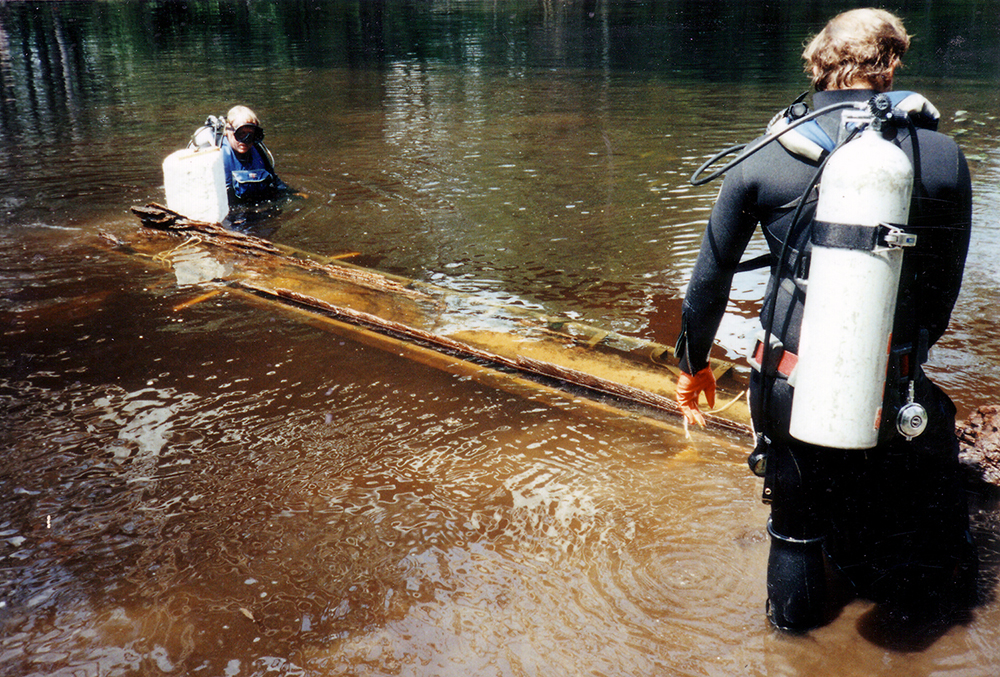
The divers bring the canoe from the river.

River Secrets

In 2000, Paul Valenti, a local scuba diver and historian, said “The murky water of the Lumber River hides more than catfish and eels.  In certain sections of the river—in low water conditions—fossilized remains from prehistoric mammals and sharks, along with a wide variety of other sea life, can be found exposed along its banks.  These remains date back to the Miocene epoch period around 5 to 10 million years ago when the region was covered by the ocean.

“One area in particular (around Stephens Park) contains some of these fossilized remains, along with the remnants of a grist mill owned by German immigrants named Wessel.  This mill operated in the 1800s.  The mill was in the bend of the river to harness some of the power of the river.  In extremely low water conditions some of the holes for the pilings are exposed. While diving in the area, a few bottles and some broken china was found.

“In May 1985 the Lumber River revealed one of its greatest secrets – a canoe dating back to 930 A.D. The 16.6-foot canoe made from yellow pine was pulled from the dark river waters near McNeill’s Bridge. The canoe was burned and scraped by Native Americans of the area to be used for transportation along the river.

“I was actually diving in search of other objects and I really wasn’t sure just what it was. it was wedged up against some trees and other debris, so it wasn’t easy to recognize. He decided it was an Indian artifact and marked the area so that he could bring archaeologist back to examine the canoe.”

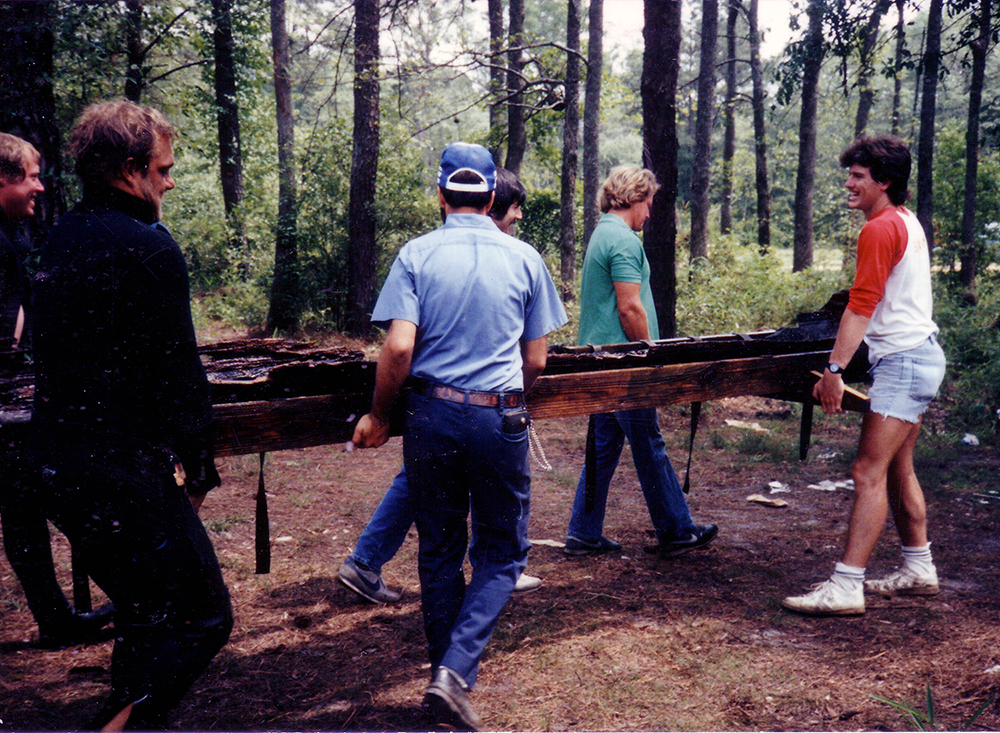
A group of volunteers help carry the canoe to the waiting trailer.

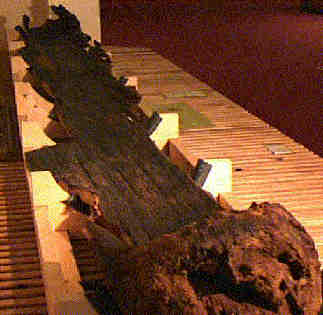
The North Carolina Department of Cultural Resources confirmed that the canoe was the oldest found in the state, dating back hundreds of years before the 1700s Lake Waccamaw canoe that had been the oldest one on record. The canoe has been preserved and is housed at the Native America Resource Center at the University of North Carolina at Pembroke.

Dr. Linda Oxendine, former Chair of the American Indian Studies department and Director of the Native America Resource Center at the UNCP, told me that the men transporting the canoe to be restored told her, “As we drove the trailer out of the boundaries of Robeson County, bits of the canoe started flying off like it didn’t want to leave its home.”

Preserved canoe at the Museum of the Southeast American Indian

I urge you to take time to paddle a canoe on the dark waters, grab a pole and fish from the tree-lined banks or just sit and drink in the beauty and peacefulness of the Lumber River and its surroundings.

Writer’s notes: I drew much of the information for this article from vintage newspapers.

The Winds of Hurricane Hazel Brought Destruction and Death

Posted on August 13, 2024August 14, 2024 by blaketyner

Hurricanes have always plagued the coast of the Carolinas even before the first successful English settlement. In Jay Barnes’s book North Carolina’s Hurricane History, we find that in 1526 Lucas de Ayllón led a large Spanish expedition in search of gold along the Cape Fear. It is believed that the ship was wrecked near Bald Head Island due to a “loathsome gale.”

Roanoke Hurricane

One of the earliest detailed recollections of a hurricane comes from Sir Walter Raleigh’s Roanoke Island Colony. Raleigh had first tried to establish a colony on the island in 1584 but the lack of proper provisions and problems with the local Indian tribe caused them to return to England. In early 1585 a group of 106 arrived at the island with the intention of establishing a military post under the command of Colonial Governor Ralph. They were soon facing the same challenges as the first expedition – lack of sufficient supplies and bad relations with the local tribe. This time things escalated, and they took Menatonon, king of the Chowanoac Indian tribe as a prisoner but he released after three days. One of the settlers killed an Indian named Wingina who was believed to be plotting to destroy the colony and this led to open war of the tribe. In June 1586 Sir Francis Drake arrived in Roanoke from St. Augustine. Drake left England on September 14, 1584 with 25 ships and 2,300 men to attack the Spanish colonies along the east coast of North America.

Drake found the colony struggling due to the lack of provisions and the war with the Indians. He offered to give them supplies and to take the unwell colonists back to England. He also agreed to leave the Francis, a three-mast ship, along with two smaller ships and four boats for Lane and his men. While Lane was aboard Drake’s ship to making arrangements, a terrible storm came ashore. Lane wrote “while these things were in hand there arose a storm that continued four days. The storm would have driven all Drakes ships onto shore, if the Lord had not held his holy hand over them.”

The Francis along with other ships were destroyed by the hurricane. This proved to be the final straw for Lane and the discouraged colonists. The abandoned the New World and returned to England with Drake. In Lane’s haste he left behind three of his men that were exploring the up-country. Lane was criticized for abandoning the colony especially since Sir Richard Grenville’s relief squadron arrived with supplies shortly after Lane left for England. The next year Drake encountered another hurricane near Roanoke Island. He rode it out at sea for six days.

Hurricane Miami

September 17, 1926 the hurricane Miami, the most destructive to ever strike the United States, hit Florida. Rowland native Charles Wyatt Adams, son of Salathiel LeGette Adams and wife Virginia, died September 22nd of injuries suffered during the hurricane. He lived in Florida for six years working as a druggist. He was married to the former Margaret Mawhinney a Pennsylvania native. They had two daughters, Jean two and a half and Barbara only three days old at the time of the storm.

Their home held strong during the first wave of the storm with only the windows being broken. He wrapped his wife and Barbara in blankets to protect them from the rain. In the morning the much worse second wave hit lifting the house from its foundations. The house was a half block before breaking apart and a portion was carried another half block. Mrs. Adams and the baby were found in the first part of the house covered in debris. She suffered minor injuries while Barbara escaped without a scratch.

Adams was struck by a piece of timber above the eyes and it peeled his scalp back to the top of his head fracturing this skull in three places. He also suffered a broken leg and hip. He was holding Jean in his arms when the house was hit. He was found four hours after the storm ended. Jean was found floating the three feet of water about thirty minutes after her father was found. She was not identified until Monday by family friends. She had been passed house to house due to the scarcity of food and it was believed both of her parents had perished.  There were also two other women in the house at the time of the storm. Once was killed while the other suffered a broken leg. Adams friend and Rowland native, D.P. McKinnon, who then living in Miami began searching for the Adams family as soon as the storm ended. He did all he could to help the family in the next days. Charles Wyatt Adams was brought back to Rowland and buried in the town cemetery.

Hurricane of 1944

On August 1, 1944, a category one hurricane hit Southport, south of Wilmington, with eighty mile an hour wind. Thirty-foot waves hit Carolina Beach destroying the boardwalk and many beach homes. Several Lumberton residents were at Wrightsville Beach when the storm hit causing severe damage and making it necessary for thousands to evacuate. Those forced to leave the beach for Wilmington included Mrs. Dickson McLean and her sons, Dickson, Jr and Bill, along with her sister, Miss Frances Sartor; Mr. and Mrs. O.L. Henry and son, Everett; as well as Mrs. Mary Patterson Johnson and sons, James, Gilbert and Hervey. All of the Lumbertonians were reported as safe form the storm. Robeson County fared well during the storm with a rainfall of 2.55 inches.

County Damages

On the evening of Thursday, November 14, 1954 heavy rains began in the county with the full force of the storm sweeping in around 10:30 Friday morning and the height of the storm lasted about an hour. Winds increased from 15 miles per hour to 45 mph before 10:30 and soon after gusts were as high as 85 mph. Most Lumberton streets were flooded and covered in debris from downed trees. Men turned out to assist the street crews in removing downed trees covering the roads. Thad Ellerbe showed up with several chain saws.

The most common tree that fell in the county was the Chinaberry tree which has extremely shallow roots. The driveway of my great-grandparents home in St. Pauls was lined with the trees and all of them came down during the storm. Most everyone remembers Chinaberry trees in their or neighbors’ yards falling. Julia Atkinson watching from her back yard as one fell on an empty lot at the corner of West 17th Street and McMillan Avenue while Dwight Morgan watched their three fell from his bedroom window. Frances Phillips was seven at the time but remembers the storm taking out their tree and since then only remembers seeing one Chinaberry tree in the area. Joe Herring remembers playing on the big China Berry tree that Hazel blew down in their back yard.

During the storm the Civil Defense was called out to assist the police and direct traffic until the power was restore. David Lennon remembers that his dad, Duval Lennon, the Civil Defense director for Lumberton so was away from home during and after the storm. His family was all hunkered down in the central hallway of their home while his dad rode around town monitoring the damage. 

The damages cause by Hurricane Hazel were felt all over Robeson County with Lumberton, Fairmont and St. Pauls reported heavy wind damage. The October 18, 1954 issue of The Robesonian reported that south Lumberton suffered less damage than most of Lumberton. An unnamed resident told the reporter “this is one time I’m glad to live in the bottoms.” The bottoms were an area located on the Lumber River past the railroad tracks on South Elm Street.

Farm damages consisted of roofs torn off or the complete destruction of the buildings. Crops suffered especially the cotton fields.

The school buildings at Barnsville suffered the loss of roofs. Fairmont reported plate glass windows being blown out of the Rawls Chevrolet Company and the J.L. Pontiac Company. While roofs were damaged or blown off of Campbell’s Men’s Store, Fairmont Drug Co., Capital Beauty Shop and Fairmont bakery. As well as downed trees blocking around ten streets. Rowland reported building damages as well as lots of downed trees like most of the county.

A week after the hurricane there were already an estimated 2,000 insurance claims filed in Lumberton alone.

Mrs. Boyd Mincey was transporting several schoolgirls home during the storm when she became trapped on the corner of Grace and First Streets by power lines landing in front and behind her car. Elston Morgan seeing their plight and armed with a broom took a great risk pushing the downed lines away so she could move. A school bus in the Long Branch area was blocked when falling trees fell in front and behind. There were eventually moved, and the bus continued its journey.

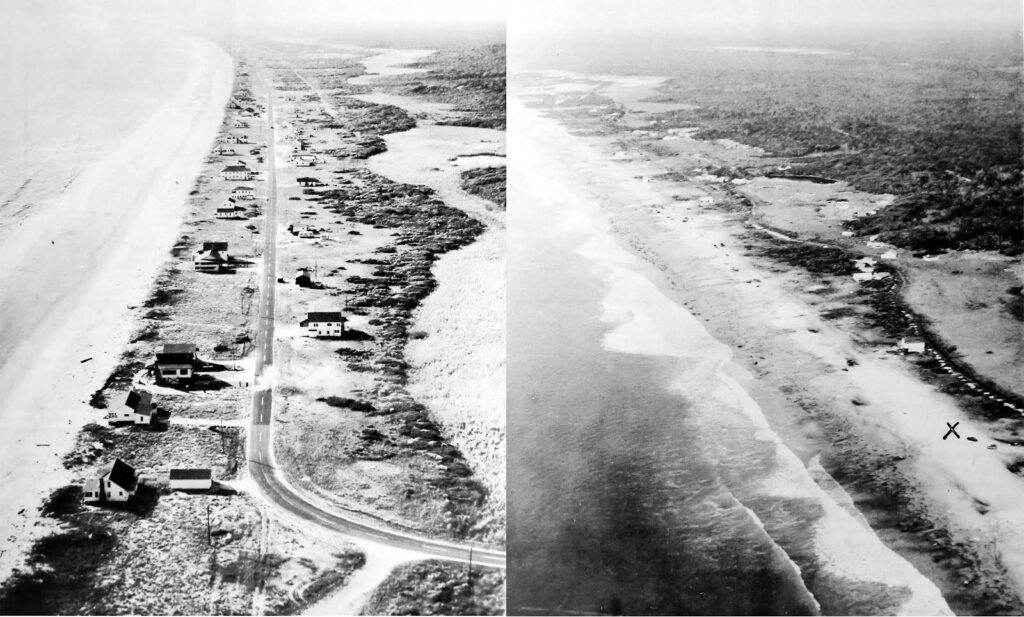
Long Beach on Oak Island, NC before and after Hurricane Hazel. Only 5 buildings remained out of the 357 buildings that existed before the hurricane.

Beach properties were hit hard with many and their contents being lost completely. Dr. George Allen only salvaged a refrigerator and two mattresses from his Holden Beach home while the banked sand at the front of John Bateman’s Carolina Beach home was around 12 feet since he could step from the bank directly onto the porch roof. Frank Morrison that left Holden Beach during the storm headed to Lumberton reported seeing the beach homes of Pete Skinner, Dr. George Allen, Johnny and Eddie McNeill as well as Zeke Stanton sweet away by the waves along with the beach pavilion. Also, at the beach were Dr. Irvin Biggs and Jack Pait who was with a fishing party. Heading toward the beach during the storm were Highway patrolman Fred Bowen, C.H. Long and J.S. Jones. During the afternoon the National Guard was called out to protect what was left of Long Beach from looters. Only five buildings remained on the beach out of the 357 buildings that existed before the hurricane. Lee Ward’s grandfather, Joseph C Ward, Sr., lived in Rowland and had a beach house in Garden City on the front row beside pier. Hazel left it an empty lot.

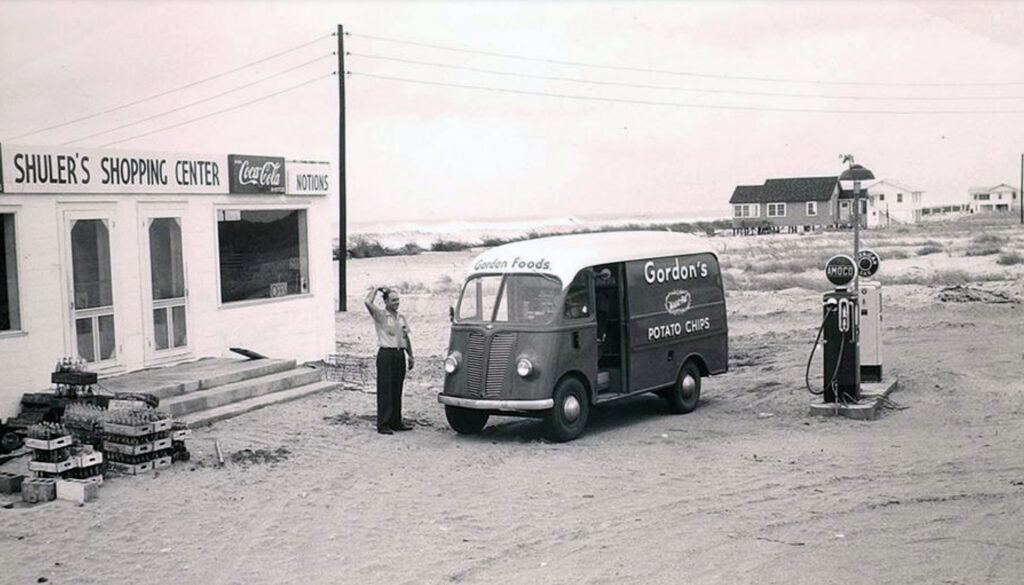
Wilmington delivery man D.G. Parisi scratches his head as he arrives for a food delivery to Shuler’s Shopping Center on Long Beach following the strike of Hurricane Hazel. Courtesy Starnews
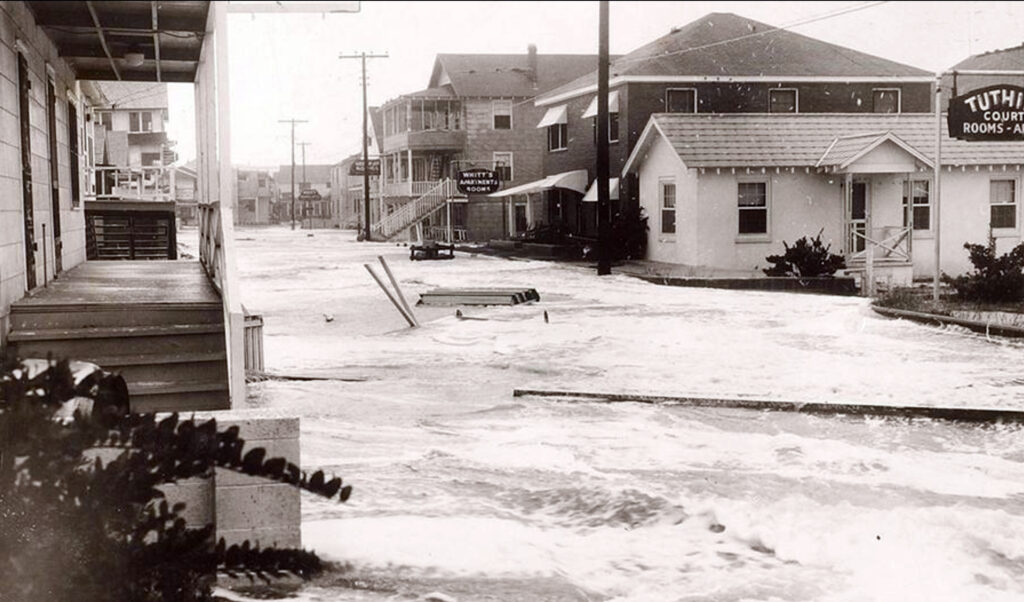
Surf spills over the roads at Carolina Beach during Hurricane Hazel. Courtesy Starnews

Ann Bellamy Russell was just two 2 years and 2 months old and living on Wrightsville Beach Road. Her daddy delivered milk for Sealtest in Wilmington. She vividly remembers lying on my parents’ bed with my mother and watching ocean water swirl in the front yard. They didn’t know where her daddy was or if he was safe. The pine trees were whipping and breaking. She can smell the seawater and hear the trees to this day.

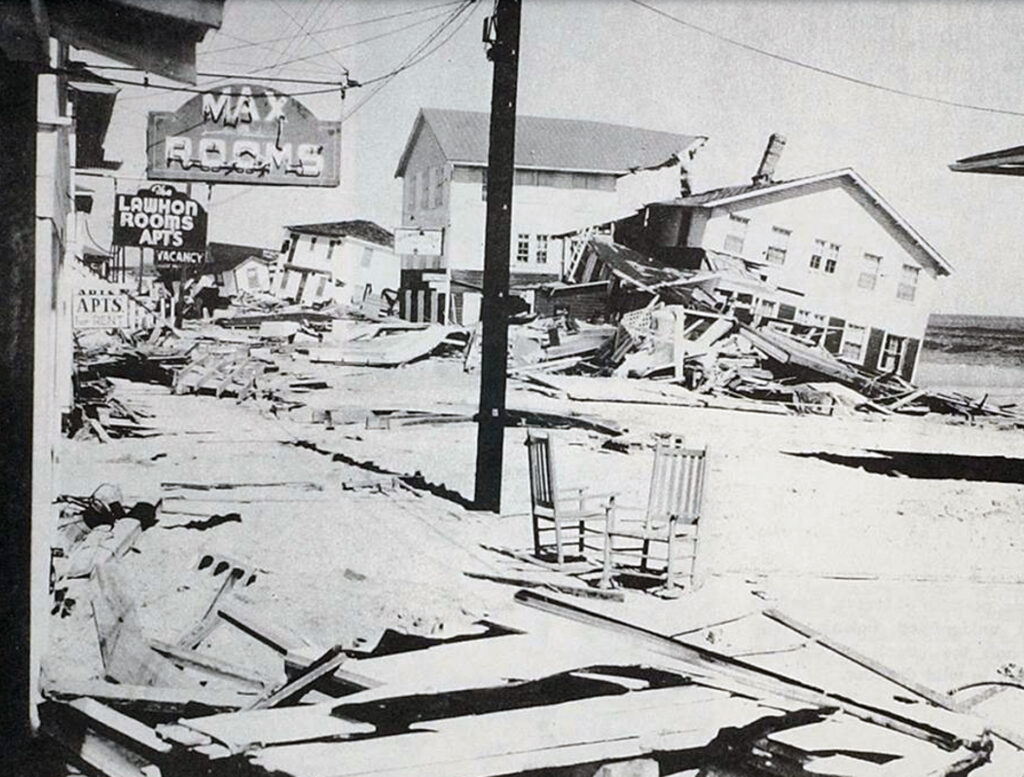
A sample of the destruction at Carolina Beach following the strike of Hurricane Hazel. Courtesy Starnews

Personal Memories

Billie Jo Faircloth Driggers was riding to Pembroke and saw a little girl crying because it was cold, and she had no coat. Billie Jo started crying wanting to give her the coat she was wearing but there was no way it would have fit her, and it was the only one she owned.

Linda Carol Whitney’s daddy, uncle and grandpa were at the Star Tobacco Warehouse in Lumberton when the roof was ripped off. While her mama, granny and aunt were home with the kids grading tobacco.

Ann Grice, a second-grade student at Orrum Elementary, was on the school bus that became surrounded by downed trees. All around were trees down on cars and houses. Grown men were crying as they reached the bus door to retrieve their children. She and her sister tried running down the dirt road to home only to be blown backwards. They stayed under barn shelter until their daddy came with car to pick them up. It was a never that no one will forget!!!

Most of the schools let out early and leaving most children to walk home. Sally Caldwell Gibson’s neighbor picked her up. On the drive the pine trees were bending over half way to the ground. Patsy Marquette remembers walking home and being so excited because of the wind blowing and trees bending. Her mom made them go straight into the house when they arrived, and it made Patsy so mad.

Seven-year-old Joyce Joyner was taking care of her brother and three sisters while her parents went to the pack house to secure everything and close the windows. While they were gone the front door keep blowing open and she didn’t know what to do, being the oldest she was in charge. She finally decided to put a suitcase against the door and sit on it. She held her three- and half-month-old sister while the other children sat with her. It held until her daddy got home and he had nailed the door shut. She says, “I am sure God was looking out for us.”

Wanda McDaniel Groce recalled the wind and rain but even more the terrified look on her mother’s face when trees began to fall. She watched her two white ducks being carried away by the wind. They were not flapping their wings. When the eye passed people emerged from their hiding places to survey the damage. Then the wind began to howl again. People thought the storm had turned around and was coming back. Meteorology was in its infancy then and we were unaware of this hurricane’s anatomy. The ducks survived minus a few feathers. And for years afterwards I watched trees lying in the woods decay slowly. A reminder of Hazel’s wrath that awful day when she was a child.

Kellen Byrd’s dad was fishing at Black River without a radio and did not know the weather forecast. He had to cut himself out of the woods with a chain saw. His family was so happy to see him alive.

Patsy Hester was at home alone because she couldn’t get to work due to the storm. She was scared to death. She mopped and waxed all the floors trying to calm down. To this day she is still afraid of storms.

Dick Holmes remembers that after the storm was over his dad took the family to the New Deal Café to eat. It was located in downtown Lumberton behind Sugar’s men’s store on 4th Street. Constantinos Peatros Loizou, better known as Gus, was cooking with gas and had lanterns and candles to light the place.

The Storm Brings Injury and Death

Several citizens were treated for injuries including Alfred Hodge who received damaged to his shoulder and chest when his house blew down around him. A tree landing on Bobby Little caused injuries to his elbow and knee. Rudolph Mears was injured while traveling on Highway 211. He was trying to dodge a dead dog on the road and his car struck a downed tree.

Daryl Thomson recalls his sister, Mary Jane, was outside with Mama getting clothes off the line when the six-foot board fence in our yard was blown down on top of her and she was taken to the new Hospital behind our house on 24th street with a concussion.

Ann McRainey Taylor remembers that on her father’s farm north of St. Pauls that one-month old Josie Ann Bullard was killed. She was the daughter of Lemoner Bullard and Esther Mae McCrowie. She and her mother were lying in bed when the storm blew a large tree on to the house. The father had been outside trying to board up windows that has been blown out.

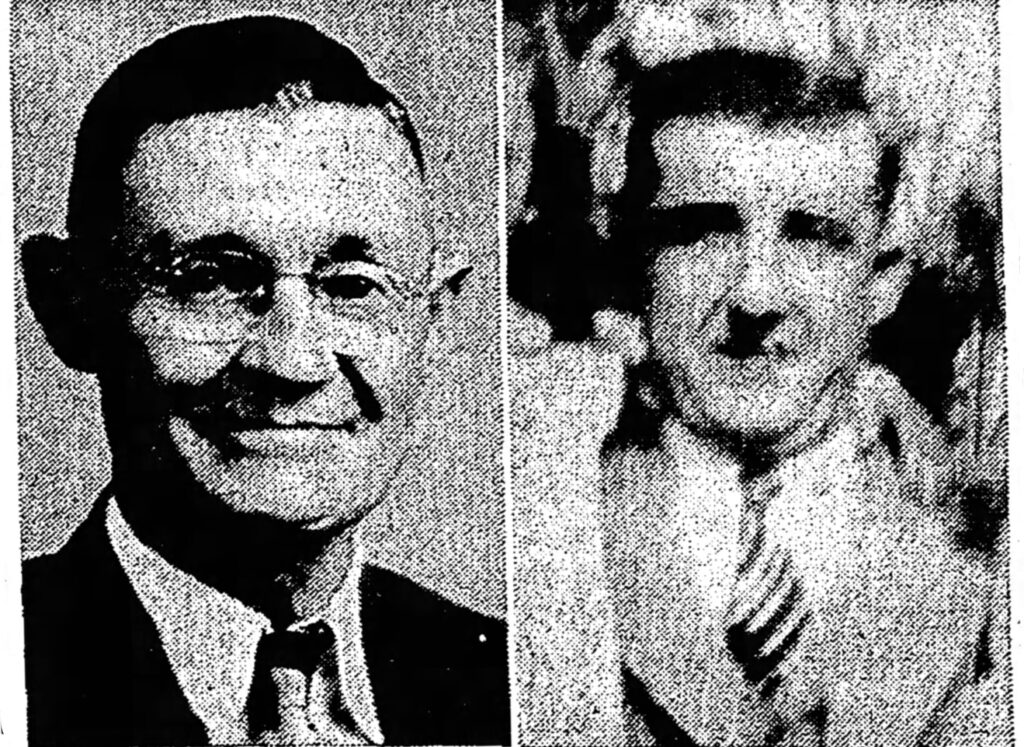
Dougald B. Todd (left) and Shelton W. Bullard were killed at Long Beach as a result of the Hazel. Courtesy The Robesonian

Two Lumberton men, Dougald Bertrum Todd, Sr. and Shelton Wardell Bullard, went to the coast to check on Bullard’s Long Beach property when Hazel hit the Carolina shores. They were last seen in Southport but must have later gone to Long Beach. Todd was found soon after the storm, but Bullard remained missing for over two weeks. Bullard was found in a wooded area of Lockwood Folly a mile south of Long Beach by a group of children.

Todd, the son of Benjamin Columbus Todd and Martha Jane Pittman, was a furniture salesman. He was survived by his widow, the former Martha Viola Scott; three sons Dougald, Jr, William and Eartle; two daughters, Emma Todd Rinaldi and Betty Todd Mclean.

Todd’s daughter, Betty, remembers going to the beach with her brothers, Dougald and Ertle Todd.  The National Guard allowed them on to the beach. They walked down the beach to where they thought her daddy was killed. There was only one house left on strand and looking back from the waterway she could see houses up in trees. They looked like they had been placed there.  There were foundations of houses were left, appliances were in trees and furniture littering lots. The first paved road was completely washed away.

Her father was found with his pants rolled up and the ignition was turned on in his truck.  Betty was a senior in high school, but they were not released early from school.  Principal did not think it was going to be bad.  They had to sit in auditorium until the highway patrol released them. “It was really bad, flooded and at my mother’s house all of the trees were down in the yard. You just had to see it to believe it.”

Bullard, the son of Elmore Bullard and Roxie Campbell. was associated with his brother, L.S. Bullard, at Bullard Motor Company. He left behind his widow, the former Bessie Lee Worley, and a daughter Joan. Lea Thompson, granddaughter of Shelton’s cousin Les Bullard was at remembers being at the Bullard house when someone from the Sheriff’s office came to inform the family that Shelton has been found. Twenty-two years later Mrs. Bullard drowned while visiting Long Beach.

A year after Shelton Bullard’s death in the October 14, 1955 issue appeared the following remembrance:

In remembrance of our son
and brother, Shelton Bullard, who was

lost in Hurricane Hazel on October 15, 1954.

HIS MOTHER AND SISTERS

One year has passed since you left us
Sad was the shock of that day
You bade no one a last farewell
A last goodbye you could not say

Quick and sudden was the call
Your sudden death surprised us all
The shock was great, the blow severe
We little thought your death so near

Every day brings sad memories
Every memory brings a tear
Deep within our hearts we carry
Thoughts of one we love so dear

Gone is the face we loved so dear
Silent is the voice we love to hear
“Tis sad but true, we wonder why

So quickly and suddenly you had to die

What happy days we once enjoyed

When we were all together

But oh, how changed it all is now

Since you have gone forever

The depth of sorrow we cannot tell

Of the loss of one we loved so well

And while he sleeps a peaceful sleep

His memory we shall always keep

Memories are treasures none can steal

Death leaves a wound none can heal

They live with us in memory still

Not just today, but always will

You are gone, but not forgotten

Never will your memory fade

Loving thoughts will ever linger

‘Round the grave where you are load

Eternal rest grant unto him, O Lord

And let perpetual light shine upon him

May his soul rest in peace,

Amen

Justice Thurgood Marshall

During Hurricane Hazel the 11th annual convention of the North Carolina National Association for the Advancement of Colored People (NAACP) was being held in Lumberton. Over a three-day period 250 delegates met at the South Lumberton First Baptist Church and Sandy Grove Baptist Church. The guest speaker for Friday night was Supreme Court Justice Thurgood Marshall who at the time was director and legal counsel for NCCAP New York City. The late Angus Boaz Thompson Sr. recalled that Marshall’s plane was late landing because of the storm conditions. The November 11, 1954 issue of Jet Magazine carried a photograph of Marshall in Lumberton with the headline Thurgood Conquers Hurricane. During the Friday night meeting, the hurricane knocked out the power but just like Marshall never let nothing stand in the way of his mission to bring equality to his people he didn’t let the lack of electricity stop him from spreading his message. The church was lite by candlelight as the crowds gathered to hear Marshall.

Much of my research comes from written sources mainly from newspapers like The Robesonian that luckily has been preserved. The first twenty-five years of the paper were destroyed when a downtown Lumberton fire destroyed the newspaper offices. We can only imagine what news was covered during those years that are lost forever. Many of the smaller newspapers in the county are completely lost like “The Maxton Blade” that was owned by African American Robert Russell. Russell’s daughter, Alice, was an actress and the wife of director Oscar Micheaux.

My other main sources for my research come from first-hand accounts often preserved in interviews, letters and diaries. It is so important that these resources that are in the hands of descendants be preserved for future use. If you or family members have these kinds of documents, I urge you to contact me or other local historians to help you make them available to researchers.

CHARLES NORFLEET HUNTER- ROBESON COUNTY EARLY BLACK EDUCATOR

Posted on July 31, 2024July 31, 2024 by blaketyner

{Writer’s Note: Retold from Hunter’s words as found in his book “Negro Life in North Carolina with My Recollections”.}

While doing some research in Duke University’s archives, I stumbled across a mention of Charles Norfleet Hunter’s teaching in Shoe Heel (modern day Maxton).  Pouring over the letters, scrapbooks and newspaper articles in the Charles N. Hunter Collection, I began to discover the important role that Hunter played in the early education of African Americans in North Carolina.

Early Life and Education

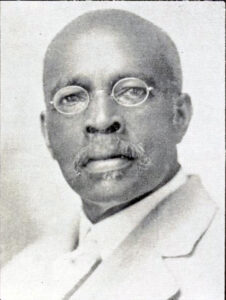
Hunter was born 1851 in Raleigh to slave parents, Osborne Hunter, Sr. and Mary Hunter.  His father, a member of the slave artisan class, was trained as a carpenter, wheelwright and miller.  Osborne was the property of William Dallas Haywood, Mayor of Raleigh before and after the Civil War and Vice President of North Carolina Mutual Life Insurance Company.  Charles’ parents, like many slaves, were not allowed to marry, and in fact his father actually leased his mother from her owner.  The couple maintained a household at the corner of Jones and Dawson streets.

Following his mother’s death when he was four, Charles and his siblings were moved into the Haywood household where his aunt served as nurse to the Haywood children.

Charles Hunter

Charles wrote later in life of his closeness with the Haywood family and how they considered their slaves part of the family and not just human property.  Close relationships between owners and slaves were not unheard of in North Carolina, with examples of such friendships lasting into the 20th century.  Hunter remained close to the Haywoods, often turning to them for assistance and advice.  He credited much of his success to his years spent with their family.  Citing the Biblical words of Ruth to Naomi, “Thy people shall be my people and thy God my God”.

At the end of the Civil War, the free blacks were left to make lives for themselves and their families.  Hunter saw education as a tool to create a new world for the former slaves.  He first pursued his own education and was valedictorian of his class at Raleigh’s Johnson Normal School.  He attended Shaw University for a year.  He was hired while still in his teens as assistant cashier of the Raleigh branch of the Freedman’s Savings and Trust Company.

Hunter the Educator

Hunter learned from Rev. W.W. Morgan that there was an immediate need for a Negro teacher who could pass the examination of the Robeson County School Board.  Several had been tested and failed.  In 1875, the county had only 4 licensed Negro teachers.

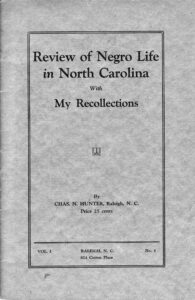
Charles Hunter Book

In Hunter’s book “Negro Life in North Carolina with My Recollections,” he chronicles his fifty years of educational work.  Hunter describes his trip to Shoe Heel and his life in the newly incorporated town.

In December of 1875, Hunter left Raleigh for Shoe Heel by train to Jonesboro and then on to Fayetteville.  In Fayetteville, he met Lumberton resident, Col. Neill Archibald McLean, Sr.  McLean climbed in the coach for Lumberton and the driver told Hunter to sit up top with him.  McLean stated he wanted Hunter to ride inside with him so that they could keep each other warm.  McLean wrapped himself and Hunter in a borrowed blanket to fend off the cold.

The coach traveled 11 miles, then stopping for a change of horses at a shanty.  After the next 11  miles,  it was time for another change of horses, this time at a cottage.  The driver invited McLean in for a cup of coffee.  McLean invited Hunter to join them inside.  Hunter remembers  that McLean drank the coffee while Hunter stood at the fire warming himself.   “0, how I did want just a swallow of that coffee!”    But sadly, it was not to be.

The coach entered the swamps with large trees creating walls around them.  McLean questioned Hunter about his background.  McLean was pleased with Hunter’s connection to the Haywood family, saying they were one of the oldest and best families in the State. “In this opinion I took immense pride for I felt that I shared the compliment which he so generously bestowed.  Negroes in the old days claimed kinship with all the white people who were related to their owner.”

After a 45-minute train ride from Lumberton to Shoe Heel, Hunter was met by railroad porter, Mr. Sam Crump.  Hunter was to make his home with the Crumps for the next three years.

Mrs. Crump was an excellent housekeeper, devout Christian lady and delightful hostess.  Their two daughters, Sallie and Louise, completed the family.  When first seeing the Crump home, Hunter was puzzled about where he was going to stay because the home consisted of only one room and a small shed room.  “I was curious to know where I was to sleep.” At about 9:00 p.m., Mrs. Crump pulled a curtain around one of the beds to screen it and from under the other pulled a trundle bed.

Evenings were spent reading the Bible and singing old hymns.   The Crumps were very religious.  Hunter recalled that  her prayer language was profound, and he was deeply religious but of nervous temperament, highly emotional and impulsive.  “His whole heart went into his petitions.  I have so often wished that every home in our land were such a Bethel as was this one.”

That first Saturday afternoon, Hunter spent time looking over the town.  It had grown out of the swamps with no regular streets and the Carolina Central Railroad passed through the center of town.  The businesses were on the west side of the tracks:  E.L. McCormic, J.C. McCaskill, Dr. Croom’s Drug Store and B.F. McLean and Co.  Hunter also found a number of comfortable private residences, a turpentine distillery, a cooperage and Lewis Lilly’s barbershop.  Drainage ditches four to five feet deep ran along the outer edges of the sidewalks and in wet weather they were nearly full.

Hunter’s school opened on Monday in the Methodist Episcopal Church with a large number of students.  He spoke of the children’s being neatly clad, respectful and well behaved.  After the first month, he returned to Lumberton before the Board of Examiners to draw his salary.  The Board consisted of W.B. Blake, J.A. McAllister and a Mr. McIntyre.  Teacher’s pay rates were based on the level of certificate that the Board awarded.  The certificates ranged from a first-grade certificate with the highest pay rate down to the lowest pay rate for a fifth-grade certificate.

“I held a first grade certificate in Wake although I had never taught.  Imagine my surprise when they awarded me a third grade.  I was disappointed.  I was discouraged.  I would have thrown up the job and left were it not for the fact that I did not have money to get home.”

Hunter did manage to make it home to Shoe Heel.  He then called a meeting of the School Committee and explained the situation.  Mr. Bishop, the white member of the Committee, said, “Hunter, I know you are qualified.  I have visited your school and have seen and heard you work.  We intend to keep you and it is the sense of the Committee that the deficiency in your salary be made up by voluntary contributions.”  After another month, the Board awarded him a second-grade certificate.

Hunter remained in charge of the school for three years.  He talked of his pupils as a fine body of boys and girls:

“I loved them and they gave every evidence of full reciprocation of my affection.  Their parents and community generally gave me hearty cooperation, none of them ever complaining.”

The pupils’ parents often took a day off from work and spent it in the school observing the work and behavior of their children.  This gave parents a deeper sympathy with the teacher and their task.  Hunter made a comment that resonates to this day:

“Would it not be well for parents to do so today the same?  If they would follow the example of those Shoe Heel people is it not possible that much of the friction, discord and antagonism, which are destroying our schools almost everywhere, would be avoided?”

Hunter recalled that during those Shoe Heel years, he never received a single disrespectful look or word from any pupil.  He reported that he “used the rod when necessary and no ugly spirit was ever shown”.

Hunter left Shoe Heel to become principal of the Garfield School in Raleigh.  A testament to Hunter’s teaching ability is the fact that many parents sent their children to Raleigh to continue their studies under him.  When the Shoe Heel children came to Raleigh, it was discovered that while they attended school only four months a year, that they were far advanced over those in Raleigh that attended ten months a year.  Hunter commented, “I could then see what the high standard of scholarship for teachers adopted by the Examiners for Robeson County had done for the children of that county.”

Hunter ends his account of Robeson county life with a very interesting story that has a wonderful life application for us all:

“During my stay in Shoe Heel the surrounding country was very swampy and infested with snakes.  I was awfully afraid of snakes. I was looking for them everywhere. If I heard a rustle in the leaves, I stopped and made an investigation and soon delivered a snake. If I heard a noise in the bushes I examined and found a snake.  I think I saw more snakes than any one in Robeson County.  Well, I was looking for snakes. Other people were not.  I have drawn a lesson from this. It is ever so in life.  If we are looking for the bad we will find it.  If we are looking for the good we will find it.  If we are looking for snakes we will surely find them.”

Hunter worked an additional 47 years in education, teaching in locations such as Oberlin School in Raleigh and the Booker T. Washington School at Wilson’s Mill.  In 1890, he served as the Secretary of the North Carolina Industrial Association and was editor of its “Journal of Industry”.  He also served as editor of the “Raleigh Independent” and “Our Advance”.

Charles Norfleet Hunter died on September 4, 1931, after a 3-month illness.  Hunter was truly a remarkable man, a monument to self-determination and the power of education.

North Carolina and Robeson County In Flight

Posted on July 31, 2024 by blaketyner

There was one thing that connected Lumberton’s Ida Van Smith to Orville and Wilber Wright, and that was the desire to fly – to soar with the birds. From the time Ida was about 3 in 1920, her desire grew as she watched the science of flight unfold after its historic beginning in her North Carolina home.

North Carolina has always felt a sense of pride that the Wright brothers choose the Outer Banks to make their first flight a reality.

Robeson county’s native son, Gov. Angus Wilton McLean, participated in the 25th anniversary of the Wright Brothers’ flight with the unveiling of a 6-foot memorial on Dec. 17, 1928.  The memorial, costing $2,500, was carved to resemble a boulder and was engraved with a fitting inscription:

“The First Successful Flight of an airplane was made from this spot by Orville Wright December 17, 1903 in a machine designed and built by Wilber and Orville Wright.”

McLean, then in the last year of his term as governor of North Carolina, was the keynote speaker for the celebration.  Standing alongside Orville Wright, McLean spoke of how important the event a quarter of a century earlier had been to the citizens of the state:

“The people of North Carolina, for whom I speak today, are by no means unmindful or unappreciative of the honor which has come to them by reason of the events occurring here when Orville and Wilber Wright sought seclusion on this remote island and began the experiments which resulted in giving to mankind a new agency of transportation. “We are happy in the thought that one of these distinguished brothers, Mr. Orville Wright, is present today to witness these exercises, commemorating the courage, the skill and the ingenuity of his brother and himself.  Their achievement has added two names to the long list of great American pioneers.”

Governor McLean shaking hands with Orville Wright

He went on to say, “They ignored the doubting and discouragements of an unbelieving world and demonstrated for the first time that man, like the birds of the air, could construct wings and soar for miles over and above the earth.”

Orville Wright was not the only person of note from the aviation world attending that day.  Standing near the monument was female pilot, Amelia Earhart.  Also present was Senator Hiram Bingham, president of the National Aeronautics Association and a World War I aviator, who had been the proposer of the bill for a Wright memorial in the US Senate.   There were also 200 delegates of the International Civil Aeronautics Conference, including Lord Thompson, former head of the British Air Forces.  Many members of the Wright brothers’ family with representatives from 40 nations were among the other 3,000 on hand that day.

Crowds gather for the 25th anniversary on December 17, 1928

McLean went on to speak of about how the Wrights blazed the way for the great accomplishments of Col. Charles A. Lindbergh, Clarence Chamberlain and Earhart.  He stressed North Carolina citizens’ appreciation of choosing our state to be the site of the early experiments, which placed the name of Kill Devil Hill and Kitty Hawk on the tongue of every airplane enthusiast. He addressed Orville Wright:

“We thank you and welcome you, and at the same time we indulge the hope that you will be spared to return twenty-five years from this date to see us celebrate the fiftieth anniversary of your marvelous work.  I verily believe that by that time transportation by air will have advanced to such a digress that it will have become the safest and most comfortable method of rapid transit.”

The white silk parachute that covered the monument was removed as a sailor released 15 carrier pigeons and the national anthem was played.

Unveiling of the monument

After the unveiling of the first monument, work then began to select a design for a larger monument to be built.  McLean returned on December 17, 1932, to witness the unveiling of the large granite monument that today dominates the sandy dunes.

Pouring rain kept the crowd to about 1,000 who came to view the new monument. The inscription reads:

“In commemoration of the conquest of the air by the brothers Wilber and Orville Wright conceived by genius achieved by dauntless resolution and unconquerable faith.”

It was into this North Carolina aviation legacy that Ida Van Smith grew up.  Ida was born in Lumberton, North Carolina, in 1917 to Theodore Deland and Martha Jane Larkin.  Ida, along with her older sister and brother, were raised in a very supportive and religious home.

By the time Ida was three, and less than two decades since the Wright Brothers’ flight at Kitty Hawk, she was fascinated by airplanes. In the early 1920s, Ida would sit on her father’s shoulders and watch as pilots visiting Lumberton would perform stunts such as tail spins and looping the loop, as well as having an assistant doing wing-walking stunts.

Growing up, she would tell her father over and over again, “I want to learn to fly.”  His reply was that, “No one was going to teach a black girl in Robeson County how to fly.”  He wanted to make her dreams come true.  So, when she was in high school, he tried hard to no avail to find someone to teach her.

Ida was valedictorian of her 1934 graduating class at Redstone Academy. She earned an education degree with a minor in mathematics from Shaw University.  She taught in North Carolina for two years before marrying Edward Smith. They soon moved to Queens, New York, and she taught in the New York City public schools in the fields of history and special education while raising four children. She earned a master’s degree from Queens College of the City University of New York in 1964.

After battling cancer in her late 40s, Ida realized that it was time to follow the dream instilled in her as a young girl. She told her daughter, Jackie Thompson, that it was time for her to learn to fly. Jackie said, “Momma, no!”  But she had heard ‘no’ too many times before.  Ida would not give up on her dream.

Ida Van Smith after her first solo flight

In 1967, while working on her doctorate at New York University, she drove to La Guardia Airport for her first flying lesson. She said “No one at my house knew where I was – no one in the world. The flight instructor and I flew over the Hudson River and he showed me different maneuvers and – I was just talking about being in the air and then I was in the air. I had wanted this so long.”

She completed her flight training in Fayetteville, North Carolina. Her father lived long enough to see his daughter earn her pilots license before he died in 1970. She had her private pilot’s license in hand, but still dreamed of more.  So, she soon completed the requirements to become a flight instructor. It is said that she was the first African American female flight instructor in the United States.

Ida realized that there were other kids just like her that were interested in flying. Children would gather around her after flights, following her on the way to her car wanting to know everything about the plane and what it was like to be in the air

Ida instructing students in her New York apartment

Her love for flight and children merged when she founded the first Ida Van Smith Flight Club on Long Island, New York. The flight training club was for minority children to encourage their involvement in aviation and aerospace sciences.  Training for the students was provided in an aircraft simulator funded by the Federal Aviation Administration (FAA) and an operational Cessna 172. Soon, there were more than 20 clubs throughout the country, with members aged 13 to 19.

Her program was then expanded into public schools, and she started an introductory aviation course for adults at York College of the City University of New York. Volunteers from varying areas in aviation gave her classes tours of airplanes and airports. They also took her students flying and gave lectures and demonstrations appropriate to each age group. Children in the program, along with their parents, flew in small airplanes, seaplanes and helicopters. They visited aerospace museums and FAA installations. Students in the program learned the controls, functions of the instruments and what makes a plane fly by sitting in Smith’s own Cessna 172 cockpit.

In the beginning, she used personal funds to establish her flight clubs. Later, the clubs found funding from corporate and private donations and volunteer efforts. In 1978-79, the FAA funded her program in 3 high schools in New York and New Jersey.  The FAA later adopted these programs.

Over the years, more than 6,000 young people were involved in the flight clubs. Many became military, commercial or private pilots.  The clubs also fostered the careers of many aeronautical engineers and air traffic controllers. During this same time, she produced and hosted a cable television show on aviation in New York.

Photographs and stories about Ida appeared in newspapers across the country. The November 1979 Ebony magazine called her the Pied Piper in the 4-page feature about her flight clubs. She was a guest several times on a New York cable show entitled “For You, Black Woman.”  In one episode, she appeared alongside Maya Angelou and Cicely Tyson.

Ida Van Smith has been featured in exhibits at The Pentagon and the International Women’s Air and Space Museum in Cleveland, Ohio. She received numerous awards for her contributions to aviation and youth education. The highest honor was a when, in 1997, she became part of the exhibit “Women and Flight” at the Smithsonian’s National Air and Space Museum in Washington, DC.

Ida retired from teaching in 1977, and with her second husband, Benjamin Dunn moved back to her hometown of Lumberton. She remained active in her namesake clubs. She was a member of the Tuskegee Airman’s Black Wings, Negro Airman International and the Ninety-Nines, an International Organization of Women Pilots co-founded by Amelia Earhart.

In 1984, she became the first African American woman to be inducted into the International Forest of Friendship for her contributions to aviation. The Forest is a living, growing memorial to the world history of aviation and aerospace. After her induction, she sponsored the inductions of Bessie Coleman and Janet Harmon Bragg.

In May 2013, just 7 months before the centennial of the Wright Brothers’ flight, Ida passed away in Lumberton, earning her final wings near the place where she first saw an airplane.

These three lovers of flight ignited the dreams of thousands. They should always hold a place of honor, not only in the hearts of all North Carolinians, but all Americans.

Robeson County May Day Celebrations

Posted on May 1, 2019May 2, 2025 by blaketyner

Today is May 1st known to most all Southerners has May Day. The tradition of May Day goes back centuries to a pagan celebration marking the midpoint between the spring equinox and summer solstice and thus meant to celebrate spring and fertility. The celebration was brought to America and was a mainstay event on the campuses of many southern women’s colleges in the 1800s and 1900s.

Highland dances at the Flora MacDonald College May Pole

Many of us have memories of the May Queen and her court in billowing white dresses twirling the ribbons around and around the May Pole. In thinking of Robeson County, my mind would automatically spring back to thoughts of Flora Macdonald college in Red Springs, NC.

May Day at Southern Presbyterian Conservatory of Music

The college began as Red Springs Seminary in 1896 and in 1903 was renamed the Southern Presbyterian Conservatory of Music. In 1914 it was finally changed to Flora Macdonald College in memory of the Scottish heroine. After Flora Macdonald College merged with Maxton’s Presbyterian Junior College to form St. Andrews College the campus was used for Vardell Hall and then later Robeson County Day School a private school which is now is known as Highland Academy.

May Day at Southern Presbyterian Conservatory of Music

May Day at Flora MacDonald College

Gladys Toon, May Queen, Flora MacDonald College ,1918

Flora MacDonald College, May Day 1918

Flora MacDonald College, May Day 1918.

From the very beginning of the school in the late 1890s the May Queen and her court would gather on the front lawn for the May Day celebration event.

Pembroke College May Day celebration

Growing up I thought of May Day as a Scottish celebration like the highland games. That was until I became a student at UNC Pembroke and began work on my honor’s college project Bridging the Generations, a look at the history of UNC Pembroke. I learned from talks with Linda Oxendine and Mary Alice Pinchbeck Teats, who grew up on the campus, that May Day was a big celebration on the campus in the 1940s. Known then as Pembroke College it was the gathering spot for most of the Native American schools in the county for a daylong celebration. In addition to the May Pole ceremony there were field games and time for frolicking with those you might only see once a year.

Pembroke College May Day celebration

My son attended Prospect Elementary located right outside of Pembroke and they held a May Day celebration each year. Each grade level would present a son and dance and the cap stone would be the May Day Queen and her court going around and around the pole.

May Day celebration on the Lumber River ca 1910

I also found an interesting picture from circa 1910 of a May Day celebration on the Lumber River in downtown Lumberton. It was probely taken at the Town Commons area which is located at the intersection of Fifth Street and the Lumber River. The Town Commons was donated by General John Willis when he donated a lot for the courthouse.

May Day celebration inside of St.Francis De Sales Catholic Church on 5th Street in Lumberton

So once again I found that many traditions in Robeson County are not exclusive to a particular race. Even through many of us will not make a trip around the May Pole today we can take a few minutes to think back on the memories of over a century of Robeson County girls making that journey. Please share your memories of May Day as I love to hear from my readers. Remember we all have the solemn duty to preserve our history.

Photographs courtesy North Carolina State Archives, Native American Cooperative Ministry, UNC Chapel Hill Library, St. Andrews Presbyterian University, UNC Pembroke and Historic Robeson.

Robeson County African Americans2

Posted on February 24, 2019August 14, 2024 by blaketyner

Robeson County African Americans

This is a brief look of some of the African Americans that played a large role in the history of Robeson County. The stories and photographs were gathered from many sources and only present a brief slice of their lives. I documented them in my books Images of American – Robeson County and Images of America – Lumberton. Take time to remember these leaders and record your memories of them and of other leaders that played a part in the history of the county and of your lives.


Alexander Hill Thompson was born a slave on June 28, 1828, to the Reverend Alexander A. Thompson and his wife, Margaret. Following the lead of his preacher father, Thompson grew up to be a preacher, educator, community organizer, and also the progenitor of 27 children by two wives. In 1877, he was one of the two founders of the Lumber River Baptist Association, which grew out of the Grey’s Creek Association. The Lumber River Missionary Baptist Association was organized in Fair Bluff, North Carolina. The minutes of the Grey’s Association show that E.M. Thompson and A.H. Thompson led the way. The association was started to teach the Bible to ministers, who recognized the importance of education for the black population. In 1881, they acquired land and started a school, naming it the Thompson Institute in honor of Alexander H. Thompson and his leadership. The Lake Waccamaw Association donated most of the money, about $l,000. There were three buildings, and Reverend Thompson was the leader while it was a religious school. In 1900, when the institute became specifically an educational institution, the Reverend J. Avery became the first principal, serving two years. Several short-term principals followed until, in 1912, the Rev. W.H. Knuckles became principal and served until 1942. (Courtesy of the Thompson Collection, Robeson Remembers, Robeson County History Museum.)


William Henry Knuckles graduated from Shaw University. He came to Lumberton in 1912 to take a position as principal at the Thompson Institute. The original institute was one building, but by 1921, under the administration of Dr. Knuckles, there were five buildings. The main complex—a three-story brick structure with wooden columns—housed dining facilities, classrooms, and living quarters for teachers and students. Under the leadership of Dr. Knuckles, the school attracted students from many of the nearby counties and from several states, some from as far away as New York. Most of the African American teachers employed in the local schools were graduates of the Thompson Institute. Dr. Knuckles passed away in 1942, and W.H. Knuckles Elementary was named in his honor as a lasting memorial. (Courtesy of Knuckles School.)


Anne T. Jeanes founded the Jeanes Foundation to train African American educators to teach African American children. Ethel Thompson arrived by train in Lumberton in the 1920s; she had been selected to work as a Jeanes supervisor in Robeson County. Her role was to assist the African American population in their educational objectives, but she found herself a record keeper of black, white, and Indian schools from the 1920s to the 1940s. She developed curricula, recruited and nurtured teachers, and reported on teacher development and student enrollment. Dr. J.H. Hayswood, the pastor of Bethany United Presbyterian Church and an avid educator in his own right, began courting her. The couple married, and though they had no natural offspring, they opened their home to eight children who lived with them at various times. It was understood that all eight would attend college, and they did. Pictured from left to right are Ethel Thompson Hayswood, Annie T. Holland, and Mame Holiday. (Courtesy of the Hayswood Collection, Robeson Remembers, Robeson County
History Museum.)


William McKinley McNeill was a local instructor who taught at the Redstone High School. He began teaching there in the mid-1930s. Better known as “Prof” by his students, he wore many hats. McNeill taught math, chemistry, physics and physical education. He coached three sports—football, basketball, and baseball —and served as assistant principal when Dr. John H. Hayswood had to be away from school. McNeill arrived at school at 7:30 a.m. and usually left around 6 in the evening. When his mentor, Dr. Hayswood, retired, the Lumberton School Board named the newly constructed school in his honor and appointed McNeil as principal. At the Hayswood School, his students had the first indoor gym. McNeill was able to hire coaches and other teachers to do many of the activities that he had once done alone. McNeill served as principal from 1949 until his death in 1964. (Courtesy McNeill Collection Robeson Remembers, Robeson County History Museum.)


Expert canners Julius E. and Alice Bryan are shown here at their Elizabethtown Road home with their winter supply of canned fruits and vegetables. Canning was a part of everyday life and was essential to feeding a family in the days before refrigeration and supermarkets. This photograph was taken by George W. Ackerman on May 20, 1932. During his almost-40-year career with the US Department of Agriculture, Ackerman took more than 50,000 photographs. (Courtesy of the National Archives and Records Administration.)


Dr. Eugene Burns “E.B.” Turner served as the pastor of First Baptist Church on West Second Street for 57 years with his helpmate and wife, Georgia McNeill. An inspirational leader, he encouraged all citizens, especially African Americans, to find the courage to use their voices to break an oppressive silence. It was upon arriving in Lumberton as a preacher at the age of 22, that he first discovered the harsh living conditions African Americans were forced to endure. There were no paved streets in the black sections of town, and most blacks lived in poor housing with little opportunity for upward movement. In the political field, he was chairman of the Robeson County Democratic Party and served 30 years on the Lumberton City Council before being elected to the Robeson County Board of Commissioners in 1992. He was also on the boards of Lumberton Economic Advancement for Downtown, Inc., the Lumberton Housing Authority, Lumberton Community and Economic Development Committee, Lumberton Commission for Youth and the Family, the Lumberton Visitors Bureau, and Historic Robeson, Inc. (Courtesy of Robeson County History Museum.)


Ida Van Smith knew from her early childhood that she wanted to be a pilot. Her father began taking her to air shows at the old Lumberton airport when she was three years old. She was delighted by barnstorming exhibitions performed by pilots and by the women performing wing- walking stunts on the airplanes. Born in 1917 in Lumberton to Theodore Deland and Martha Jane Larkin, Smith graduated from Red Stone Academy and Shaw University. She earned a master’s degree from Queens College and became a teacher in the New York City Public Schools in the fields of history and special education. In 1967, at the age of 50, she finally fulfilled her personal dream of learning to fly. Once she had her private pilot’s license and instructor rating, Smith founded the Ida Van Smith Flight Club on Long Island, New York. The flight-training club was for minority children to encourage their involvement in aviation and aerospace sciences. Training for the students was provided in an aircraft simulator funded by the Federal Aviation Administration and an operational Cessna 172. Soon, there were more than 20 clubs throughout the country, with members between the ages of 13 and 19. As a result, thousands of children were exposed to aviation, and many pursued related careers. Smith also produced and hosted a cable television show on aviation and taught an introductory aviation course at York College of the City University of New York. (Courtesy of Robeson County History Museum.)


Major Alexander L. Lewis, a Lumberton native, was serving as Post Chaplain of US Army Garrison Fort Hamilton in August 1958 when alerted that he would be leaving for Korea.  He was the only African-American holding this type of position in the Army.  Lewis had served in combat during in Europe and the Pacific, where he was awarded a bronze and silver star.  (Courtesy Historic Robeson, Inc.)


Professor John Truman Peterson became Principal of the Red Springs black school in 1933; this was the year the first high school class graduated.  His entire mission was to provide a quality education for Red Springs African American children.  On 1 July 1958 the new high school was named in his honor.

While the 1969 integration of the school system the Peterson High School became the Peterson Elementary School.  The building was destroyed 28 March 1984 when a tornado ripped through the town.  The new Peterson Elementary School was opened for students 2 September 1986. (Courtesy Red Springs Historical Museum)


Dr. Joy Johnson graduated from the Laurinburg Institute and then attended Shaw University.  He was called to the First Baptist Church in Fairmont in September 1951.  He was active in his community serving as State Secretary of the NAACP, President of the Robeson County Black Caucus and was founder of the African American Cultural Center in Lumberton.  He was elected the first black mayor of Fairmont.  (Courtesy African American Cultural Center)


The Norwood Tower and the Last LBJ

Posted on June 12, 2018 by blaketyner

Happy Tuesday from downtown Austin. I am standing in front of my favorite Austin buildings – The Norwood Tower.  Besides being a beautiful building, it is also home to the Austin’s last LBJ. Read on and find out more.


This Gothic Revival office building featuring finials and gargoyles was the city’s first skyscraper. The lobby contains Texas limestone flooring and marble columns. The plaster ceiling is highlighted with gold leaf medallions.

“The Norwood Tower is the most beautiful building in Austin. We used to call it ‘frozen music.” – Lady Bird Johnson


From the building’s website we find this information about the building and owners. In 1925, municipal securities and bonds broker Ollie Osborn Norwood (1887-1961) recognized the need for professional space in a city with only two other office buildings, the eight-story Scarbrough Building (1910) and the nine-story Littlefield Building (1912). Described as an inventive gambler “with a talent for grasping entireties and total concepts,” the jovial, socially gifted Norwood first planned a six-story building but was convinced by his architects and bridge club partners, Bertram Giesecke and Watt Harris, to build a Gothic Revival “Castle in the Sky” that would rise 16 stories. In the entire city, only the Capitol and the University of Texas Tower were taller. The Norwood Building’s height was to surpass that of any other building in downtown Austin for almost 40 years.


“The Norwood Building was the first “skyscraper” in Austin. The top floor was occupied by the Butler family. A party was given for the 1938 graduates of Austin High, and I was among those invited. It was thrilling and at that point even frightening to be up so high.” – Liz Carpenter, Press Secretary to Lady Bird Johnson


Thomas J. Butler and his wife, Hazel, were the owners of The Norwood Tower when she approached him with the idea of building a residential penthouse on the 15th floor. The eight rooms of the ‘Sky Terrace’ opened onto a large, landscaped patio that faced a miniature gothic clock-house for the original clock, which chimed and kept time for many years before becoming too expensive to maintain. The Butlers enjoyed their panoramic view of the city from 1931 until 1966, when Mr. Butler could no longer climb the stairs required to reach the penthouse; the elevator went only as far as the 14th floor at the time.


Ok so how does the last LBJ figure into the Norwood Tower and for that matter who is the last LBJ. Well most people know that Texas native and President of the United States of America Lyndon Baines Johnson was known and referred to by his initials – LBJ. He ascended from his position as Vice President when President John Fitzgerald Kennedy was assassinated November 22, 1963 in Dallas, Texas. He moved into the White House on December 8, 1963 but he was not the only LBJ to move into the Philadelphia Avenue home that day. Three other LBJs moved in with him that day. President Johnson was serving as a Senatorial aide to Richard M. Kleberg, owner of the famous King Ranch in South Texas, when he had a first date with a young lady named Claudia Alta Taylor at the historic Austin Driskill Hotel. Johnson keep once away that Claudia, known to most as “Lady Bird” was the one for him and he proposed that day, but she waited ten weeks to give him the answer of yes. After they married she would be known as Lady Bird Johnson hence that second LBJ in the family. The last two LBJs were their daughters, Lynda Bird Johnson and Luci Baines Johnson. Lynda was named for her parents while Luci was names for a paternal aunt as well being given her father’s middle name.

The Johnson’s connection to the Norwood came in 1997 when the family purchased the tower. Luci Baines Johnson and her second husband, Ian Turpin, chose to follow the lead of the Butlers and renovated the penthouse as their residence. This move twenty years ago affirmed their commitment to downtown revitalization, urban living, and the building’s rich, historic significance.


“The Norwood Tower has had a pull on the heartstrings of generations of Johnsons since 1950. Mother’s generation called it the ‘frozen music building.’ My generation called it the ‘wedding cake’ building. Today, we call it home for our business and residence and we hope someday you will, too!” – Luci Baines Johnson


The couple remodeled the 14th and 15th floors for their residence, converting the quaint Gothic clock-house on the 15th floor into a tiny chapel. The presence of two 5,000-gallon water tanks on the 15th floor, which originally provided water pressure for the entire building, made it possible for Johnson to add a raised lap pool with a waterfall, surrounded by aquatic plants. The 14th floor suite, which is cruciform in shape, opens to large terraces on each of the building’s four corners. With the help of master gardeners, she completely designed the landscaping to include native plants from five topographies of Texas.

To keep their home grounded in its Texas heritage, Luci and Ian chose building materials indigenous to Texas – limestone, mesquite, and curly maple.

“Living downtown in the Norwood Tower is our commitment to the future of Austin. I believe every downtown is the physical, spiritual and economic heart of a community. It is our passionate desire to be a part of the marvelous parade revitalizing and recapturing the soul of this city we love. Living in Austin is a gift to all of our lives. It is our family’s joy and privilege to give back to the city we love.” – Luci Baines Johnson

{Author’s notes – the vintage 1931 photograph is courtesy of The Stateman newspaper’s website, all other photographs were taken by the author.}

Down the Road – Robeson County Tobacco Warehouse

Posted on May 9, 2018 by blaketyner

Hello, I am Blake Tyner and welcome to the first episode of Down The Road. This new series, Down the Road, is going to be looking at aspects of history from around the country. So, sit back, kick up your feet and enjoy this trip down history’s road.

In 1898 the firm of Caldwell and Carlyle along with L. H. Caldwell and Q. T. Williams built the first tobacco warehouse in Lumberton. It was that same year Kenneth M. Biggs gathered a group of men together to form the Lumberton Tobacco Market. Their slogan was the “Border Belt’s Best.”

By the 75th anniversary of Lumberton tobacco in 1973 there were twenty-four warehouses with over 35 acres of space operated by six firms: Hedgepeth operated by E. H. Collins and Albert Thornton Jr.; Star operated by Hogan Teater, D. T. Stephenson and Russell Teater; Smith operated by Jack Pait; Cooperative managed by L. D. West; Liberty operated by R. H. Livermore Sr. and H. D. Goode; and Carolina operated by J. L. Townsend, Sr. and James Johnson.

In 1975 the Lumbee Warehouse the first native American warehouse opened on Second Street in Lumberton by Ralph Hunt and Howard Oxendine.

Most of the tobacco warehouses were located either downtown along Second Street or either out on Pine and Cedar Streets

In 1899 Fairmont had its first tobacco warehouse to open.  By the 79th anniversary they were shipping out a million pounds of tobacco a day at a cost of a little over $137 a pound.

Elliott Jerome Chambers was known as the daddy of the Fairmont Tobacco Market he operated a warehouse in Fairmont more than 40 years and was also oldest warehouseman in the Border Belt.

The price of tobacco fluctuated from $26 a pound in 1919 up to $137 in 1978. The lowest was period was when the depression hit in 1931 and they were realizing just $11 a pound.

I hope you have enjoyed this quick look at the history of the tobacco market in Robeson County. Make sure you comment below on what you thought of the video, follow us on our website blaketyner.com. Also feel free to send us any ideas for future videos that you would like to see. So, join us each week on Down The Road.


  • 1
  • 2
  • 3
  • 4
  • Next
© 2026 Blake Tyner – Historian & Storyteller | Powered by Minimalist Blog WordPress Theme