Episode One takes place just after a brief breakfast at a local Austin establishment – The Driskill !
Episode One takes place just after a brief breakfast at a local Austin establishment – The Driskill !


Maxton, Alma & Southbound Railroad
The Maxton, Alma & Southbound Railroad Company history extends back to March 1881 when the North Carolina legislature incorporated the Alma and Little Rock Railroad Company. The charter issued to Messrs. J.B. Wilkinson and P.A. Fore of Alma who proposed to build a railroad from Alma to Little Rock, S.C., to bring timber to their mills in Alma.
 Construction began later in 1881 but by December, the railroad extended only from Alma to Alfordsville. Apparently, construction was not resumed the following year and the railroad was essentially a logging road bringing timer into Alma.
Apparently no further construction took place until 1889 when the railroad, which was by then renamed the Maxton, Alma and Rowland Railroad, began work early in the year to extend the railroad to Rowland. Track lying to Rowland was finished around the end of May 1899. Arrangements were made to run trains into Maxton over the Carolina Central tracks from Alma to Maxton.
On October 1, 1889, the Maxton Union reported the Maxton, Alma and Rowland Railroad carried its first freight from Maxton, 25 bales of cotton shipped from McNatt & Co. The Maxton agent for the MA&RRR at that time was Mr. J.S. McRae. In the next issue of the Union, an article advised that the MA&RRR freight was leaving Maxton daily at 4:00 p.m. for Rowland and Wilmington as well as all points north and south. It also reported that Maxton merchants were shipping most of their cotton over the MA&RRR. In October 1889, MA&R advised they would put on a passenger coach and that the Carolina Central would close its office in Alma, moving their agent to Maxton. All exchange of mail, express and passengers between the two railroads would take place in Maxton.
In February 1890, the MA&R telegraph line was in operation and the Maxton agent was very busy handling freight and sending messages. The depot was apparently located a few blocks east of Main Street, between the Carolina Central Line and Wilmington Street. Later in 1890, the MA&R acquired a passenger coach and the railroad reported doing a good passenger business. The line prospered until the panic of 1893. Around 1900, the MA&R ceased operating into Maxton and ran only from Alma to Rowland
In 1911, the Maxton, Alma & Southbound Railroad Company chartered with an authorized capital of $125,000.00. The MA&S purchased the railroad from the Alma to Midway from the Alma Lumber Company. Late in that year, the line was extended to Bracey. The MA&S officers were A.J. McKinnon, President; R.M. Williams, Vice President; A.J. Steed, Treasurer and Purchasing Agent; C.J. Lenair, Chief Engineer.
In April 1912, the MA&S announced plans to build the railroad three miles from Bracey to Rowland. Business was good and there were two scheduled trains in each direction between Alma and Rowland each day except Sunday. The railroad owned two standard passenger coaches, about ten freight cars and two steam locomotives. Business went along good until the postwar depression in 1922. From late 1922 until mid 1923 train service was reduced to one train per day in each direction. In 1925, passenger service was dropped and the schedule went to one train per day. During the 1920s, the production of watermelons was promoted along the MA&S and as many as forty cars per day were shipped out.
In the early 1930s, both freight and passenger traffic fell further. Often the need for a train was only to carry the mail. The MA&S purchased a 1922 gasoline motor car, which could carry mail, and passengers when there were no freight cars to move.
An application for abandonment was made and approved in 1937. The entire remaining track was taken up and sold for scrap along with the locomotives and other remaining items.
This image is featured in by book – Robeson County in Vintage Postcards.

Main Street McDonald
When looking at this wonderful postcard of main street McDonald you feel as though you have stepped into the old west. The town grew up on the lands of Richard Townsend.
A special 1910 supplement to The News and Observer gives a wonderful account of the founding of McDonald. The town dates back to 1905 and the establishment of a railroad station, at that time the Mr. Spurgeon McLean owned the only store in the area. In the first five years, the area grew to include five other stores as well as a public school under the leadership of Miss Lena Hatcher. The year 1910 brought the first brick building to town with the construction of the Iona Supply Company whose motto was we carry everything from the cradle to the grave.
Mr. A.L. Hall and Mr. F.S.Greyard, successful business in McDoanld with McLean provided the driving spirit in the early years of the town. The town also boasted a cotton gin and blacksmithshop. Early residences in the town were those of Spurgeopn McLean, A.L. Hall, D.H. Britt, J.L. Townsend, C.T. Davis and F.M. Davis.
The town was officially incorporated in 1911 and in 1920 had a population of 120. This postcard was sent from Elrod on 29 December 1914.
This postcard iscourtesy of the late Mutt McCoy and is featured in my book – Robeson County in Vintage Postcards and is courtesy of Mutt McCoy.
I have been blessed enough to find bits of history on Robeson County in old barns and the universities archives around the country. I have knocked on doors and emailed people asking them to share what they have with the public. Today’s find comes from a place that is the last place I would expect to find photographs of the mill village surrounding the Jennings Cotton Mill in East Lumberton, NC. They are part of the Swiss National Library Archives. They were taken ca 1938 by Annemarie Schwarzenbach.
If you know the names of anyone in this family please let contact me.


The writer, reporter and photographer Annemarie Schwarzenbach lived her life to the fullest, becoming a cultural icon. On the 75th anniversary of her tragic death, more than 3,000 pictures are being made available to the public. (SRF, swissinfo.ch)
Schwarzenbach was born in Zurich on the 23rd May 1908 into a wealthy family of Swiss silk producers. As the third of five children, she decided to become a writer at the age of 17, and studied history in Paris and Zurich where she graduated from school in 1931. In 1933, she started to work as a journalist and photographer for Swiss magazines and newspapers for almost 10 years, travelling around the world.
Following a bicycle accident, she died on November 15, 1942 at the age of 34. The writer and reporter achieved early fame during her lifetime, but it was not until the end of the 1980s that her work was rediscovered.
The Swiss National Library has now made available online more than 3000 of her photographs taken during her travels between the 1930s and 1940s in Europe, Africa, America and Asia. (Article source)
I am constantly searching for new bits of information and not seen before photographs to document Robeson County’s rich history. I found these great photographs while sitting in a traffic jam this morning.
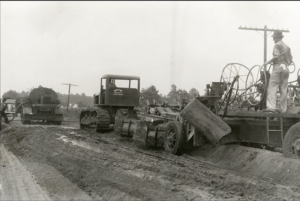
Robeson County road construction work on US 74 and the Lumberton-Fairmont toad in the 1930s. Courtesy of the Luther J. Jordan Photograph Collection, NC Archives.
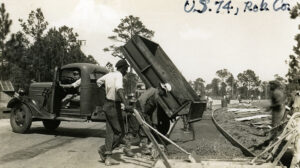
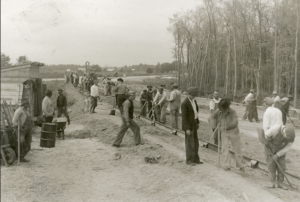
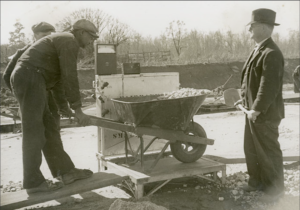
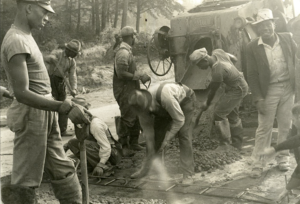
Lumbee couple Archibald “Archie” and Margaret “Peggy” Oxendine. Her maiden name was also Oxendine, her parents were James and Elizabeth “Besty” (Revels) Oxendine. Betsy was the daughter of Nathaniel Revels. This photograph is courtesy of UNCP University Relations and is featured in my book Images of America Robeson County. 
The Burnt Swamp Baptist Church was organized in 1877 in the Jamestown Community east of Pembroke. The old church building was relocated to the grounds of the Burnt Swamp Baptist Association in the 1980s. This photograph is featured in my book Images of America Robeson County. 
{transcript of the video}
I grew up in Robeson County surrounded by history. I spent much of my childhood with my great-grandparents where I gained a love for the stories of Robeson County and her people. Many of the stories that I grew up with fueled the fire in my adolescent, but growing, imagination. First hand accounts of “The Depression” and the fortitude and tribulation it took to survive. War time stories in Robeson County, the revolution on through to Vietnam. For a young mind, these were the factual fairy tales and memories that I embraced. Knowing that my great-grandparents endured through these time frames gives me a profound appreciation for them and for the historical accounts they imparted to me.
She signed me up for the war, they didn’t draft me. They wouldn’t want a one-eyed prison guard! – Da (Grand daddy Lewis)
My passion for history later lead me to pursue my history degree at UNC Pembroke. During the course of many years working at UNCP Penbroke and Robeson County History Museum, my research into the county’s history resulted in award winning exhibits, books and presentations. A midst all of the discovery and exhibition, there were always too many stories to convey. It is for this reason, I still love sharing all of the little tidbits and research about our rich history.
In this new video series “Down The Road”, I will tell my gathered stories of Robeson County and her people. I will share with you and hopefully spark interest and engage conversation in our history revisited.
The Wilmington, Charlotte, and Rutherfordton Railroad was the first to cross Robeson County. It had stops in communities that no longer exist, such as Bellamy and Alma. The Maxton station, shown here, was the last stop in Robeson County. This photograph is courtesy of the Carolina Collection, UNC-Chapel Hill and is featured in my books Images of America Robeson County and Robeson County in Vintage Postcards. 