Blake Tyner – Historian & Storyteller

Menu
  • Home
  • About Me
  • Historical Projects
  • Publications
Menu

Category: Robeson County

Robeson County May Day Celebrations

Posted on May 1, 2019May 2, 2025 by blaketyner

Today is May 1st known to most all Southerners has May Day. The tradition of May Day goes back centuries to a pagan celebration marking the midpoint between the spring equinox and summer solstice and thus meant to celebrate spring and fertility. The celebration was brought to America and was a mainstay event on the campuses of many southern women’s colleges in the 1800s and 1900s.

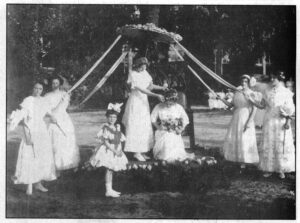
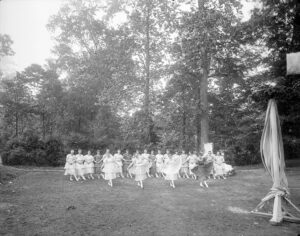
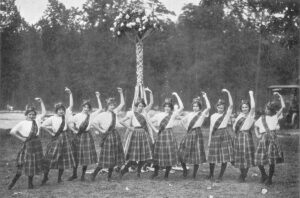
Highland dances at the Flora MacDonald College May Pole

Many of us have memories of the May Queen and her court in billowing white dresses twirling the ribbons around and around the May Pole. In thinking of Robeson County, my mind would automatically spring back to thoughts of Flora Macdonald college in Red Springs, NC.

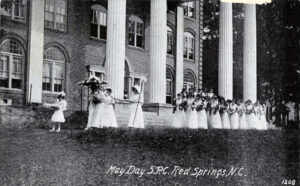
May Day at Southern Presbyterian Conservatory of Music

The college began as Red Springs Seminary in 1896 and in 1903 was renamed the Southern Presbyterian Conservatory of Music. In 1914 it was finally changed to Flora Macdonald College in memory of the Scottish heroine. After Flora Macdonald College merged with Maxton’s Presbyterian Junior College to form St. Andrews College the campus was used for Vardell Hall and then later Robeson County Day School a private school which is now is known as Highland Academy.

May Day at Southern Presbyterian Conservatory of Music
May Day at Flora MacDonald College
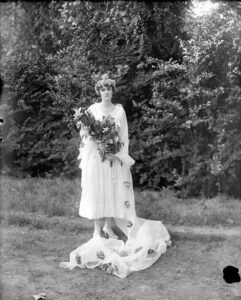
Gladys Toon, May Queen, Flora MacDonald College ,1918
Flora MacDonald College, May Day 1918
Flora MacDonald College, May Day 1918.

From the very beginning of the school in the late 1890s the May Queen and her court would gather on the front lawn for the May Day celebration event.

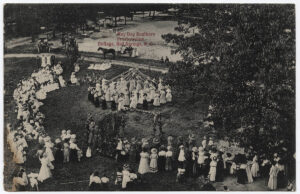
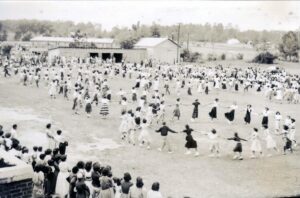
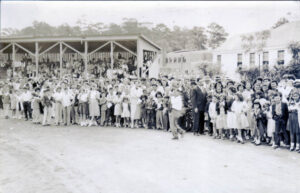
Pembroke College May Day celebration

Growing up I thought of May Day as a Scottish celebration like the highland games. That was until I became a student at UNC Pembroke and began work on my honor’s college project Bridging the Generations, a look at the history of UNC Pembroke. I learned from talks with Linda Oxendine and Mary Alice Pinchbeck Teats, who grew up on the campus, that May Day was a big celebration on the campus in the 1940s. Known then as Pembroke College it was the gathering spot for most of the Native American schools in the county for a daylong celebration. In addition to the May Pole ceremony there were field games and time for frolicking with those you might only see once a year.

Pembroke College May Day celebration

My son attended Prospect Elementary located right outside of Pembroke and they held a May Day celebration each year. Each grade level would present a son and dance and the cap stone would be the May Day Queen and her court going around and around the pole.

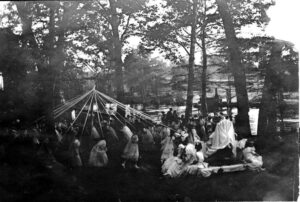
May Day celebration on the Lumber River ca 1910

I also found an interesting picture from circa 1910 of a May Day celebration on the Lumber River in downtown Lumberton. It was probely taken at the Town Commons area which is located at the intersection of Fifth Street and the Lumber River. The Town Commons was donated by General John Willis when he donated a lot for the courthouse.

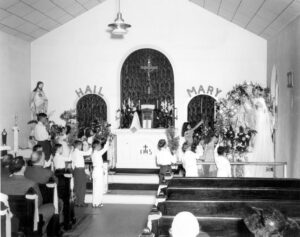
May Day celebration inside of St.Francis De Sales Catholic Church on 5th Street in Lumberton

So once again I found that many traditions in Robeson County are not exclusive to a particular race. Even through many of us will not make a trip around the May Pole today we can take a few minutes to think back on the memories of over a century of Robeson County girls making that journey. Please share your memories of May Day as I love to hear from my readers. Remember we all have the solemn duty to preserve our history.

Photographs courtesy North Carolina State Archives, Native American Cooperative Ministry, UNC Chapel Hill Library, St. Andrews Presbyterian University, UNC Pembroke and Historic Robeson.

Robeson County African Americans2

Posted on February 24, 2019August 14, 2024 by blaketyner

Robeson County African Americans

This is a brief look of some of the African Americans that played a large role in the history of Robeson County. The stories and photographs were gathered from many sources and only present a brief slice of their lives. I documented them in my books Images of American – Robeson County and Images of America – Lumberton. Take time to remember these leaders and record your memories of them and of other leaders that played a part in the history of the county and of your lives.


Alexander Hill Thompson was born a slave on June 28, 1828, to the Reverend Alexander A. Thompson and his wife, Margaret. Following the lead of his preacher father, Thompson grew up to be a preacher, educator, community organizer, and also the progenitor of 27 children by two wives. In 1877, he was one of the two founders of the Lumber River Baptist Association, which grew out of the Grey’s Creek Association. The Lumber River Missionary Baptist Association was organized in Fair Bluff, North Carolina. The minutes of the Grey’s Association show that E.M. Thompson and A.H. Thompson led the way. The association was started to teach the Bible to ministers, who recognized the importance of education for the black population. In 1881, they acquired land and started a school, naming it the Thompson Institute in honor of Alexander H. Thompson and his leadership. The Lake Waccamaw Association donated most of the money, about $l,000. There were three buildings, and Reverend Thompson was the leader while it was a religious school. In 1900, when the institute became specifically an educational institution, the Reverend J. Avery became the first principal, serving two years. Several short-term principals followed until, in 1912, the Rev. W.H. Knuckles became principal and served until 1942. (Courtesy of the Thompson Collection, Robeson Remembers, Robeson County History Museum.)


William Henry Knuckles graduated from Shaw University. He came to Lumberton in 1912 to take a position as principal at the Thompson Institute. The original institute was one building, but by 1921, under the administration of Dr. Knuckles, there were five buildings. The main complex—a three-story brick structure with wooden columns—housed dining facilities, classrooms, and living quarters for teachers and students. Under the leadership of Dr. Knuckles, the school attracted students from many of the nearby counties and from several states, some from as far away as New York. Most of the African American teachers employed in the local schools were graduates of the Thompson Institute. Dr. Knuckles passed away in 1942, and W.H. Knuckles Elementary was named in his honor as a lasting memorial. (Courtesy of Knuckles School.)


Anne T. Jeanes founded the Jeanes Foundation to train African American educators to teach African American children. Ethel Thompson arrived by train in Lumberton in the 1920s; she had been selected to work as a Jeanes supervisor in Robeson County. Her role was to assist the African American population in their educational objectives, but she found herself a record keeper of black, white, and Indian schools from the 1920s to the 1940s. She developed curricula, recruited and nurtured teachers, and reported on teacher development and student enrollment. Dr. J.H. Hayswood, the pastor of Bethany United Presbyterian Church and an avid educator in his own right, began courting her. The couple married, and though they had no natural offspring, they opened their home to eight children who lived with them at various times. It was understood that all eight would attend college, and they did. Pictured from left to right are Ethel Thompson Hayswood, Annie T. Holland, and Mame Holiday. (Courtesy of the Hayswood Collection, Robeson Remembers, Robeson County
History Museum.)


William McKinley McNeill was a local instructor who taught at the Redstone High School. He began teaching there in the mid-1930s. Better known as “Prof” by his students, he wore many hats. McNeill taught math, chemistry, physics and physical education. He coached three sports—football, basketball, and baseball —and served as assistant principal when Dr. John H. Hayswood had to be away from school. McNeill arrived at school at 7:30 a.m. and usually left around 6 in the evening. When his mentor, Dr. Hayswood, retired, the Lumberton School Board named the newly constructed school in his honor and appointed McNeil as principal. At the Hayswood School, his students had the first indoor gym. McNeill was able to hire coaches and other teachers to do many of the activities that he had once done alone. McNeill served as principal from 1949 until his death in 1964. (Courtesy McNeill Collection Robeson Remembers, Robeson County History Museum.)


Expert canners Julius E. and Alice Bryan are shown here at their Elizabethtown Road home with their winter supply of canned fruits and vegetables. Canning was a part of everyday life and was essential to feeding a family in the days before refrigeration and supermarkets. This photograph was taken by George W. Ackerman on May 20, 1932. During his almost-40-year career with the US Department of Agriculture, Ackerman took more than 50,000 photographs. (Courtesy of the National Archives and Records Administration.)


Dr. Eugene Burns “E.B.” Turner served as the pastor of First Baptist Church on West Second Street for 57 years with his helpmate and wife, Georgia McNeill. An inspirational leader, he encouraged all citizens, especially African Americans, to find the courage to use their voices to break an oppressive silence. It was upon arriving in Lumberton as a preacher at the age of 22, that he first discovered the harsh living conditions African Americans were forced to endure. There were no paved streets in the black sections of town, and most blacks lived in poor housing with little opportunity for upward movement. In the political field, he was chairman of the Robeson County Democratic Party and served 30 years on the Lumberton City Council before being elected to the Robeson County Board of Commissioners in 1992. He was also on the boards of Lumberton Economic Advancement for Downtown, Inc., the Lumberton Housing Authority, Lumberton Community and Economic Development Committee, Lumberton Commission for Youth and the Family, the Lumberton Visitors Bureau, and Historic Robeson, Inc. (Courtesy of Robeson County History Museum.)


Ida Van Smith knew from her early childhood that she wanted to be a pilot. Her father began taking her to air shows at the old Lumberton airport when she was three years old. She was delighted by barnstorming exhibitions performed by pilots and by the women performing wing- walking stunts on the airplanes. Born in 1917 in Lumberton to Theodore Deland and Martha Jane Larkin, Smith graduated from Red Stone Academy and Shaw University. She earned a master’s degree from Queens College and became a teacher in the New York City Public Schools in the fields of history and special education. In 1967, at the age of 50, she finally fulfilled her personal dream of learning to fly. Once she had her private pilot’s license and instructor rating, Smith founded the Ida Van Smith Flight Club on Long Island, New York. The flight-training club was for minority children to encourage their involvement in aviation and aerospace sciences. Training for the students was provided in an aircraft simulator funded by the Federal Aviation Administration and an operational Cessna 172. Soon, there were more than 20 clubs throughout the country, with members between the ages of 13 and 19. As a result, thousands of children were exposed to aviation, and many pursued related careers. Smith also produced and hosted a cable television show on aviation and taught an introductory aviation course at York College of the City University of New York. (Courtesy of Robeson County History Museum.)


Major Alexander L. Lewis, a Lumberton native, was serving as Post Chaplain of US Army Garrison Fort Hamilton in August 1958 when alerted that he would be leaving for Korea.  He was the only African-American holding this type of position in the Army.  Lewis had served in combat during in Europe and the Pacific, where he was awarded a bronze and silver star.  (Courtesy Historic Robeson, Inc.)


Professor John Truman Peterson became Principal of the Red Springs black school in 1933; this was the year the first high school class graduated.  His entire mission was to provide a quality education for Red Springs African American children.  On 1 July 1958 the new high school was named in his honor.

While the 1969 integration of the school system the Peterson High School became the Peterson Elementary School.  The building was destroyed 28 March 1984 when a tornado ripped through the town.  The new Peterson Elementary School was opened for students 2 September 1986. (Courtesy Red Springs Historical Museum)


Dr. Joy Johnson graduated from the Laurinburg Institute and then attended Shaw University.  He was called to the First Baptist Church in Fairmont in September 1951.  He was active in his community serving as State Secretary of the NAACP, President of the Robeson County Black Caucus and was founder of the African American Cultural Center in Lumberton.  He was elected the first black mayor of Fairmont.  (Courtesy African American Cultural Center)


Carolina College

Posted on May 1, 2018August 13, 2024 by blaketyner

Carolina College
By Blake Tyner

The Reverend S.E. Mercer discussed the idea of a Methodist college for women at an October 1906 meeting of. Several locations were considered but the final vote was to build on the heritage of Maxton, it being the site of the former Floral College. Mercer was appointed financial agent and began to solicit funds. The cornerstone for this the first building to be built for the Carolina Methodist College for Women was laid in 1908 but construction was not finished until 1912. Opening enrollment was sixty-five girls from Georgia, North and South Carolina. Reverend Mercer was named the first president of the college; he remained for two years before resigning. Reverend R.B. John of Scotland County was named the second president; he severed until 1923 when S.E. Green was named.
By 1926 Duke University had received its large legacy from Buck Duke with the condition that the Duke admit women students. As a result the North Carolina Methodist Conference voted in 1926 to close Carolina College.
On September 28, 1927 a presentation was made to the Fayetteville Presbytery asking to establish a junior college. After discussion it was decided to acquire the former Carolina College property from the Methodist Conference for the $35,000, which was the outstanding debt on the facility. The new college opened for its first session on September 11, 1929.
Dr. E.L. Siler, one of the first trustees in a Founder’s Day address, February 1930 said, “Presbyterian Junior College originated in the soul and brain of R.A. McLeod.” He was chosen as first president of the institution and served until his death in January 1932. Other presidents were Mr. R.G. Matheson, Jr. 1932 – 1934; Rev. Cary Adams 1934 – 1938; and Dr. Louis LaMotte 1938 – 1961. In 1961 it merged with Flora McDonald College to form St. Andrews Presbyterian College and moved to Laurinburg.
With the departure of Presbyterian Junior College the Maxton campus was once again empty when in stepped Colonel Leslie Blankinship. He was a Virginian by birth and had been president of Millersburg Military Institute in Kentucky. He made arrangements to take over the deserted campus and received his first students in 1962. Colonel Blankinship served until 1969 when he resigned to accept a position with the United States Office of Education in Atlanta. Rev. Harold Stanley served as president until the academy was closed due to financial difficulties on May 27, 1972. This building burned in 1973.
The first photograph is a postcard of what they planned for the college.
Find several photos of the college as well as photographs from student scrapbooks.

Robeson County Railroads – pt 2

Posted on May 1, 2018 by blaketyner

Maxton, Alma & Southbound Railroad

The Maxton, Alma & Southbound Railroad Company history extends back to March 1881 when the North Carolina legislature incorporated the Alma and Little Rock Railroad Company. The charter issued to Messrs. J.B. Wilkinson and P.A. Fore of Alma who proposed to build a railroad from Alma to Little Rock, S.C., to bring timber to their mills in Alma.

Construction began later in 1881 but by December, the railroad extended only from Alma to Alfordsville. Apparently, construction was not resumed the following year and the railroad was essentially a logging road bringing timer into Alma.

Apparently no further construction took place until 1889 when the railroad, which was by then renamed the Maxton, Alma and Rowland Railroad, began work early in the year to extend the railroad to Rowland. Track lying to Rowland was finished around the end of May 1899. Arrangements were made to run trains into Maxton over the Carolina Central tracks from Alma to Maxton.

On October 1, 1889, the Maxton Union reported the Maxton, Alma and Rowland Railroad carried its first freight from Maxton, 25 bales of cotton shipped from McNatt & Co. The Maxton agent for the MA&RRR at that time was Mr. J.S. McRae. In the next issue of the Union, an article advised that the MA&RRR freight was leaving Maxton daily at 4:00 p.m. for Rowland and Wilmington as well as all points north and south. It also reported that Maxton merchants were shipping most of their cotton over the MA&RRR. In October 1889, MA&R advised they would put on a passenger coach and that the Carolina Central would close its office in Alma, moving their agent to Maxton. All exchange of mail, express and passengers between the two railroads would take place in Maxton.

In February 1890, the MA&R telegraph line was in operation and the Maxton agent was very busy handling freight and sending messages. The depot was apparently located a few blocks east of Main Street, between the Carolina Central Line and Wilmington Street. Later in 1890, the MA&R acquired a passenger coach and the railroad reported doing a good passenger business. The line prospered until the panic of 1893. Around 1900, the MA&R ceased operating into Maxton and ran only from Alma to Rowland

In 1911, the Maxton, Alma & Southbound Railroad Company chartered with an authorized capital of $125,000.00. The MA&S purchased the railroad from the Alma to Midway from the Alma Lumber Company. Late in that year, the line was extended to Bracey. The MA&S officers were A.J. McKinnon, President; R.M. Williams, Vice President; A.J. Steed, Treasurer and Purchasing Agent; C.J. Lenair, Chief Engineer.

In April 1912, the MA&S announced plans to build the railroad three miles from Bracey to Rowland. Business was good and there were two scheduled trains in each direction between Alma and Rowland each day except Sunday. The railroad owned two standard passenger coaches, about ten freight cars and two steam locomotives. Business went along good until the postwar depression in 1922. From late 1922 until mid 1923 train service was reduced to one train per day in each direction. In 1925, passenger service was dropped and the schedule went to one train per day. During the 1920s, the production of watermelons was promoted along the MA&S and as many as forty cars per day were shipped out.

In the early 1930s, both freight and passenger traffic fell further. Often the need for a train was only to carry the mail. The MA&S purchased a 1922 gasoline motor car, which could carry mail, and passengers when there were no freight cars to move.

An application for abandonment was made and approved in 1937. The entire remaining track was taken up and sold for scrap along with the locomotives and other remaining items.

This image is featured in by book – Robeson County in Vintage Postcards.

McDonald, NC

Posted on May 1, 2018 by blaketyner

Main Street McDonald

When looking at this wonderful postcard of main street McDonald you feel as though you have stepped into the old west.  The town grew up on the lands of Richard Townsend.

A special 1910 supplement to The News and Observer gives a wonderful account of the founding of McDonald. The town dates back to 1905 and the establishment of a railroad station, at that time the Mr. Spurgeon McLean owned the only store in the area. In the first five years, the area grew to include five other stores as well as a public school under the leadership of Miss Lena Hatcher. The year 1910 brought the first brick building to town with the construction of the Iona Supply Company whose motto was we carry everything from the cradle to the grave.

Mr. A.L. Hall and Mr. F.S.Greyard, successful business in McDoanld with McLean provided the driving spirit in the early years of the town. The town also boasted a cotton gin and blacksmithshop. Early residences in the town were those of Spurgeopn McLean, A.L. Hall, D.H. Britt, J.L. Townsend, C.T. Davis and F.M. Davis.

The town was officially incorporated in 1911 and in 1920 had a population of 120.  This postcard was sent from Elrod on 29 December 1914.

This postcard iscourtesy of the late Mutt McCoy and is featured in my book – Robeson County in Vintage Postcards and is courtesy of Mutt McCoy.


Swiss National Library Source of East Lumberton Photographs

Posted on April 28, 2018 by blaketyner

I have been blessed enough to find bits of history on Robeson County in old barns and the universities archives around the country. I have knocked on doors and emailed people asking them to share what they have with the public. Today’s find comes from a place that is the last place I would expect to find photographs of the mill village surrounding the Jennings Cotton Mill in East Lumberton, NC. They are part of the Swiss National Library Archives. They were taken ca 1938 by Annemarie Schwarzenbach.

If you know the names of anyone in this family please let contact me.

The writer, reporter and photographer Annemarie Schwarzenbach lived her life to the fullest, becoming a cultural icon. On the 75th anniversary of her tragic death, more than 3,000 pictures are being made available to the public. (SRF, swissinfo.ch)

Schwarzenbach was born in Zurich on the 23rd May 1908 into a wealthy family of Swiss silk producers. As the third of five children, she decided to become a writer at the age of 17, and studied history in Paris and Zurich where she graduated from school in 1931. In 1933, she started to work as a journalist and photographer for Swiss magazines and newspapers for almost 10 years, travelling around the world.

Following a bicycle accident, she died on November 15, 1942 at the age of 34. The writer and reporter achieved early fame during her lifetime, but it was not until the end of the 1980s that her work was rediscovered.

The Swiss National Library has now made available online more than 3000 of her photographs taken during her travels between the 1930s and 1940s in Europe, Africa, America and Asia. (Article source)

1930s Road Construction

Posted on April 26, 2018August 5, 2024 by blaketyner

I am constantly searching for new bits of information and not seen before photographs to document Robeson County’s rich history. I found these great photographs while sitting in a traffic jam this morning.

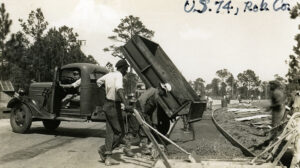
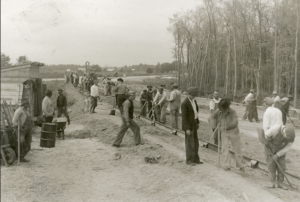
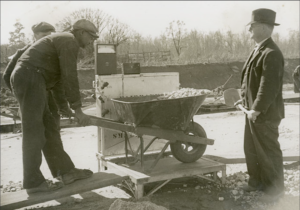
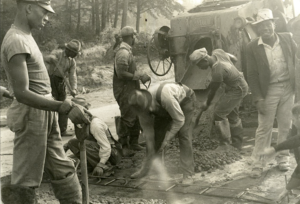
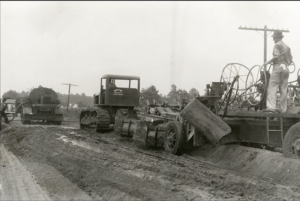
Robeson County road construction work on US 74 and the Lumberton-Fairmont toad in the 1930s. Courtesy of the Luther J. Jordan Photograph Collection, NC Archives.

Robeson County. Construction work on US 74. Robeson County, NC 1930s.

Robeson County. Widening US 74 between Lumberton and Maxton, NC. October 1939.

Robeson County. Weighing rock for road construction. Robeson County, NC. 15 January 1940

Robeson County. Widening curve on US 74, pouring the concrete. November 1939

Robeson County. Widening and resurfacing the road from Fairmont to Lumberton, NC. July 1939

Oxendine Couple.

Posted on April 25, 2018 by blaketyner

Lumbee couple Archibald “Archie” and Margaret “Peggy” Oxendine. Her maiden name was also Oxendine, her parents were James and Elizabeth “Besty” (Revels) Oxendine. Betsy was the daughter of Nathaniel Revels. This photograph is courtesy of UNCP University Relations and is featured in my book Images of America Robeson County.

Burnt Swamp Baptist Church

Posted on April 25, 2018 by blaketyner


The Burnt Swamp Baptist Church was organized in 1877 in the Jamestown Community east of Pembroke. The old church building was relocated to the grounds of the Burnt Swamp Baptist Association in the 1980s. This photograph is featured in my book Images of America Robeson County.

Down the Road

Posted on April 18, 2018July 31, 2024 by blaketyner

History revisited…

{transcript of the video}

I grew up in Robeson County surrounded by history. I spent much of my childhood with my great-grandparents where I gained a love for the stories of Robeson County and her people. Many of the stories that I grew up with fueled the fire in my adolescent, but growing, imagination.  First hand accounts of “The Depression” and the fortitude and tribulation it took to survive. War time stories in Robeson County, the revolution on through to Vietnam. For a young mind, these were the factual fairy tales and memories that I embraced. Knowing that my great-grandparents endured through these time frames gives me a profound appreciation for them and for the historical accounts they imparted to me.

She signed me up for the war, they didn’t draft me. They wouldn’t want a one-eyed prison guard!  – Da (Grand daddy Lewis)

My passion for history later lead me to pursue my history degree at  UNC Pembroke. During the course of many years working at UNCP Penbroke and Robeson County History Museum,  my research into the county’s history resulted in award winning exhibits, books and presentations. A midst all of the discovery and exhibition, there were always too many stories to convey. It is for this reason, I still love sharing all of the little tidbits and research about our rich history.

In this new video series “Down The Road”, I will tell my gathered stories of Robeson County and her people. I will share with you and hopefully spark interest and engage conversation in our history revisited.

  • 1
  • 2
  • 3
  • Next
© 2026 Blake Tyner – Historian & Storyteller | Powered by Minimalist Blog WordPress Theme