Those who have seen the movie remember that every hundred years the small Scottish village appears out of the mist for one day. Well in Robeson County we have an area that I have named Brigadoon. It is the McAlpin-McNair Cemetery and at first thought you must be thinking how can a cemetery appear and disappear. The answer is plain and simple neglect – over the years the cemetery as become so overgrown that the twenty foot tall main monument erected in memory of Duncan and Catherine McNair could not even be seen. The McNairs and their monument are an interesting part of Robeson County’s history.
The McNairs
Duncan McNair and his wife, Catherine McCallum McNair, along with their young son, John, traveled from Kentyre, Argyleshire, Scotland in June 1786 and settled in the area of Bladen County that would become St. Pauls about a mile west of the Stage Road. Less than a year after they arrived Robeson County was created by splitting off part of Bladen County and naming it in honor of Col. Thomas Robeson the hero of the Revolutionary Battle of Elizabethtown.
Duncan McNair found himself surrounded by many like minded Scottish emigrants desiring to participate in Presbyterian worship but commuting to the nearest church in Fayetteville was out of the question for most families. Plans were made to form a local congregation and the St. Pauls Presbyterian Church was founded in 1799. The Rev. Daniel Brown preached the first sermon and was the supply pastor for about one year and McNair was elected the first Ruling Elder. The area around the St. Pauls Presbyterian Church began to organize into a community and in the 1830s the post office took the name St. Pauls after the church thus the founding of the church lead to the creation of the present Town of St. Pauls.
Descendants
The McNairs had four sons Malcom, John, Robert and Duncan and two daughters Polly and Catherine. Malcom married Margaret Dalrymple, John married Polly Graham, Robert married Elizabeth Patterson and Duncan married Elizabeth McNair. Daughter Polly married Neil McArthur and Catherine married Neill McGeachy. Their descendants have gone forth to be soldiers, pastors, business leaders and politicians serving not only St. Pauls and Robeson County but all across the United States. Twenty-seven young men of the family served in the Confederate Army with only four losing their life during the fighting.
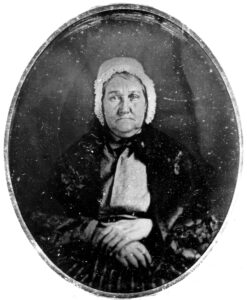
John Calvin McNair, the McNair’s grandson through Malcom and Margaret Dalrymple McNair, graduated in 1849 from the University of North Carolina at Chapel Hill and became a schoolmaster teaching for a while at the Robeson Institute in St. Pauls. After his brother’s death he entered Columbia Theological Seminary in South Carolina, where he took special interest in the questions of science and theology. In April 1857 he was licensed as a Presbyterian minister. He was encouraged by his mother to study abroad in Scotland and while there he became sick dying on January 19, 1858. He was buried in Old Grange Cemetery in Edinburgh, Scotland.
In his will of May 26, 1857, he left his estate to provide for his mother until her death and then to establish a lecture series at UNC Chapel Hill. The objective of the lectures is to show the mutual bearing of Science and Theology upon each other.
Robert Evander McNair, their great-great-grandson through Robert and Elizabeth Patterson McNair, found his career to be as a lawyer and politician. He began his law practice in the late 1940s and in 1951 was elected to the S.C. House of Representatives where he served as chair of the Labor Commerce and Industry Committee and later the Judiciary Committee. He was elected Lieutenant Governor of South Carolina in 1962 and served until he succeeded Donald S. Russell as Governor of South Carolina in 1965. In 1966, he was reelected to a full term as governor serving, at that time, an unprecedented six years in that office. Governor Robert E. McNair died on November 17, 2007.
The Monument
The effort to erect a monument to the McNairs was headed by their great-granddaughter Miss Etta Brown, French Professor at Flora MacDonald College and historian of the Virginia Dare Chapter of the Daughters of American Colonists. She contacted as many descendants as she could find and found many willing to contribute toward the cost of the monument. The results lead to a railroad car of Mount Airy granite being delivered to the old McAlpin-McNair graveyard where the McNairs are buried. The monument was built with a square base eight feet by eight feet and rises twenty feet in height. The front has a gray marble tablet that reads “McNair” while a matching tablet on the rear reads “Duncan McNair and his wife Catherine McCallum McNair. They came from Scotland to N.C. n 1786.” The monument was dedicated with a large crowd of descendants present in April 1932. In June 1932 Miss Etta Brown presented a marble memorial tablet to the St. Pauls Presbyterian Church which is in a place of honor in the sanctuary. It reads “Duncan McNair First Ruling Elder of this church Elected 1799.”
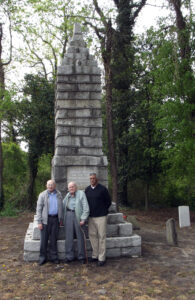
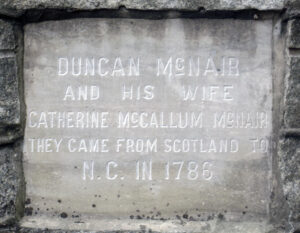
In the years since the monument was place in the cemetery they both have been neglected at times. In the 1950s the young boys of the church cleaned off the cemetery making the monument visible from the road but before long the area was taken over by weeds, vines and small trees blocking it from the view. In the early 1990s church member and local historian, Bill McKay, cleared off the area trying to preserve this rich part of local history. He tried his best to continue the heavy task of removing undergrowth and vines until his death in 2005.
Recently Tommy Hall a descendant who grew up in St. Pauls but now lives in Fayetteville spearhead the efforts to reclaim the monument and graveyard from the debris and vines. He was one of the young church boys who worked to clean up the cemetery in the 1950s. He contacted Rennert Mayor Michael Locklear to see if anyone in the community was willing to help with the effort. Hall was surprised to learn from Locklear that people in the community were very willing to donate time and heavy equipment to preserve what they considered to be an important part of their history. They managed to not only put this cemetery in the best physical shape that it has seen since 1932 but in the process also reclaimed the Tolar Cemetery that adjoins it. The beautiful gravestones and wrought iron fence was completely hidden by vines and trees had grown up twisting the fence. The Tolars played a large role in the early history of Rennet. When the town was incorporated in 1895 Bunyan, Carson and U.S. Tolar all served as original town commissioners and Thomas J. Tolar was the first postmaster.
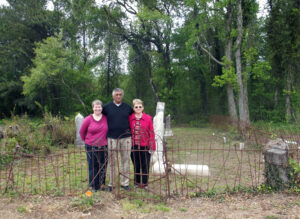
Recently in April of this year a small group of McNair and Tolar descendants and history lovers gathered eighty-one years after the monument was erected to celebrate their ancestors, the restoration of the graveyards and McNair’s oldest descendant. The day was opened with prayer by Rev. Sue Hudson pastor of St. Pauls Presbyterian Church and a talk by Hall about the preservation efforts. Hall introduced 97-year-old J. Browne Evans, the oldest member of the church and thought to be the oldest living descendant of the McNairs. The afternoon was a great time of fellowship, renewing old friendships and discussing genealogy.
One lesson is to be learned from this preservation effort and that is that each of us needs to do our part to preserve the rich, diverse history of Robeson County. There is something that everyone can do from cleaning off an old cemetery to helping to track down old photographs to taking time to talk with our elders and recording their memories. Do not make the mistake of thinking someone else will do it like the Nike commercial says “Just Do It.”
Searching Family Tree Undercovers Fox Hunting by K. Blake Tyner
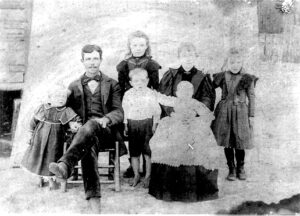
I started doing genealogy on my many North Carolina families when I was twelve. Spending lots of time listening to my great-grandparents, Rudolph and Esther Lewis, tell me stories of their families made me feel much closer with those who died more than fifty years before my birth. My third great-grandfather, Charles Upton Spivey, known to most everyone as Charlie existed in just one old faded photograph so I sought to put the facts with his photograph.
He was born July 28, 1868 to Confederate Veteran John Spivey and his wife, Flora Ann Ivey, and died January 9, 1931. He married Amerett Prevatte on December 6, 1888, and they were parents of Raymond, James Latty, Charlie Hubert, Lula and Lillie, my ancestor who married Wert Warren Lewis. She died October 6, 1909 and he married Dora Lee McKeithan on December 6, 1911. He and Dora were parents of Robert, Boyd, Annie Ruth, Eston, and Liston. She died in December 26, 1925. On July 10, 1926 he married Alice Prevatte.
In the Register of Deeds office I made a usual find, a deed dated April 24, 1930 in connection with their divorce. From reading the document I found out they separated July 28, 1929 just eighteen days after their third anniversary. They both gave up any right to the other’s property and Charlie had to in addition pay Alice $1,000. This seemed like a large amount for a farmer in the first years of the Great Depression.
Newspaper Reveals More
A desire to learn more about Charlie also led me to old issues of The Robesonian, my forever source of answers on most Robeson County questions. In searching I found those items that add fruit to the family tree. I found out about his farming skills form a June 26, 1926 issue that told of him bringing in one of the first cotton bolls of the year. I discovered he loved to fish from a 1903 issue that told of a fishing trip to High Hills, SC with son-in-law, Wert Lewis, and Charlie Flowers. On this trip they killed a seven foot alligator.
I found something unexpected, Charlie was a fox hunter. In the January 29, 1925 issue is a letter written by R.F. Kinlaw of Howellsville talking about how his cat was killed by dogs belonging to Hampton Jackson; William Bryan, Jr. and Charlie while they were on a fox chase. Kinlaw goes on to talk about how he will miss the cat because he had never found one as good at destroying rodents before this one.
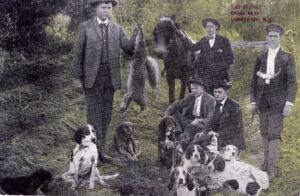
Reading about the fox chase led me on one of my favorite exercises, wandering around history. I wanted to find out if fox chases or hunts were something that happened a lot in Robeson County. I spent hours looking through the paper and found fox hunting was a sport enjoyed by men and women of all ages and backgrounds in the county.
Christmas and New Year Hunts
I quickly found out that fox hunts around Christmas and New Year Day were a favorite part of the holiday activities. Here is a wonderful account of the 1923 Christmas hunt by William Kemp Culbreth, one of the founders of the Robeson County Fox Hunters Association.
Christmas morn, while the hearts of the children were filled with
joy for the good things grand old Santa Claus had placed in their
stocking, the sportsmen were listening with wide-open ears for
the blowing of the fox horns. With the toot of the horns the howl
of the hounds filled with joy the hearts of many, and for miles
around the hum of the auto, the blowing of fox-horns, the clatter
of hoofs and the rattle of buggies could be heard.
From east, west, north and south they were making their way to
the banks of the old Lumbee and the clocks were striking six
the writer started for the scène while the sun was shedding its
beautiful light on the trickling waters . . . the old and the
young, the rich and the poor, all for the Christmas race, all
hearts full of expectation of a glorious chase. The writer is
sixty-seven years old and he has never seen a better race.
Before the sun was up the hounds had old Reynard (Reynard the
Fox was medieval Europe’s trickster figure, a nasty but
charismatic character who was always in trouble but always
able to talk his way out of any retribution) going with 36 hounds
in chase and 100 men, boys and girls all enjoying the sport of the
exciting chase.
For three hours the sport went on and upon the public highway
in sight of two hundred sportsmen the old fox was captured alive
and is awaiting another chase of joy. All went home filled with
joy and to hearts content to enjoy a good Christmas turkey for
dinner. So closed the great annual fox hunt of the Robeson
Country Fox Club.
Rev. SE. Mercer wrote in the January 6, 1905 issue about a fox hunt in which Red Buck was a guest. It is always interesting how in the old newspapers people are called by only nicknames, the writer not thinking that there would be a time when just that nickname would not give the identity of the person. So as I read old articles I desire so to know more these nicknamed people thus begins more searching to find out about these people. Red Buck was the name that Henry Edward Cowan Bryant was most known as; he was the Washington, D.C. correspondent for the Charlotte Observer, New York Herald and the Boston Globe. Bryant also taught school in Alfordsville in 1894.
We were in Maxton last Friday night. There was a sensation.
Red Buck had come. Yes, Red Buck was really out in the country
two miles distant. He brought with him some highlanders of Mecklenburg, descendants of the very men who signed the famous Declaration of Independence. Ere the sun had dawned next morning we were on our way. A brighter and more lovely day we never saw. The fields were soon glistening in the morning sun. The world was
beautiful and the air was crisp and bracing.
After a successful chase, Mercer wrote more about Red Buck “he is a great fox hunter, he loves the bass notes of his horn but when his clear, lusty, exciting, penetration voice, rings out on the morning air, every dog in the pack is stirred to do his best. If you want to have a jolly good time in a fox hunt get with Red Buck”.
College Girls
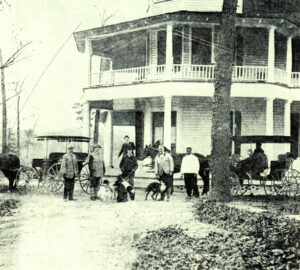
The more I researched fox hunting the more interesting the findings were for me. The girls at Southern Presbyterian College (later Flora Macdonald College) held fox hunts. In January 1911 it was reported that the college girls enjoyed their hunt when at four in the morning they could be heard singing on the way to a special train charter to take them to Mill Prong which was the scene of the fun. They returned to the college about one in the afternoon a tired but radiant crowd for the fox had been caught.
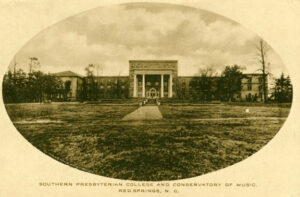
Another of their hunts took place on Monday, November 4, 1912 when ninety-six people left the college at four in the morning on a private train heading to Bowmore. After arriving it was not long before the lead blew his bugle followed by the sharp yap of the hounds. It was not until eleven that three foxes were found and they pack split in two with the chase being on.
The girls had a great feast after the hunt digging potatoes out of Mr. W.F. Williams potato patch, roasting them in the hot ashes and cooking bacon on the end of a stick. They ate this with bread, apples and ginger cakes voting it the best feast they ever had. At four in the afternoon they returned to Red Springs desiring to do it all again.
Other Hunts
In early July 1912 J.B. McCormick tells of a great fox chase when he put his pack of hounds in Cole Camp Swamp and the foxes began to bark at the hounds. The dogs managed to chase several foxes the size of house cats but none were caught the weather being too hot. They attending did enjoy a day of music and fun.
Early November 1914 Parkton was the site of an evening chase with the procession having five buggies, two on horseback and a dozen on foot with nineteen trained Robeson County hounds. The chase led into Cumberland County where others joined in hearing the fun. By midnight it was decided that the fox had deceived the splendid pack.
The end of February 1915 the Lumber Bridge Hunters including Malloy, McCormick and Everett enjoyed an all night chase reporting it as the finest race of the season with more than twenty hounds. Only problem was the fox was one of those educated ones and he succeeded in make the escape. In December 1919 a hunt was held in the Orrum area that lasted eighteen hours until two in the morning with the fox outsmarting all the hunters.
There are over twenty more accounts of fox hunting easily found in The Robesonian making for some great reading. Take time to search for and write down your family’s stories.